Max Parmentier once wanted to become secretary general of the United Nations. He also entertained the idea of tending a beach bar. These ambitions require rather different shoes, but both offer a view of the world and plenty of conversations. He eventually chose a third occupation: building companies. Now, after nine years at Birdie, he is preparing to change his relationship with the business he helped create.
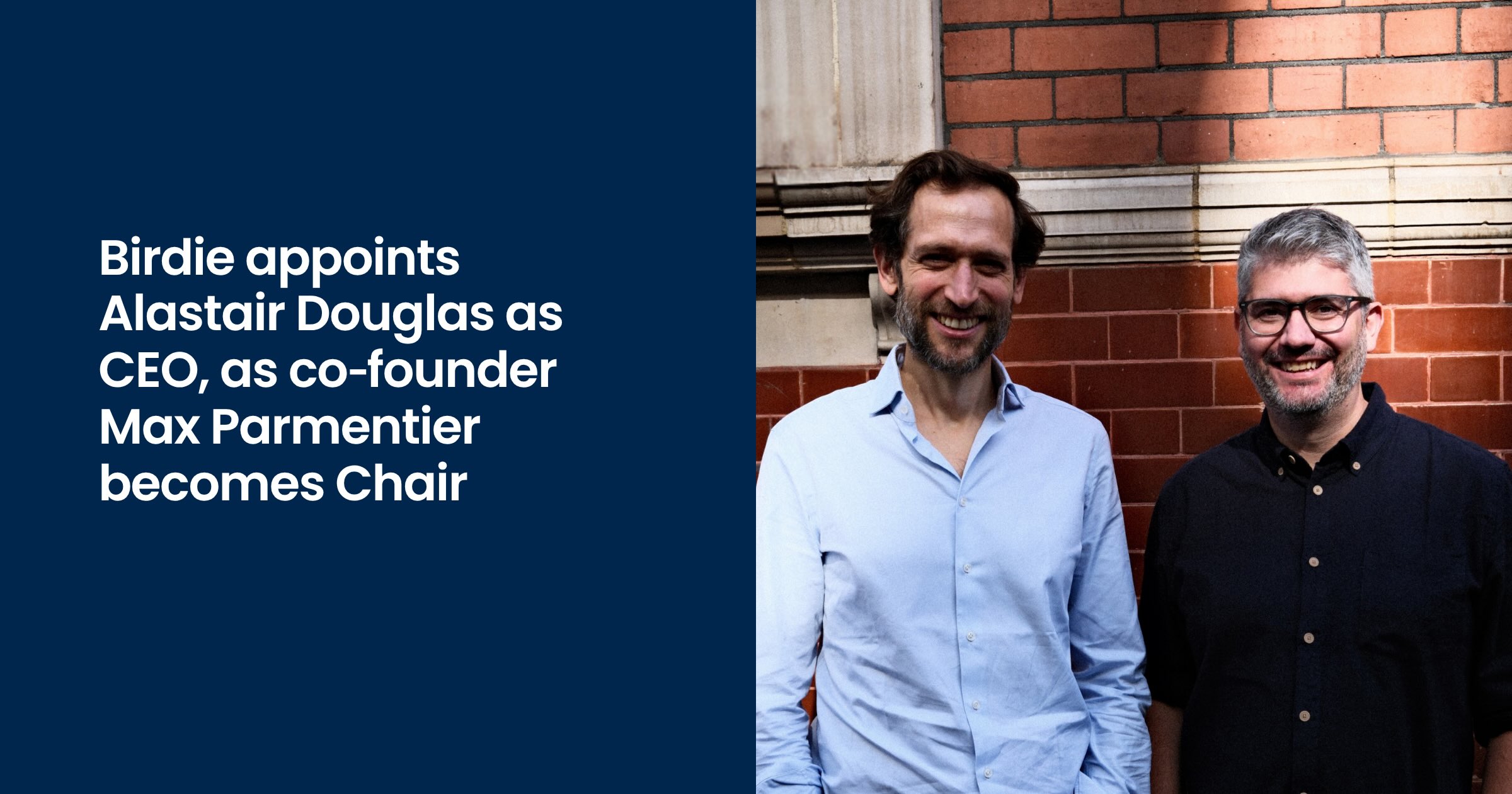
On 5 October 2026, Birdie announced that Alastair Douglas would take over as chief executive at the beginning of November. Parmentier would become chair. For the rest of October, the two would work alongside each other. It is a useful moment to look at a founder whose career has repeatedly moved between ideas, institutions and the practical business of getting things done.
The incoming chief executive has run TotallyMoney and was on the founding team at Peakon. Parmentier is making room for someone with a different operating history while staying involved through the board. A founder’s signature is easy to put on a launch announcement. Deciding when someone else should sign the next one is a more interesting exercise.
An inheritance of permission
Born in Belgium and raised in Brussels, Parmentier belongs to the fifth generation of the Bekaert business family. The family connection matters here less as a surname in a company register than as a childhood atmosphere. He has described a grandfather who told stories about entrepreneurship, independent thought and the possibility that one person could change an entire industry.
His brothers, too, became entrepreneurs. In his account, trying things was ordinary family behaviour. Failure did not have to acquire the weight of a personal verdict. That is a considerable inheritance before anyone starts discussing money. A young person who thinks permission is already granted can spend less time waiting for it.
He won the FBN Next Generation Lombard Odier Award in 2020 for Birdie. Yet his account of the family influence is appealingly domestic: stories passed down, examples close at hand, a sense that a working life could be made rather than merely selected. The ambition was large; the transmission mechanism was a grandfather talking to a grandson.
“He gave us that comfort to dare and try.”
Max Parmentier, on his grandfather
Before the startup, a student constituency
Parmentier’s early public roles involved actual constituencies. At Louvain, he coordinated roughly 1,000 students involved in shared project housing through Organe. He later served as vice president of the university council, representing 21,000 students. Long before a product roadmap, there were people to organise and competing interests to reconcile.
His volunteering began as a teenager. He also worked on a national information and communications technology strategy during a UNDP internship with the Bolivian vice-presidency in La Paz in 2005. In 2008, he advised Belgian diplomats during Belgium’s membership of the UN Security Council. The ambition to enter public life had acquired some practical appointments.
The academic route was similarly international: Louvain, the CEMS programme associated with Esade in Barcelona, and Columbia in New York. At Columbia, where he studied from 2006 to 2008, he was a teaching assistant in international finance and monetary theory. Teaching graduate students is a fairly direct way to discover whether an explanation survives being questioned.
2005-2006 / Vice president of the university council
A consultant moves closer to the machinery
He joined McKinsey in 2008, working on international assignments. Part of his consulting work dealt with climate strategy, bioenergy and deforestation. These are subjects in which a polished recommendation still has to survive contact with incentives, institutions and other people’s budgets. His later career would move progressively closer to that contact point.
In 2012 he joined Riaktr as a project manager. The following year he moved to the Global Fund, first working with the chief financial officer and later leading sourcing strategy and supply chain. He went on to found and run Wambo, an online procurement marketplace. Before Birdie, he also worked as an entrepreneur in residence and ventures lead at Kamet, AXA’s startup studio.
The sequence helps explain why his founder story does not begin with a lone programmer and an irresistible app. He had seen consulting, a smaller technology business, an international organisation and a venture studio. Each offered a different way of moving resources. Entrepreneurship became the route through which he could take responsibility for the result.
- 2008McKinseyInternational consulting
- 2012RiaktrProject management
- 2013Global FundFinance, sourcing, then Wambo
- 2017BirdieCo-founder and CEO, following Kamet
- 2026Next: the chairPlanned for early November
The mistake was having too many good ideas
Birdie began in 2017. Looking back in 2020, Parmentier identified an error that sounds familiar to anyone who has sat through an enthusiastic planning meeting: the company pursued too many projects, products and markets at once. He said he had stretched the business and failed to focus it. The projects needed more time than the team had allowed.
There is something refreshing about an entrepreneurial lesson that involves subtraction. New markets look excellent on a slide. They are less accommodating when each needs staff, attention and a sequence of decisions. Parmentier’s conclusion was to narrow the work and execute it more thoroughly, even while acknowledging the risk of concentrating the company’s bets.
By January 2021, the same lesson had become advice for other innovators: expect progress to take longer than planned, and choose a smaller number of tasks you can finish properly. He paired that with a commercially blunt test about who would pay and whether the business could scale. Good intentions, in this account, still have to make it through the purchasing department.
“better do few things well than too many things poorly”
Max Parmentier, advice to innovators, 2021
A two-day workshop, and a minister for the fun
The organisation inside Birdie was another deliberate construction. In 2018, Parmentier described the team spending two days at their head of operations’ apartment debating and voting on company values. The setting was modest enough to keep the exercise human. There was food, conversation and a decision about how colleagues ought to treat each other.
The early arrangements included open salary information, individual development plans and direct feedback. Staff were expected to take responsibility for their work and learning. An elected colleague organised social events under the title Minister of Social Affairs. Parmentier’s old interest in government had, at least in this small corner of the company, found an unusually sociable portfolio.
By November 2019, Birdie was publicly celebrating B Corp certification. The assessment covered its business model, workforce, environmental practices and other operating details. For a founder concerned with the social purpose of a company, this supplied an external framework for promises that might otherwise remain inside a slide deck. Even the office lights made it into the application.
Building with other people’s strengths
In 2021, Parmentier publicly described a distributed team, asynchronous work and volunteering during office hours. That same announcement introduced an $11.5 million investment led by Index Ventures, with Kamet participating. The company was asking investors and prospective colleagues to accept the operating philosophy alongside the commercial proposition.
His own explanation of leadership has room for uncertainty. In a 2022 interview, he identified resilience, pragmatism and vulnerability as qualities that mattered to him. He described admitting doubts, seeking help and allowing colleagues to outperform him in areas where he was weaker. He also said recruitment occupied about 40 per cent of his time.
Those remarks give the coming transition a little more context. A founder who says that the team should supply abilities he lacks has already accepted part of the logic of succession. Doing it at the level of the chief executive is another matter. The organisational principle becomes a personal decision about authority, responsibility and how much room to leave somebody else.
“Customers first, team second, investors third.”
A boardroom, a mountain, a very long novel
There are other places to find Parmentier besides Birdie. He joined Bekaert’s board in May 2022 and was reappointed in 2023 for a term running to the 2027 annual meeting. The family connection now comes with a formal governance role. His public profile also includes board work with the Altius Society, an Oxford-based forum for discussion about long-term social and economic change.
Away from those roles, his listed interests include climbing, mountaineering, improvisation and what he calls weird jokes. His favourite book is War and Peace. Anyone inclined to diagnose a founder from a reading choice should perhaps first admit that Tolstoy supplies enough characters to accommodate almost any theory.
His routine is more practical than theatrical. In 2024, he described setting daily objectives and blocking separate time for focused work, messages and meetings. He was also trying to find an evening activity that would let him wind down with friends, family or a hobby. Even a person interested in remaking institutions has to decide when to stop checking Slack.
Leaving room for the next builder
Birdie’s selection for Tech Nation’s Future Fifty programme in 2024 brought another network into view. Parmentier welcomed the chance to exchange knowledge with other businesses facing questions about hiring, investment and expansion. He spoke about building relationships with colleagues, investors and partners as part of the pleasure of founding a company. The work had never been confined to the product.
As October 2026 ends, the next piece of that work is the handover. Fellow co-founders Rajiv Tanna and Abeed Mohamed are remaining in leadership roles. Douglas will lead the business, while Parmentier moves to the chair. Continuity will depend on people carrying responsibilities that once converged on the founder’s desk.
The route from student organiser to consultant to founder has produced a recurring question: where can he be useful? For years, the answer was to build and lead Birdie. In November, it is due to change. Someone raised on the freedom to start things is now exercising the freedom to step aside. There is enterprise in knowing when to make space.
“I’ll be right beside him as Chair.”
Max Parmentier, October 2026