Calvin H. Knowlton bought a shop and began taking things out of it. Amherst Pharmacy, in Lumberton, New Jersey, had been a full-scale drugstore, with merchandise extending beyond its professional business. After purchasing it in 1975, he spent the next three years narrowing that assortment. The shelves became more specialized. Long before he had a company listed on Nasdaq, he was making the rather less photogenic decision of what a business should stop selling.
It is a useful place to begin a career that can otherwise disappear beneath initials, degrees, awards, and company names. Knowlton has been a shop owner, a teacher, a department chair, an association president, and a chief executive. He has also been a departing chief executive. By April 2026, at 76, he was working on the expansion of his twelfth company. The résumé could use a revolving door.
The shop with fewer things on its shelves
Lumberton put him in a local market with plenty of competition. In 1990, Amherst had seven competing businesses within two miles. Running the place meant deciding what customers would come to him for, then organizing around that decision. Specialization was visible in the merchandise itself. This was business strategy at the scale of a shelf, with neighbors available to deliver a verdict.
His personal account dates his launch of a fully computerized New Jersey pharmacy to 1973. The later Amherst acquisition gives the early career another firm marker. Computers and a narrower retail focus were already part of the story before the larger enterprises arrived. The chronology matters: the technology-minded executive grew out of the daily work of operating a business, rather than arriving fully formed at a podium.
He kept studying while that working life developed. Temple University supplied his pharmacy degree in 1972. A decade later, he was also teaching. By 1990, he had taught at Temple, Rutgers, and Philadelphia College of Pharmacy. The shop and the classroom existed alongside one another. Knowledge had somewhere immediate to be tested, and practical experience had somewhere to be questioned.
A detour through Princeton
Then there is the degree that makes a reader stop scanning. In 1984, Knowlton earned a Master of Divinity from Princeton Theological Seminary, studying ethics and education. He later completed a doctorate in pharmacoeconomics at the University of Maryland, Baltimore, in 1993. Three institutions, three distinct fields. A conventional business biography would have had an easier time with an MBA.
The combination gives his later language about organizations some context. His public interests include how people learn, how colleagues treat one another, and what obligations accompany leadership. It would be too convenient to assign every management decision to a seminary classroom. Still, ethics and education were subjects he formally studied, well before company culture became a recurring topic in his public work.
During the 1990s, he served as a professor and department chair in Philadelphia. He was also president of the American Pharmacists Association from 1994 to 1996. An academic department, a professional association, and a private enterprise ask different things of a leader. His working life moved among all three. Authority, in each room, came with a different set of people to persuade.
Thirty-two ways to work together
At Tabula Rasa HealthCare, Knowlton put a number on the preferred way of working: 32 fundamentals. Together, they formed the TRHC Way. In a 2016 interview, he emphasized that “behavior is what supports our values.” The wording is practical. A value can sit undisturbed on a wall for years. Behavior has to get through a Tuesday afternoon with other people.
His list of priorities included integrity, accountability, equality, collaboration, problem solving, and fun. That final item is easy to skim past in a corporate description. It also raises a reasonable expectation. If enjoyment makes the official list, employees are entitled to look for evidence of it. The same is true of accountability and equality. A declared culture gives people language with which to judge their employer.
One recollection makes his approach more tangible. A colleague described being invited to join Tabula Rasa despite knowing nothing about the industry. Knowlton would handle the product and financial side; the colleague’s assignment was the people. The resulting position was chief culture officer. In an organization built around specialized knowledge, he had made room for somebody with a different kind of attention.
“you help me take care of the people”
Calvin Knowlton, recalled by a colleague
This is a statement of intention, and intentions deserve to be examined alongside results. It also reveals something about how he chose to divide the work. Culture had a person responsible for it. Whether an organization lives up to its vocabulary remains a daily question, but a named responsibility is at least something colleagues can point to when they ask who is listening.
Two founders in the frame
Orsula Knowlton belongs near the center of this account. She is Calvin’s wife and a recurring business partner, with her own background in executive work, strategy, marketing, and business development. Their histories overlap at excelleRx, at CareKinesis, and at Tabula Rasa. Treating her as a supporting character would leave a substantial portion of the business unexplained.
Calvin founded excelleRx in 1995 and led it until 2007. Orsula held senior marketing and strategy responsibilities there during those same years. At CareKinesis, founded in 2009, their leadership roles continued. At the Tabula Rasa parent company, Calvin became chairman and CEO in 2014, while Orsula carried responsibilities including marketing and new business development. The partnership had accumulated years of shared work before the IPO.
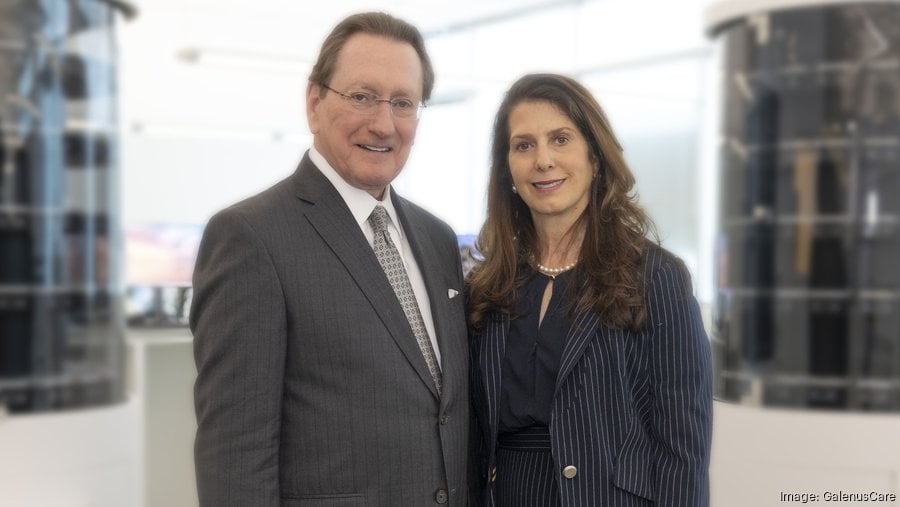
Marriage and company leadership bring their own overlapping calendars. Here, the professional continuity is visible in the succession of organizations and roles. Both founders would leave Tabula Rasa in 2022. Their names would appear together again in subsequent ventures. A photograph of the two of them captures that continuity rather neatly, although it cannot show the years of decisions that sit behind it.
The bell and the boardroom
In September 2016, Tabula Rasa completed an initial public offering that raised $52 million. That year also brought an expanded, 75,000-square-foot headquarters in Moorestown. The business had reached a scale far removed from Amherst’s retail shelves. Public ownership added another audience: investors who could support the company, question its choices, and press for different leadership.
The public-company chapter ended painfully for the founders. By September 2022, the stock had lost much of its value and the company faced pressure from its largest shareholder, Indaba Capital Management. Calvin and Orsula agreed to leave. The transition announcement named Brian Adams interim CEO and Michael Purcell independent board chairman. Governance changes and a strategic review accompanied the agreement.
That episode belongs beside the listing. Entrepreneurship produces photographs of milestones and documents of separation; both record real events. Knowlton had helped create the organization and spent years leading it. The board’s decision established that its next phase would be run by others. A founder’s investment in a company, personal as well as professional, does not guarantee the right to lead it indefinitely.
The classroom keeps turning up
Alongside the executive career runs a record of writing, teaching, and professional service. Knowlton has authored or co-authored textbooks, chapters, and articles. He has led professional organizations as well as companies. These are different ways of putting an idea into circulation: through a course, a book, an association, or an organization with employees and customers.
In 2021, the University of Maryland, Baltimore awarded him an honorary Doctor of Sciences. It was a return to an institution where he had earned his doctorate nearly three decades earlier. Other recognition had arrived along the way, including regional Ernst & Young entrepreneurship awards in 2003 and 2013, and the Remington Honor Medal in 2015. The calendar of honors stretches across several separate business chapters.
There are less predictable entries, too. His board service has included Philadelphia’s Settlement Music School. A 2022 company filing listed him as chairman of BKON, a beverage technology business. The professional biography has room for music and something to drink. Neither establishes a private hobby; both show that his organizational interests extended beyond the companies most closely associated with his name.
His published topics in 2023 included continuous learning, collaboration, and support for working parents. These subjects put the ordinary working day back into view. After the titles and transactions, there are still people trying to learn a skill, finish a shared task, or manage responsibilities outside the office. They are the audience for any claim that a company takes its culture seriously.
Company number twelve
GalenusRx followed the Tabula Rasa departure, with Knowlton serving as executive chairman and co-CEO in 2023. Another venture, GalenusCare, followed in 2025; it now uses the ChorusRx brand. By April 2026, he was discussing plans to expand into markets across the country. The ambition was national, and the work of building another organization was under way.
The phrase “starting again” can suggest that experience has been erased. Knowlton’s sequence suggests a more complicated picture. A new company arrives after the shop, the teaching, the acquisitions, the listing, and the departure. Those events remain in the record. What changes is the organization in which the next decisions must be made, and the people who will live with their consequences.
Back in Lumberton, he had taken a broad assortment and given it a narrower purpose. Decades later, the questions are larger but still recognizable. What should this company do? Who should do it together? What will its stated values ask of the people in charge? Company number twelve gives Calvin H. Knowlton another place to work on the answers.