The electricity reached the house. It did not necessarily reach the field. Max Nelen noticed the distinction while travelling through Southeast Asia, looking at farms through the eyes of someone who had worked in renewable energy. A household could have a connection, while the business outside still depended on an engine and another purchase of fuel. The map might show access to electricity. The farmer’s expenses told a different story.
There was something almost impolitely ordinary about the opportunity: ask what it cost to move water. Nelen saw diesel pumps, spoke with farmers and began working out whether sunlight could do the same job at a price that justified the switch. The question took him from consulting and venture building into agriculture. In November 2019, he founded Agros.
Today, the company combines solar irrigation with financing and advisory services. Its work spans Myanmar, Cambodia and Indonesia. Behind that geography sits a fairly intimate transaction: a farmer must believe a piece of equipment will earn its place on the farm, and must have a way to pay for it. Nelen’s career has become an extended investigation of those two requirements.
The electricity stopped at the house
Nelen is originally from Belgium. His working life took him through Brussels and London, then to Singapore. He had already been an entrepreneur before working as a consultant. His background includes Roland Berger and Rainmaking, where his work involved innovation in energy and the development of ventures including TablePointer and Solar AI.
That experience supplied a starting point, rather than a ready-made answer. Energy access businesses in Africa interested him. He wanted to understand whether comparable opportunities existed in Asia. Farm visits complicated the assumption that a region with household electricity had already solved the energy problem. The usefulness of a connection depended on where the work happened.
“There is no plug in the fields that the farmers can use to electrify.”
Max Nelen, 2021
A socket is a small detail to build a company around, until you need one somewhere it does not exist. His observation pushed the investigation toward productive uses of energy. Irrigation offered a recurring task with an identifiable expense. It also offered a way of making the climate argument in the language of a farm’s accounts.
His early visits changed another assumption. Nelen had expected farmers to resist changing familiar practices. Conversations suggested a more practical explanation: willingness depended on the tools, incentives and financing available. Someone could be interested in a different method and still have perfectly good reasons to keep using the old one. The business would have to address those reasons.
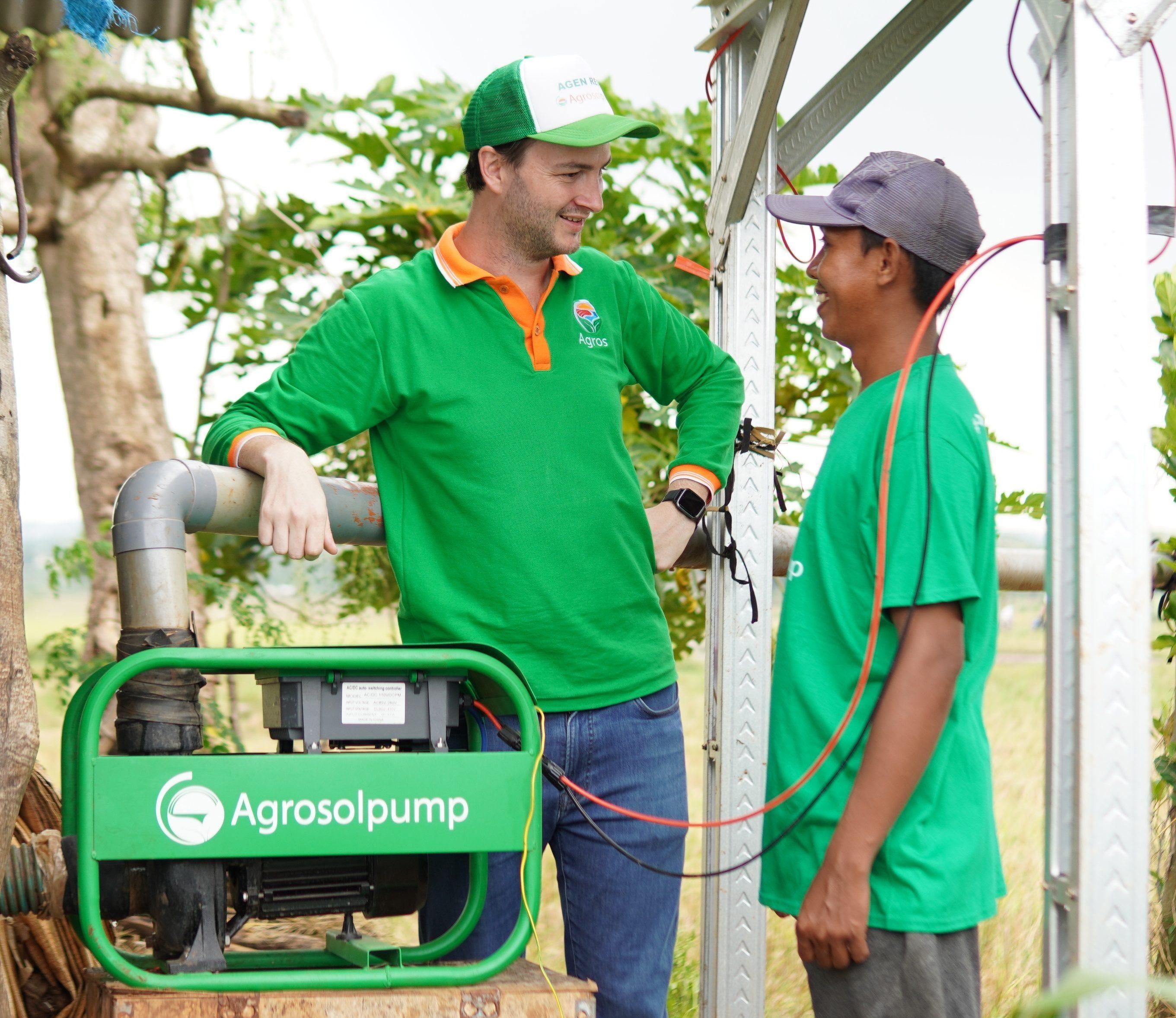
A payment date is part of the product
Buying equipment creates a problem that a calculation of eventual savings cannot settle by itself. The purchase comes first. The benefit arrives later. For a farmer earning money around harvests, the interval matters. A persuasive forecast does not put cash in a pocket on installation day.
Nelen’s approach to Agros has repeatedly brought technology, advice and financing together. The farmer needs equipment that improves the economics of the farm, help understanding and using it, and a payment arrangement that fits income. Each part affects the usefulness of the others. A product can be affordable over its working life and still be difficult to buy today.
This makes the payment date a design decision. The customer’s calendar belongs beside the pump specifications. It is an unshowy piece of entrepreneurial thinking, but it changes the offer: a farmer can assess a transition in terms of the crop cycle already governing the business.
That same logic appears in Nelen’s language about innovation. He starts with the customer’s circumstances, then asks what needs to change around the technology. Distribution, financing and service carry their own design work. Solar power provides the energy; adoption requires a system of decisions that a farmer can live with.
There is a useful discipline here. Every attractive claim eventually encounters the customer’s arithmetic. What will this cost? When will I pay? Who will help me use it? The questions are modest enough to fit across a kitchen table. They are also large enough to determine whether a company grows.
The village has its own sales department
In 2023, Nelen described an expansion strategy that relied on grassroots ambassadors. Farmers, farm managers, shop owners and equipment suppliers could help introduce Agros through relationships they already had. The company was entering communities with their own channels of information and their own people worth listening to.
The approach suited his caution about expanding headcount too quickly. A growing company needs people, but each new market also needs knowledge that cannot be delivered by an organisational chart. Someone has to understand the local purchase decision. Someone has to recognise the concerns behind a polite hesitation.
Agros’s leadership reflects that need for local experience. Its team includes Myanmar country director Thet Win Naing and Cambodia country director Soeng Vay. Their backgrounds bring business development and agronomy into an enterprise whose founder entered through energy. Country operations have to translate a shared idea into a working local business.
By January 2024, Agros had expanded into Indonesia. The move enlarged the map and added another set of agricultural conditions. In a television discussion that year, Nelen emphasised differences between crops and regions. He talked about starting with farmers’ most tangible problems and building trust through solving them.
He opened his answer with a small concession: “I don’t think I have the magic wands.” It was a welcome reduction in the usual supply of entrepreneurial sorcery. His proposed sequence was patient: understand the community, identify the immediate problem, earn the chance to address the next one.
That sequence gives trust a practical meaning. It develops around an experience the farmer can judge. A company may arrive with several ambitions; the customer encounters them one purchase at a time. The next conversation depends partly on whether the previous promise survived contact with the field.
Learning to wait for the soil
Solar irrigation gave Agros its initial offering. Nelen’s ambitions reached beyond it. Agrosoil brought soil management into the company’s work, with tailored inputs intended to improve production. The broader idea was to build a relationship around more of the farmer’s operating needs.
He also recognised that soil management works on a different timetable. In 2023, he described a gradual approach to nutrient management, rather than an immediate, wholly organic conversion. A pump can alter a fuel expense quickly. Changes in the soil require patience, suitable inputs and a reason for the farmer to keep investing.
The distinction matters to the story of Nelen as a founder. An expanding product range brings opportunities, but it also brings different sales arguments and different periods before a customer can judge the results. The farmer who appreciates an irrigation system still has to evaluate the next offer on its own terms.
In February 2024, Nelen described the squeeze facing farmers who pay for inputs, produce a crop and receive only a fraction of its eventual value. His interest in profitability follows from that observation. The environmental goal depends on a transition that people can sustain economically. A compelling mission still has to accommodate the cost of the next season.
There is a personal acknowledgement in that interview too. He described his own privileged position, contrasting everyday decisions about dinner with the financial pressures he had encountered on farms. It helps explain the attention he gives to customer economics. The journey began with energy; spending time with farmers widened the question.
Two sides of the same cash-flow problem
Agros had to finance the transition on its side of the transaction as well. In November 2022, Nexus for Development’s Pioneer Facility agreed a US$500,000 loan for inventory and working capital in Cambodia and Myanmar. Leap201 also provided a S$100,000 loan that year. These were funds for the machinery of growth, including the unglamorous interval between buying stock and receiving money.
A US$2.7 million pre-Series A followed in March 2023. On 11 March 2025, Agros announced a US$4.25 million Series A, co-led by Gaia Impact, Schneider Electric Energy Access Asia and Wavemaker Impact. The Global Innovation Fund joined, while Silverstrand Capital and PropertyGuru founder Steve Melhuish continued their support.
For Nelen, raising money also involved managing relationships and uncertainty. In a July 2025 fundraising conversation, he described investors arriving through introductions, events and existing connections. He discussed combining debt with equity and agreeing fallback options with the board before attempting a raise. Behind the announcement sat preparation for a less cooperative outcome.
On 18 December 2025, EDFI ElectriFI announced a US$2 million working capital facility. It would support expansion in Indonesia and Cambodia and help scale Pay-after-Harvest financing. The purpose connected the company’s cash needs with the customer’s seasonal payments. Buying equipment early enough to deliver it and receiving money later is a financing problem at both ends.
What the next harvest has to prove
Agros stated a 2027 ambition to partner with 30,000 farmers, increase their collective income by US$40 million and prevent one million tonnes of carbon dioxide emissions. Those figures describe the destination the company set itself. They give the next stage a scale; the work remains a succession of farms, purchases and seasons.
Nelen’s earlier writing offers a clue to how he approaches that work. In a 2019 essay on entrepreneurial mindset, he argued for learning, changing direction and making it acceptable to abandon an idea that the evidence does not support. It was written before Agros, yet its interest in revising assumptions fits the account of his farm visits.
He has a life outside those calculations. Asked in 2024 what he did away from work, he listed scuba diving, hockey and tennis, along with different cuisines, remote beaches and mountain peaks. He also mentioned time with his fiancée, Jie, and friends. The list gives the profile a welcome patch of leisure, even as he admitted that thoughts of farming and climate occupied much of his attention.
The enduring question in his story is simple enough to ask beside a pump: does this make the farmer’s next season easier to finance and more worthwhile to grow? Nelen’s business has taken shape around making the answer convincing. Sunlight helps. So do the people who install the equipment, the advice that follows it and a payment date that arrives when the crop has finally earned its money.