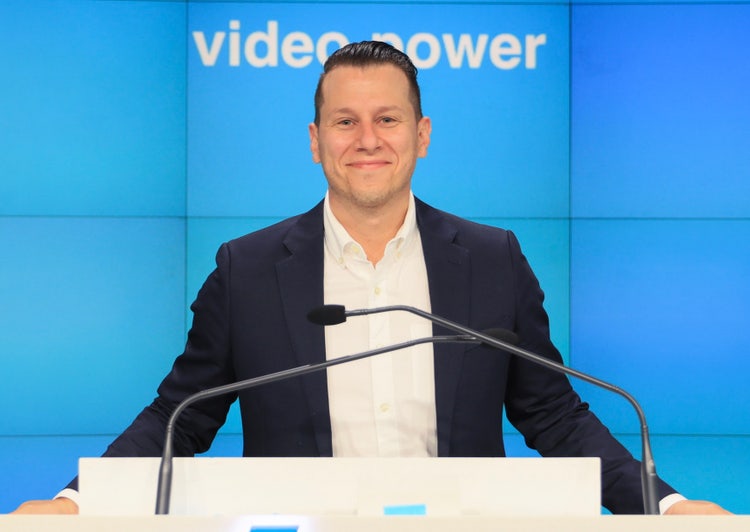
There's a quiet tension at the center of every creative platform: the gap between what the tools make possible and what the people using them can actually earn. Matthew Smith has built his career closing that gap - first at Shutterstock, then Vimeo, then through his own startup, and now at Adobe, where he holds one of the most consequential product portfolios in the creative technology industry.
Smith is VP of Creative Cloud Strategy & Growth at Adobe, overseeing a cluster of products that reads like a map of the modern creator economy: Adobe Stock, Behance, Adobe Podcast, and the AI/ML content layer threading through all of them. The portfolio is vast and, by design, interconnected. A photographer sells on Stock. A designer posts their work on Behance. A marketer builds a podcast episode with Adobe's AI audio tools. Smith is the executive responsible for making those three journeys feel coherent - and commercially viable for everyone involved.
"Generative AI capabilities must be built in a way that enables creators to monetize their talents - similar to how Adobe has done with Adobe Stock and Behance."
- Matthew Smith, on Adobe's approach to responsible AIThe Long Road Through Product
Smith's path to Adobe is not a straight line. He studied English Literature at Union College - the kind of undergraduate choice that raises eyebrows at tech companies until you meet the person who made it. Literature demands pattern recognition, close reading, and the ability to extract meaning from competing signals. It turns out those are exactly the skills that make a great product manager.
His first major stop was Gerson Lehrman Group, where he joined as a Senior Product Manager in 2007. GLG is a knowledge marketplace - one of the original platforms connecting companies with expert insight - and working there in the late 2000s meant operating in the earliest days of platform-model thinking. The experience of building professional knowledge products, at the moment when the internet was just starting to reorganize expertise into marketplaces, left a clear mark on Smith's subsequent career choices.
Shutterstock came next. Smith spent three years there across multiple roles, including General Manager of Offset.com - a premium stock imagery business targeting high-end commercial buyers. Running Offset meant managing the tension between exclusivity and volume, and between creator compensation and platform economics. That tension never left him.
A brief stint at Movable Ink followed, before Smith made his most unexpected pivot: he co-founded Workframe in 2016.
Building Something From Scratch
Workframe had nothing to do with creative software. It was a workflow platform built for commercial real estate - specifically for organizations managing large, geographically distributed teams across concurrent construction and fit-out projects. The pitch: CRE has a massive project coordination problem, and no one had built software that gave portfolio-level visibility into workflow across multiple simultaneous initiatives.
Founding Workframe gave Smith something that most product executives only observe from the outside: the lived experience of starting a company, finding product-market fit, building a customer base, and navigating an exit. Newmark Group acquired Workframe in October 2019. It was a clean outcome - strategic acquirer, genuine product integration - the kind of result that validates the founding thesis without requiring a lengthy legal battle.
After the acquisition, Smith surfaced at Vimeo as Senior Vice President of Product. Vimeo in 2019-2021 was a company in full transformation - moving from a creator-beloved video platform toward enterprise video infrastructure, while trying not to lose the creative community that had defined it. Smith's job was to manage that product identity at scale, in a company that was growing fast and changing faster.
"The creator economy is at the center of everything Adobe is building - how we grow Creative Cloud is inseparable from how creators grow their businesses."
- Matthew Smith, on Adobe's creative growth strategyAdobe: The Portfolio Play
When Smith joined Adobe, he landed in a role that required exactly the accumulated experience he'd spent fifteen years building. Adobe Stock is a marketplace - and he'd spent years at Shutterstock learning how creator compensation and platform incentives interact. Behance is a creative community platform - and he'd spent time at Vimeo understanding the fragile relationship between platform mechanics and creative trust. Adobe Podcast is an emerging product at the intersection of AI and audio production - and his co-founding experience had made him comfortable operating in ambiguity at the edges of what technology can do.
The AI piece is where Smith's current work gets genuinely significant. When Adobe launched Firefly - its family of generative AI models - it made a deliberate bet: Firefly would be trained on licensed content, not scraped from the open web. Adobe Stock content, licensed appropriately, became the training substrate. That meant the IP questions that have paralyzed other AI companies became, at Adobe, a commercially sensible business decision. Stock contributors get paid. Enterprise customers get indemnification. The legal exposure that haunts every other generative AI product doesn't accumulate.
Smith oversaw the operational execution of that framework: doubling the human moderation team, building AI-specific content review systems, launching contributor disclosure requirements, and standing up new compensation pathways including Firefly bonuses and Adobe Stock Missions. This is the unglamorous work of responsible AI deployment - the kind that never trends on social media but determines whether a product survives its first encounter with the real world.
The Podcast and the Platform Layer
"In the Making" - Adobe's podcast about the creator economy - launched under Smith's oversight and attracted hundreds of thousands of subscribers in its first season. The show is about creative entrepreneurship, and it sits squarely in the center of what Smith's portfolio is attempting to do: demonstrate that Adobe's tooling connects to real creative businesses, not just design workflows.
Season 2 expanded the format, adding Discord community touchpoints, LinkedIn Live sessions, and Adobe Express templates accompanying each episode. The podcast functions as a product, not just a marketing channel - which is entirely consistent with how Smith has always operated. At Shutterstock, at Vimeo, at Workframe: the brand and the product are the same thing, or they're both failing.
Adobe Podcast - the AI audio tool, distinct from "In the Making" - gives Smith's portfolio another forward-facing asset. The product's speech enhancement capability, which uses AI to clean up audio recorded in poor acoustic environments, became a genuine viral moment in the creative tools space. People who had never thought about Adobe's audio ambitions suddenly found themselves sharing demo videos. Smith had positioned the product correctly: accessible enough for casual creators, powerful enough for professionals.
Outside the Office
Smith has maintained parallel commitments to the startup ecosystem throughout his Adobe tenure. He advises AlleyCorp, the New York-based venture studio and investment firm. He mentors early-stage founders through First Round Fast Track. Both commitments reflect the same instinct: the people building the next generation of creative and professional tools need direct access to people who have built and shipped at scale.
His LinkedIn handle - matthewjordonsmith, with a distinctive spelling - has accumulated a steady following of creative and product professionals tracking Adobe's AI moves. He joined Twitter in March 2009, before the platform became mandatory for product executives, which suggests he's been paying attention to digital communities longer than most.
Based in New York, Smith operates at a useful remove from Adobe's San Jose headquarters - close enough to the power center to matter, far enough from it to see the creator economy on its own terms. New York's media, design, and advertising communities are his immediate context. The city's relationship with visual culture - its galleries, its agencies, its independent designers and photographers - is the precise demographic Behance and Stock need to stay connected to.
The job, at its core, is to make sure that when a photographer in Brooklyn sells a license through Adobe Stock, or a designer in Midtown builds a portfolio on Behance, or a podcaster in the Bronx cleans up their audio using AI tools - they all feel like they're participating in the same creative platform. That's not a marketing brief. It's a product strategy. And it's what Matthew Smith shows up to work on.