The first useful thing Matthew Haag stole was time. Hours after school. Hours after a shift at McDonald’s. Hours that other people would have called leisure and that Haag, a teenager in suburban Chicago, quietly turned into practice. The second useful thing was a name. “Nadeshot” came from the Halo maneuver known as a grenade shot, clipped and capitalized into the kind of alias that looked natural in an online bracket. A person can spend years trying to acquire a memorable brand. Haag, before he was old enough to vote, had one blinking above his score.
In 2008, at 16, he began competing professionally in Call of Duty 4: Modern Warfare. Esports was then less an industry than a conviction held by young people carrying controllers into convention halls. The money was inconsistent, the path was obscure, and respectable adults did not hand out maps. Haag attended Moraine Valley Community College, studied business, worked for the Golden Arches and kept playing.
This is usually where origin stories develop a suspiciously neat sense of destiny. His did not. He joined OpTic Gaming in 2010, was dropped, returned as a substitute, moved among rosters, and kept making videos. The mess mattered. Competition taught him how quickly status could vanish; the camera taught him that an audience might stay.
A captain learns where the camera belongs
The breakthrough arrived in 2011 at Call of Duty XP. OpTic won the tournament and its $400,000 team prize; Haag’s reported share was $100,000. In a young scene, the money made the possibility tangible. Yet his influence came from something harder to place on a results table. Nadeshot understood that the match was only part of the show. The team house, the travel day, the joke after practice and the explanation after a loss all belonged to the story.
By 2014 he was captain of OpTic’s Call of Duty team, a position that required both playing the objective and absorbing the attention. That summer, OpTic entered the MLG X Games Invitational as an underdog and left with gold medals. Later that year, Haag was named Best Esports Player at The Game Awards. The honors were formal recognition of a career built in a culture that had once seemed determined to remain informal.
“From their work ethic alone I’ve just seen that you have to put 100 percent of yourself into everything that you do.”Matthew Haag, on his parents and the meaning of 100 Thieves
Then came the harder professional move: leaving while people still knew his name. Haag stepped down from OpTic’s active roster in 2015 after a disappointing Call of Duty Championship finish. He was 22. Retirement is an absurd word at that age, but competitive games have no patience for ordinary chronology. His first career had compressed adolescence, employment and celebrity into a handful of seasons.
He did not disappear. He made the life around gaming his subject, building YouTube and streaming channels that let viewers follow Nadeshot without needing a match on the calendar. Competitive credibility brought the first audience. Openness kept it. He could be excitable, exacting, wounded by a loss and willing to narrate all four states. The polished founder biography came later; the audience had already seen the rough footage.
Professional debut at 16.
Call of Duty XP champion with OpTic Gaming.
X Games gold, OpTic captaincy and a Game Award.
Leaves active competition and commits to content.
Builds 100 Thieves into an esports organization.
$60 million Series C at a reported $460 million valuation.
The shirt he would not hide
The founding insight behind 100 Thieves was not delivered in the dialect of management consulting. Haag wanted gaming clothes he could wear in public. As a teenager, he loved games but would not have worn a team shirt to school. Traditional sports had jerseys that functioned as civic costume. Gaming had merchandise: a logo applied to cotton, frequently with all the grace of a bumper sticker.
So 100 Thieves began with taste as much as competition. The name carried a family lesson. Haag has said he watched his parents work blue-collar jobs and learned that the life you wanted was not going to be presented politely. You put everything into it, then went and took the opportunity. “Thieves” made that ethic a little mischievous. The “100” made it total.
In 2017, during the NBA Finals, Haag flew to Oakland to meet Cleveland Cavaliers owner Dan Gilbert. The pitch was not simply for another team in matching jerseys. It was for an organization built from three connected behaviors: watching elite players, following entertaining personalities and wearing the culture. Gilbert led a $10 million seed round. The following year, a Series A co-led by Scooter Braun and Drake brought two more co-owners and put 100 Thieves into an unusual neighborhood between the locker room, the studio and the shop.
Teams create stakes, rituals and moments no script can guarantee.
Creators keep the relationship alive between matches and seasons.
Apparel turns affiliation into a daily, visible choice.
The three pieces corrected one another. Esports alone could be thrilling and financially unforgiving. Content could be popular and fleeting. Apparel could be desirable but hollow. Together they offered a loop: a team produced drama, creators gave it personality, and clothing gave fans a badge that survived the final score.
“I just always wanted to have something that was wearable, and that’s really the inception of 100 Thieves.”Haag, discussing the 100 Thieves × Adidas collection
Years later, when Adidas proposed putting Haag’s face on the tongue of a shoe, the founder’s answer was admirably un-founderly: absolutely not. The product had to be wearable. Vanity had met quality control and, for once, quality control won.
The founder comes back into frame
100 Thieves accumulated the furniture of a serious company: rosters in multiple games, creators with enormous followings, a Los Angeles headquarters, partnerships, fashion collaborations and investors with famous names. In 2021 it raised $60 million in Series C funding at a reported valuation of $460 million, up from a reported $160 million post-money valuation two years earlier. Haag greeted the number with pleasure and a player’s refusal to treat a lead as a final result: “It doesn’t stop here.”
Valuations are photographs, not laws of physics. The more durable evidence of Haag’s thesis is how ordinary the combination now feels. A gaming organization can field a Valorant roster, produce a creator show, release a cut-and-sew collection and host a live golf spectacle without appearing to have wandered into the wrong building. 100 Thieves helped make that range legible.
Haag eventually stepped away from the CEO position, confirming in 2025 that he was no longer running the company day to day. He remained its founder and co-owner, and returned to the work through which people had first trusted him: appearing on camera, streaming and staying close to competition. The title changed. The relationship did not.
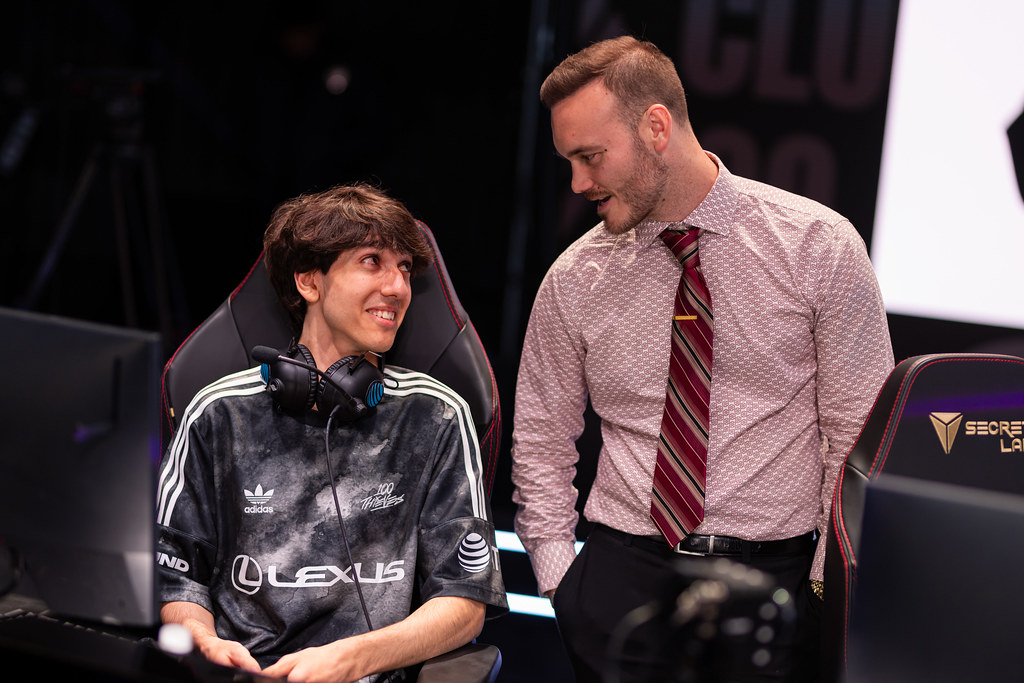
There is a pleasing circularity in seeing him beside a young 100 Thieves player at an LCS match, leaning in from the coach’s side of the chair. He knows the view from the seat. He also knows that careers continue after the headset comes off. His own did not advance in a straight line from player to executive. It expanded outward: captain, narrator, designer of context, owner.
Even his recurring hole-in-one challenge fits the pattern. An eight-hour attempt at one improbable shot becomes a live event, sponsor vehicle and community gathering. The premise is both ridiculous and pure Nadeshot: keep swinging, leave the camera on, let the audience inhabit the waiting. Golf supplies a slower scoreboard. The competitive instinct recognizes it anyway.
What the gamertag kept
Matthew Haag’s central trick was not turning play into work. Millions have tried that, and the phrase makes both activities sound less interesting. It was understanding that a modern sports figure could be more than performance. The game supplied proof. Video supplied intimacy. Clothing supplied identity. A company supplied continuity.
The name Nadeshot survived every transition because it never belonged to only one job. It was present when he was an amateur looking for an opening, a captain calling the next play, a creator addressing viewers directly and a founder asking established investors to take gaming culture seriously. The screen name did not conceal Matthew Haag. It gave him a shape large enough to grow into.
At 16, the objective was simple: win the bracket. At 22, it was to invent a life after winning. At 25, it was to build the organization his younger self would have recognized and worn. Today the most accurate title may also be the least corporate one: Nadeshot is still a player. Only the map keeps getting bigger.