The first customer had a wonderfully ordinary problem. People were texting Mayvenn, and Mayvenn needed a way to answer them at scale. Matthew Berman heard about it while working at 500 Startups, where a conversation with Mayvenn's Taylor Wang gave him something more useful than an abstract startup idea: a person waiting for a product to exist. He spent the next six weeks, nights and weekends, building a prototype. Mayvenn started using it. Berman had his first customer before the company that would become Sonar had much of a history to tell.
That is a clean origin story, though Berman's own account allows for the untidy part. Leaving a job, finding investors, hiring people, making payroll, and keeping customers pleased filled the nine years that followed. He wrote about the high points and the low ones in a 2023 farewell to Sonar, after its sale to Marchex and before he moved on. What makes the account vivid is his choice of detail. He remembers the problem, the six weeks, the first user, and the colleagues who made the work possible.
Today the problem arrives in a different inbox. A new AI model appears. A company claims another leap. People want to know what happened and what they might do with it. Berman, now the face of the YouTube channel bearing his name and of Forward Future, has made a job of working through that flood in public. His videos, interviews, guides and newsletter address the question familiar to anyone who has ever bought software: what can this actually do for me?
The customer came before the pitch
Berman says he moved to San Francisco in 2009 with two interests already fixed in his mind: technology and entrepreneurship. At 500 Startups, he spent nearly two years close to founders and the daily mechanics of making young companies work. The Mayvenn conversation did more than supply a market. It gave him a concrete task that he could try to solve himself. There is an admirable lack of ceremony in the sequence: hear the complaint, write the software, let the customer use it.
Once Mayvenn was using the prototype, he found more customers and decided to leave 500 Startups. In the same conversation with his boss, Christine Tsai, he told her he was going to build Sonar and asked whether she would invest. She agreed. Berman also recalls proposing to his then-girlfriend that week. She agreed too. Even by startup standards, it was a dense few days of asking consequential questions and hoping for yes.
Sonar became an enterprise text and messaging platform for businesses that needed a more organized way to talk with customers. Berman later named Zillow, Bird and DriveTime among its customers. He credited its investors, the team, and the people who trusted the product early. He also described the satisfaction of hearing that the software had helped a business. For a founder who began with one unanswered operational problem, that response was a useful measure of progress.
The company grew into a business large enough to draw Marchex's attention. The transaction closed on December 13, 2019. The price was structured as $8.5 million in cash at closing, $4 million in stock, and a possible additional $1.5 million tied to sales targets. Those are transaction figures, not a measure of Berman's personal proceeds. He remained with Sonar after the acquisition and did not write his farewell until May 2023.
“Nothing beats hearing that our software helped their business.”Matthew Berman, on Sonar
A farewell with a new subject
A sale can make a founder's story sound finished, especially when compressed into a line on a biography page. Berman's account resists that neat ending. He wrote about nine years of leadership, about colleagues he expected to keep as friends, and about the debt he felt to his wife, Aiste, for living through the company's demands alongside him. The public post gives credit away more readily than it gathers it.
Near its end, though, the subject changes. Sonar had already used AI, Berman wrote, and the rapid development of large language models had pulled him into a new field. He did not describe a fully drawn business plan. He said he was going to take time to decide what came next, while being clear about the direction: “I'm going all-in on artificial intelligence.” It is an unusually plain sentence for a career pivot. It also makes sense from someone who had learned to follow a problem before knowing precisely what the company around it would become.
Forward Future emerged as the public expression of that turn. Berman describes himself as a lifelong learner interested in technology and intent on sharing AI knowledge, from research papers to tutorials and news. Forward Future now offers a daily briefing, videos, guides, model reviews and interviews. The newsletter describes its aim in practical terms: fast, clear and actionable coverage for newcomers and people already working in the field.
A founder knows that product announcements can be eloquent while products themselves remain awkward. Berman's coverage reflects that experience. When Forward Future presents a model review, the pitch is about what the model can do, where it falls short, and what using it felt like. A reader or viewer can watch a capability being tried, then decide how much of the result matters for their own work. His judgment is a guide, not a universal benchmark; the demonstration is the more durable part.
The interviewer keeps his founder's questions
The scale of the conversations changed quickly. At Microsoft Build in 2025, Berman interviewed Satya Nadella about AI agents, software, and the future of the tools businesses already use. At Google I/O that year, he spoke with Sundar Pichai about Gemini, world models, diffusion and self-improving systems. Forward Future has also featured conversations with people across the companies and research groups reshaping AI. The former startup operator now puts questions to those making decisions that reach far beyond one startup's customers.
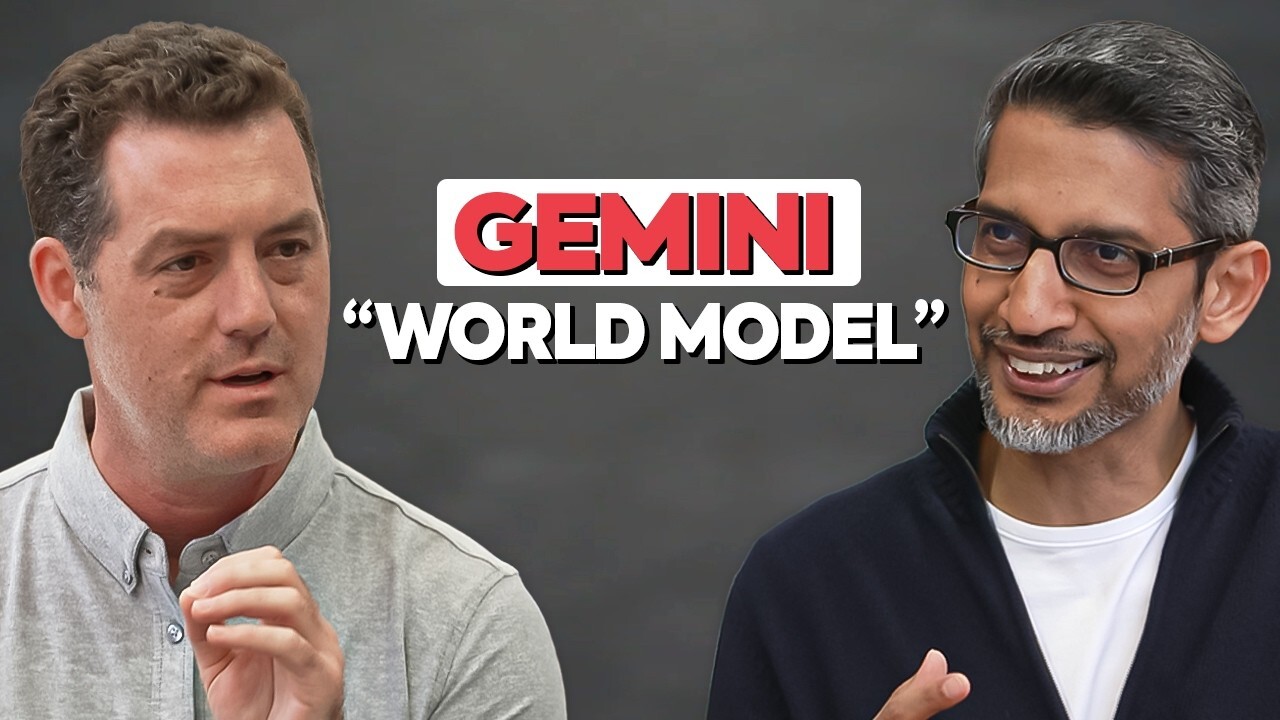
There is something disarming in the description under Berman's Pichai interview on YouTube. After listing the substantial topics, he apologizes because the camera kept going out of focus. The note is small, but it locates the conversation in the real work of making media. A CEO can explain a world model; a camera can still refuse to cooperate. Both facts fit inside the same upload.
His public voice is broadly optimistic about the usefulness of AI, while his questions often turn toward applications. In an August 2025 post, he wondered whether advances might come from the wider system of researchers, software and computing rather than from models improving themselves in isolation. It was a question, not a prophecy. That distinction matters in a field where certainty is cheap and each new release arrives with its own weather system of claims.
The audience has grown large enough that Berman is now part of the route by which technical news reaches working people. Forward Future's media kit lists more than 635,000 YouTube subscribers. Numbers like that change what an interview can do: an executive is speaking to people who may build with the product tomorrow, buy it next quarter, or decide it is not useful at all. Berman sits between those choices and the companies asking for attention.
One practical habit, two careers
Forward Future is more than a camera pointed at Berman. Nick Wentz appears alongside him in its newsletter and in the company's account of its mission, which is to make a complicated future easier to read. The site publishes daily briefings and longer guides; its interviews draw on voices beyond one host. A person who spent years building a team to run a software company is again working in a format that depends on colleagues, editors, guests and readers.
The work is also exposed to a peculiar pressure. The AI news cycle rewards speed, while understanding takes time. An interview offers access but requires judgment about which claim deserves a follow-up. A model demo can reveal a genuine improvement and still leave open whether it will hold up in someone else's workflow. Berman's material lives in that gap between announcement and use, where a viewer can see the tool's behavior before joining the applause or the groans.
His path offers a useful way to read the current moment without pretending it is tidy. The person who once built a system to cope with too many customer messages now helps an audience cope with too many technology messages. The medium changed from software to explanation. The working instinct survived: listen for the specific difficulty, put a tool or a claim in front of real people, and pay attention to what happens next.
When Berman left Sonar, he thanked the people who had made the first answer possible and went looking for a new question. Years later, the question still arrives with each release and each interview. It may be grandly framed as the future of intelligence. In practice, it is often humbler and more useful: show me how this works.
Follow the work
- WatchMatthew Berman on YouTube
- ReadForward Future newsletter
- Watch / InterviewSundar Pichai on Gemini and world models
- Watch / InterviewSatya Nadella on agents and software
- FollowBerman on X
- FollowBerman on LinkedIn
- FollowBerman on Instagram
- ReadHis farewell to Sonar