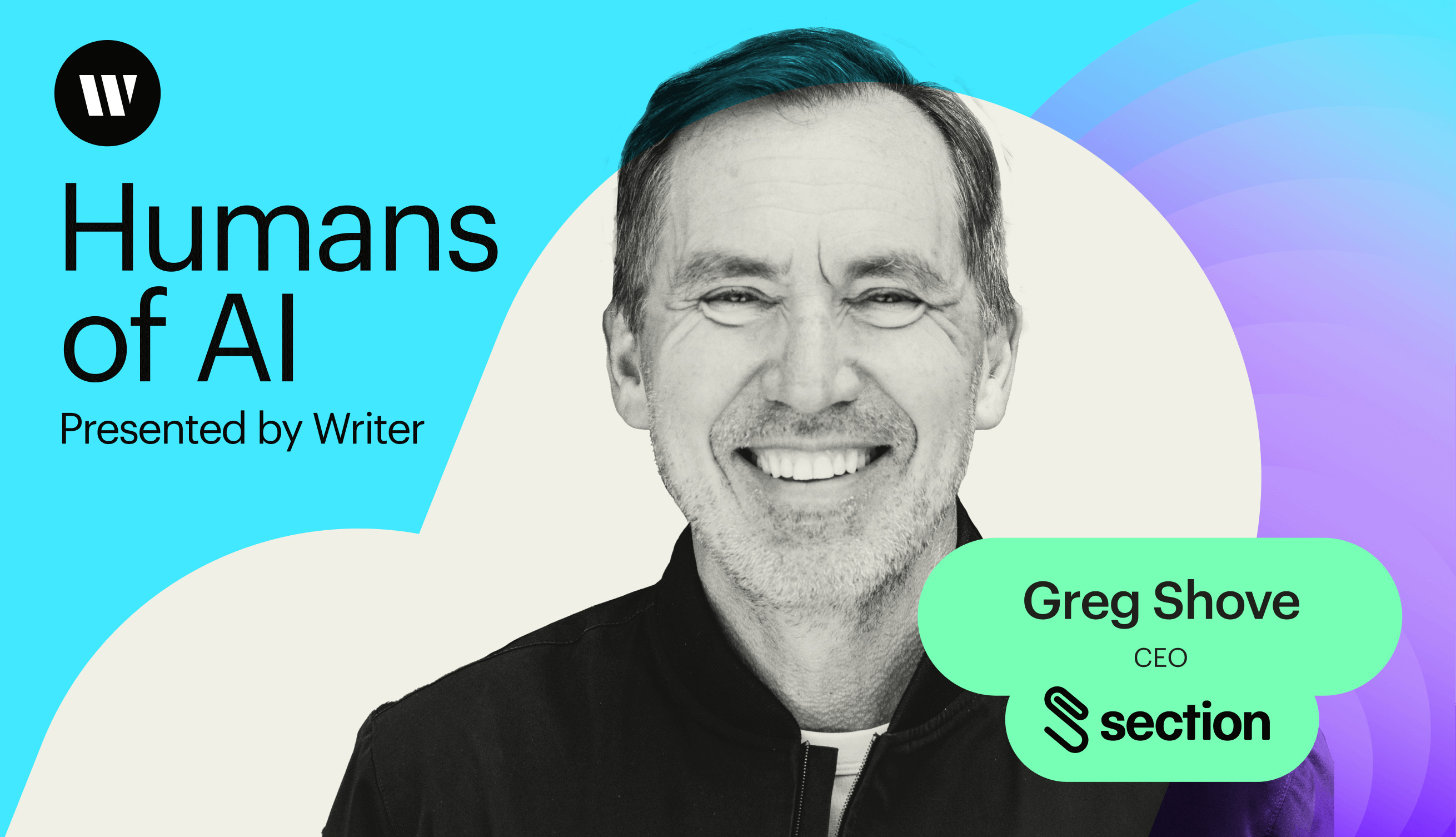
Greg Shove likes a technology wave, though “likes” may be too leisurely a verb. His career has the rhythm of a person who sees a swell, paddles toward it and accepts that the board may occasionally hit him in the face. Interactive shopping in the 1990s. Workforce communications in the social and mobile era. Online business education when classrooms went virtual. Now artificial intelligence, which he treats less like a software category than a force that is already rearranging the furniture while most executives debate the floor plan.
He is the CEO of Section, an AI education and workforce-transformation company, and calls himself a seven-time founder and CEO. The arithmetic contains three exits, more than $250 million in total exit value by his account, and enough companies that did not work to spoil any clean triumphal narrative. His own summary of the Silicon Valley bargain is brisk: long labor, some exits, financial security, bruises, dead ends. It is not the fable sold in business school. It is, however, a career.
A grocery-store theory of ambition
The useful beginning is not a garage. It is a grocery store. Shove was working in technology in Toronto, with time at Digital Equipment and Sun Microsystems behind him, when a mentor questioned the geography of his ambition. On a Saturday at Mollie Stone's in Palo Alto, the mentor said, Shove would meet more people in technology than he might encounter all year in Toronto.
The advice was comic, specific and correct enough to change a life. Shove entered Stanford's Sloan Fellows program, earned an MS in 1993 and stayed in California. Proximity became a strategy. Soon he co-founded 2Market, an interactive-shopping startup acquired by AOL in 1995. He joined the buyer and worked on e-commerce and business development during the years when AOL was a portal to the internet rather than a punch line about dial-up tones.
There was Apple, too, during a less glamorous chapter for the company. Apple fired him. Shove now folds that detail into his anti-mythology: he saw a celebrated company when it was cold and another, AOL, when it was hot. A logo on a résumé freezes a moment. Living inside the company reveals the weather.
“Failure is a great teacher.”Greg Shove
His later startups included the online venture seemebuyme.com and SocialChorus, the workforce-communications company he co-founded with Nicole Alvino in 2008. Their connection began at Stanford, where Shove had advised Alvino's student team and became a mentor. The business lasted through multiple identities and pivots, eventually becoming Firstup. In 2020, SocialChorus took a $100 million majority investment led by Sumeru Equity Partners. The tidy version ends there. Shove's preferred tag for the episode was drier: the last pivot worked.
The pivot that did not ask permission
Shove became Section's CEO in 2019. Scott Galloway had founded the company around accessible, high-quality business education, and Shove helped turn the early project into a virtual school. The pandemic accelerated the demand. Then the market cooled, Section cut staff in 2022, and the old model met the familiar gravity of online education: attention is expensive, completion is hard and a famous lecturer does not repeal economics.
In February 2023, Shove used ChatGPT for the first time. He saw a new wave and moved Section toward it. The company would teach AI through the lens of business, for people in marketing, sales, finance and leadership rather than engineers building foundation models. He also founded Machine & Partners, an AI lab that builds applications and workflows for enterprises.
Inside Section, the turn produced tension. Some employees were not thrilled. Shove has admitted that he dislikes conflict and once tried too hard to make everyone happy with a decision. The pivot demanded a less soothing posture. People could dislike the decision, work through the discomfort and keep moving. Consensus was no longer the same thing as commitment.
This is where his AI argument becomes more interesting than evangelism. Enterprise adoption is not a pep rally. It is change management with software attached. Employees wonder what the tools mean for their jobs. Managers buy licenses without redesigning a single process. Leaders ask for experimentation while preserving their own habits under glass. Shove's response is to make the executive a player-coach: use the tools, show the experiments, fund access, set guardrails and talk plainly about the anxiety.
“Leadership is everything that happens every day that no one sees.”Greg Shove
AI gets a seat before the meeting
Before a Section board meeting, Shove gives an AI model the same material sent to human directors. He asks it to play several roles: an aggressive advocate for growth, a cautious steward of cash, an adviser hunting for blind spots. The model does not vote or carry fiduciary responsibility. It rehearses the argument. By the time the humans meet, the obvious questions have already been asked once.
It is a revealing use case because it does not pretend judgment has been automated. Shove describes AI as a thought partner, particularly useful against cognitive habits that harden with experience. A younger employee may use it as a patient tutor. A veteran leader can use it as a dissenter who is always available and unmoved by the boss's title. Both still have to check the work.
Optimize
Remove friction from work already being done.
Accelerate
Increase speed or quality in a valuable workflow.
Transform
Redesign the work, product or operating model itself.
The distinction matters. Most companies begin with efficiency because saved minutes are visible. Shove argues that value leaks away when every employee saves time but the organization changes nothing. A faster draft is pleasant. A redesigned customer process, a new service or a decision reached with better evidence can alter the business. The tool earns its keep only when the workflow catches up.
His adoption tactics can be almost comically analog. He has discussed putting reminders where people work so they remember to ask whether AI belongs in the task at hand. The point is repetition. One annual training day cannot create a daily habit, just as one exuberant keynote cannot perform the unphotogenic work of leadership.
The company after headcount
Shove's newer label for the destination is “supercompany”: an organization that turns AI capability into business value faster than competitors, with smaller teams and more autonomous operations. He explores the idea through Section events and a podcast that began as AI Truth Serum before taking the Supercompanies name. The guests and examples change. The question stays sharp: once intelligence becomes cheap and abundant, what should a company become?
The phrase has some comic-book voltage, but his practical program is stubbornly ordinary. Pay for employees' tools. Teach them how to use those tools responsibly. Map the real workflow. Decide whether the goal is cutting cost or creating value. Measure what changed. Keep humans answerable for the outcome. Repeat on Tuesday.
He also publishes Personal Math, a newsletter built around the unwritten rules of work and ambition. It suits him. Shove describes himself as Canadian in his belief in a level playing field, British in his refusal to quit and American in his instinct to dream of something better. On his own site, he chooses three plainer adjectives: ambitious, relentless, aspirational. The fourth, visible across the record, is revisable.
Even his domestic experiments have become small proofs. In 2026 he described a Sunday agent designed to help him and his wife coordinate the week: who needs the car, who is home for dinner, when each can exercise, whether the dog will be alone too long. The grand future of work, it turns out, may arrive as a better calendar note. Technology is often most persuasive when it stops performing futurism and handles Wednesday.
“I'm ambitious, relentless, and aspirational. And I motivate teams to be as well.”Greg Shove
Shove has set a public goal of bringing one million leaders into the AI class by the end of 2026. The number is deliberately large. The method underneath it is intimate: one executive opening a tool, one team exposing a clumsy workflow, one meeting made harder to fool. The aspiration is scale; the mechanism is practice.
His classroom has already ranged well beyond Section's own staff. Shove says he has trained more than 10,000 knowledge workers and delivered over 100 lectures and workshops, including sessions for IBM, LVMH, Citibank, AB InBev and Berkeley Haas. The range supports his central claim: AI literacy is becoming an operating skill across functions, not a specialist badge reserved for technical teams. Fluency, in his telling, begins when a person can apply a model to work they already understand.
After seven startup tours, he does not need another pristine origin myth. His more useful inheritance is a tolerance for revision. Move close to the action. Form a judgment. Make the turn. Live with the tension. Inspect the result. If the pivot fails, the lesson joins the company. If it works, Monday morning should look different.