A dictionary is an unusual place to begin a technology company. It is an even less promising place to find a shortcut. Around 2000, Sameer Maskey was reading through 6,000 words from an Oxford dictionary, working out rules that would help a computer pronounce Nepali. The machine needed instruction in sounds, rhythm and the small distinctions people handle without congratulating themselves.
Maskey was a mathematics and physics student at Bates College in Maine. His project required him to cross into computer science, seek specialists at other institutions and make a language audible to a machine. Before a company called Fusemachines appeared, there was this wonderfully particular task: give the computer enough information to say something properly.
More than two decades later, the questions have grown. How does a business put AI to work? Who gets trained to build it? Can Nepal supply the people and infrastructure behind the software? Maskey’s career keeps returning to the distance between having an ability and having somewhere to use it.
A college decision made in a cybercafe
He grew up in Kathmandu, where computers were expensive enough that he first used one in high school. A local cybercafe offered internet access and a way to investigate colleges abroad. During one visit, while he was emailing a friend about his acceptance to Bates, students from the college who were studying in Nepal noticed. They helped persuade him to attend.
It is a satisfying detail because it resists the usual tidy account of an academic journey. An admissions decision had a human sequel, conducted in a room full of computers far from Maine. People who knew the institution could make it feel like a place he might actually go.
At Bates, his speech project brought him into contact with researchers at Carnegie Mellon and other schools. His adviser, mathematics professor John Rhodes, supported the work. A 2001 campus account caught the oddity of the assignment: a student was teaching a computer the rhythms of a language. One suspects the computer was a rather demanding pupil.
A dictionary, phonetic rules and the task of making typed Nepali speak.
What a sentence leaves unsaid
Maskey graduated from Bates in 2002. At Columbia University, he moved deeper into the problem of turning speech into useful information. His 2008 doctoral dissertation, Automatic Broadcast News Speech Summarization, examined how a machine could produce summaries from spoken news. Julia Hirschberg advised the research.
The subject has an appealing everyday quality. A broadcast contains more words than a listener may need. A useful summary has to preserve what matters. Yet the simplicity of that description conceals a problem that occupied researchers across language, speech and machine learning. Sound carries information that a plain transcript can flatten.
His published work followed those complications: soundbite detection, intonational phrases, speech translation and methods for evaluating summaries. He collaborated with researchers including Hirschberg, Andrew Rosenberg and Kathleen McKeown. The papers record a career assembled through particular problems and shared investigations, years before conversational AI acquired its present audience.
At IBM’s T. J. Watson Research Center, he worked on speech translation and question answering. His academic teaching included statistical methods for natural language processing, followed by courses connecting data science with entrepreneurship. Research, teaching and building products were becoming overlapping occupations.
- SpeechHow should the machine say it?
- MeaningWhat should the machine keep?
- WorkWhere can this become useful?
- AccessWho gets to build it?
An editorial map of Maskey’s work, from speech software to AI education.
The customer arrived before the sales lesson
In January 2013, Maskey left IBM. He began Fusemachines with work he knew: a dialogue system that could answer customer questions. He wrote the first version himself, in his living room. The product belonged to the long history of attempts to let people ask computers for help in ordinary language.
New York City became an early customer. The timing helped: the Bloomberg administration was nearing its end and wanted the system operating before the changeover. For a founder learning to sell, a quick government deal was an education with a misleading first chapter.
He later acknowledged that the experience had left him underestimating the difficulty of sales. A working product and an interested buyer can make a business look beautifully straightforward. Repeating the transaction requires a process, a team and the patience to discover how differently the next customer behaves.
The early company also expanded from customer-service chatbots into sales assistance, applying language technology and machine learning to business tasks. The technical work could travel. Finding enough people to carry it forward became a separate assignment.
The recruiting map had blank spaces
By 2020, Fusemachines was combining AI tools with teams of engineers for businesses in the United States. Maskey saw an opening in the mismatch between companies seeking AI expertise and people in developing countries who lacked a route into advanced training. Nepal was central to that argument, rather than a distant place to mention in the founder’s biography.
The model joined two interests that are often discussed separately. Students could gain skills and access to international work. A growing company could develop the engineers it needed. The arrangement depended on education producing people capable of doing the work customers were paying for.
That carried a stronger obligation than a general declaration about potential. A training program had to connect the mathematics to the task. Employers had to trust the results. Engineers had to be given opportunities to move beyond exercises and work on systems with real users.
“Talent is everywhere, but opportunities are not.”
Sameer Maskey · 2024 interview
In the early years, Maskey personally taught engineers, sometimes before dawn in New York to reach Kathmandu. Eventually, the people he had trained began teaching newcomers. In 2017, the company selected 27 fellows from more than 400 applicants. Fourteen worked elsewhere, including at competing companies. Access extended beyond its own payroll.
A classroom with a commercial consequence
The fellowship continued. In February 2026, Fusemachines announced another Nepal cohort, offering full scholarships to qualifying applicants after a selection process. The company reported that the program had trained more than 1,200 fellows across 12 countries since its launch in 2017.
Its curriculum covered foundations and applications, including machine learning, deep learning and generative AI. Mentorship and practical projects accompanied the coursework. That combination reflects the gap between hearing about a field and becoming able to contribute to it.
Maskey’s public conversations return to making education affordable and accessible. The ambition reaches further than adding another course to someone’s schedule. It asks whether a person who lives outside an established technology center can acquire the preparation, support and professional connections to enter the field.
The distinction matters in his own story. Moving from Kathmandu to an American college opened a route into research. The fellowship attempts to make some of that technical preparation available without requiring everyone to retrace his geography.
Four letters in Times Square
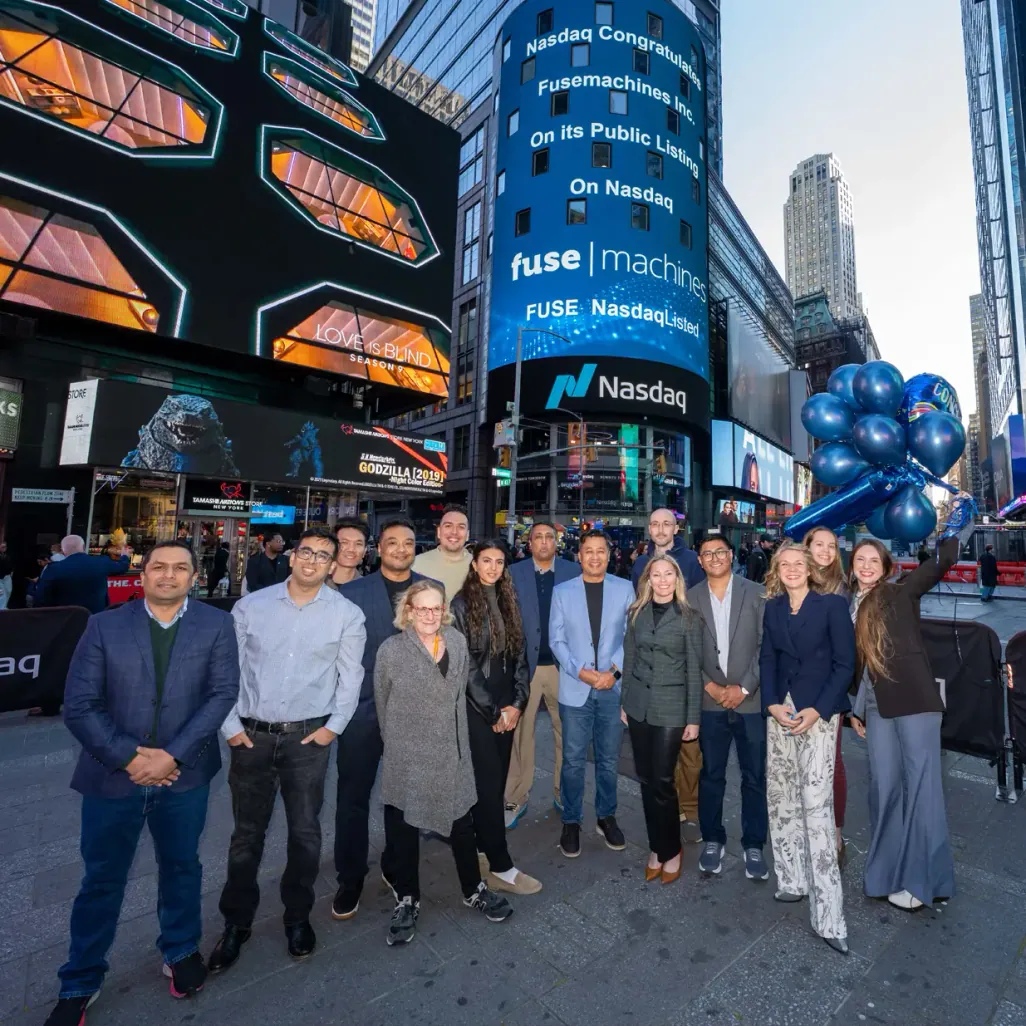
On October 22, 2025, Fusemachines completed its business combination with CSLM Acquisition Corp. Trading began the next day under the symbol FUSE. The public-market debut arrived twelve years after Maskey founded the company.
A photograph of the team in Times Square supplies the visible version of that milestone: people gathered beneath the company’s name on Nasdaq’s screen. It is an agreeable reversal of the early living-room scene. A product once written by its founder had become an enterprise with colleagues, customers and public shareholders.
The work carried on in a recognizable direction. In February 2026, Fusemachines said its Interview AI Agent was assisting all of its initial technical screening interviews. The software offered recruiters technical questions, follow-up guidance and structured assessments, keeping people involved in evaluating candidates.
In August, the company announced an agreement under which Qintess committed to spend at least $6.5 million on its agentic AI products and services over three years. The commitment describes future purchases under a contract. The practical challenge is delivering useful systems inside another organization’s working day.
The adviser takes another seat
June 2026 brought a connection back to the laboratory: Hirschberg joined the Fusemachines board. The researcher who had advised Maskey’s doctorate was now helping oversee the company he had built. Her experience in speech, language and industry research fitted subjects that had occupied him since college.
For all the movement between countries and institutions, certain relationships have endured. Columbia remains part of his working life through his role as an adjunct associate professor. His professional identity leaves room for teaching alongside the demands of running a business.
His view of AI also retains a researcher’s interest in what systems actually do. In a 2019 conversation over bibimbap in Kathmandu, he directed attention toward surveillance and the “misuse of advanced AI systems.” His concern was attached to human decisions about deployment. The tools have purposes, owners and consequences.
A bigger machine for Nepal
In May 2026, Maskey argued for Nepal to build sovereign AI computing infrastructure. His proposed national AI factory would give researchers, universities and startups access to resources for building models and services locally. He connected that possibility to Nepal’s hydropower and called for an initial government-backed investment.
It is an argument about what the country could build, with financing, governance and execution still to be addressed. It also extends an old preoccupation. Access to skills matters; so does access to the equipment on which those skills can be used.
The undergraduate’s assignment was measured in thousands of words. The founder’s assignments now involve training programs, enterprise customers and the infrastructure of a country. Across those changes, a Nepali voice remains present in the conversation. Maskey has spent much of his career finding practical ways for more people to join it.