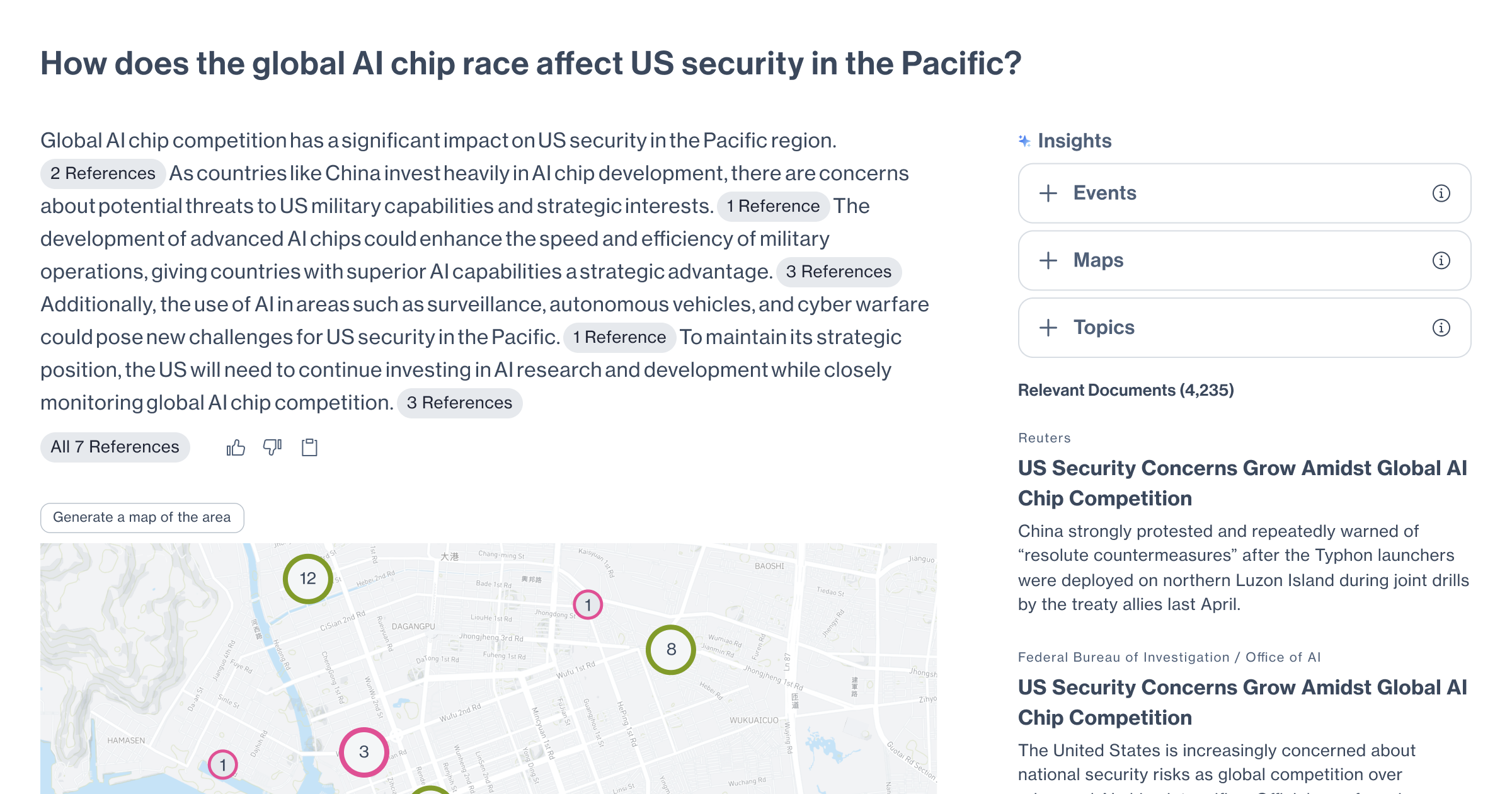
A briefing slide is loading inside a secure facility somewhere in northern Virginia. The analyst behind it has not read the 4,000 documents the slide summarizes. She doesn't need to. Each claim is footnoted to a source she can pull up in one click. The system that built the slide is called Primer.
§ 01Who they are now
Primer.ai is a 140-person, San Francisco-headquartered AI company that builds software for the people who watch the world for a living. Analysts. Investigators. Operators. The unglamorous middle of the national-security pyramid - the ones who actually read the cable traffic and the open-source feeds and the foreign press and try to turn it into something a decision-maker can use before lunch.
That is the room Primer was built for. Not the consumer chatbot room. Not the marketing-copy room. The room where being wrong has consequences, and where "the model said so" is not, by itself, an acceptable answer.
§ 02The problem they saw
The world produces text faster than humans can read it. That much is obvious. The less obvious part is what happens inside a government agency when the firehose hits an analyst's desktop: ninety-six tabs, three classification levels, a deadline at 0700, and a memo that has to hold up if it ends up in front of Congress.
The temptation, in 2024, was to point the latest large language model at the problem and see what came out. The temptation, predictably, did not survive contact with the customer. Hallucinations are entertaining in a demo. They are unacceptable in a finished intelligence product. So is sending your sensitive documents to someone else's cloud.
Primer's bet was that the right product was not a smarter chatbot. It was a layer between the noise and the analyst that did three boring, important things: ingest everything, attribute everything, and never leave the building.
§ 03The founder's bet
Primer was started in 2015 by Sean Gourley, a New Zealand-born physicist who had spent his Oxford years modeling the mathematical patterns of war and insurgency. His first startup, Quid, mapped business landscapes from unstructured text. His second startup wanted to do the same thing for governments - except for actual wars.
The In-Q-Tel money came early, which is to say the CIA's investment arm wrote a check before generative AI was a dinner-party topic. By the time the rest of the industry caught up to large language models, Primer had spent the better part of a decade thinking about source attribution, secure deployment, and the unglamorous plumbing of federal IT.
In 2023, Gourley stepped back. Sean Moriarty - who had previously run Ticketmaster, a different kind of high-stakes real-time system - took over as CEO. The pitch under Moriarty is less about the romance of AI and more about the unromantic mechanics of selling enterprise software inside a SCIF. He has been doing the second thing for twenty-five years.
§ 04The product
There are four pieces, and they fit together in the way good enterprise software tends to: each one boring on its own, useful in combination, indispensable once you have wired it into your workflow.
Primer Enterprise
The flagship. A secure platform for analyzing massive volumes of unstructured data - news, documents, intercepts, proprietary feeds - that turns the lot of it into structured, traceable insight. Deploys in air-gapped environments, customer-hosted clouds, and DDIL (denied, degraded, intermittent, limited) networks. Which is to say: the bandwidth-starved tent in the field, not just the dashboard in the office.
Primer Command
Real-time narrative monitoring across global news and social media. The use case is anyone whose job is to notice when a story is being shaped, picked up, weaponized, or buried. Press offices use it. So do counter-disinformation teams. So, reportedly, do some less talkative customers.
Primer Delta
Document sorting at scale. Feed it a million PDFs and it returns entities, locations, topics, and a defensible chain of citations to the underlying text. The most photogenic of the four, and the one most often demoed.
Primer API
For customers who already have a mission system and just want Primer's extraction, summarization, and search inside it. Less glamorous. More widely deployed.
§ 05The road so far
§ 06The proof
Customer lists in this corner of the industry are mostly classified. The ones Primer has been allowed to publish are nevertheless instructive: NATO, the U.S. Department of Defense, Walmart, Microsoft. The integration partners read like the seating chart at a federal contracting conference: Palantir, GDIT, Carahsoft, AWS, Microsoft, Flashpoint.
Figure 01
§ 07The mission
Strip away the marketing surface and the company's purpose is simple enough to fit on a Post-it: accelerate human understanding so the people who defend open societies can act faster than the people who don't. Primer's own phrasing is more careful - "empower decisions that can be defended, and acted upon confidently" - but the through-line is the same.
It is a stated mission that some readers will find admirable and some will find uncomfortable, and Primer would tell you both reactions are reasonable. The company makes no secret of who its customers are. It also makes no secret of the constraint that follows from that: every claim must be traceable to a source, and every model must be operable without phoning home.
This is what "trustworthy AI" looks like when the audience is not a Senate hearing but a working analyst, and when the failure mode is not bad PR but a bad call.
§ 08Why it matters tomorrow
The decade ahead will be very loud. More text, more languages, more synthetic media, more actors with the budget to flood any given information environment. The agencies that protect democracies will either learn to read faster than the adversary or they will be reading yesterday's news, which is to say, losing.
Primer's bet is that the answer is neither more analysts (there aren't any) nor smarter chatbots (they hallucinate). The answer is a layer in between - software that reads everything, attributes everything, runs anywhere, and hands the analyst back her morning.
Back in northern Virginia, the briefing slide is finished. The analyst clicks one footnote. Then another. Then a third. The cited document opens. The claim holds. She moves on to the next question, the one she actually has time for now. The room she is in did not exist in this shape ten years ago. It exists now in part because a quiet company in San Francisco decided AI for grown-ups had to look like this, and built it.