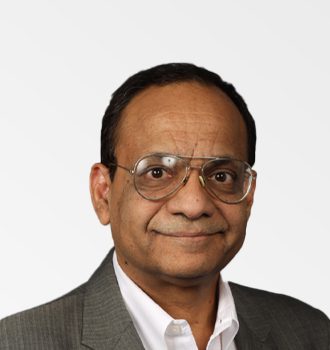
Before the Gold Rush, He Was Already Mining
In 1993, when most of Silicon Valley was still arguing about whether the World Wide Web was a fad, Alok Aggarwal was deploying AI-based supply chain management systems inside paper mills for IBM - and saving those mills roughly 1.5% in operating costs. That might sound modest. For industrial operations running on thin margins, it was the difference between a good year and a great one. It was also the kind of quiet proof that mattered to Aggarwal: AI that actually works, in the real world, on unglamorous problems.
That instinct - to build rather than announce, to verify rather than theorize - has defined his four-decade arc through AI. From the T.J. Watson Research Center in Yorktown Heights, where he published 95 papers and filed eight U.S. patents, to the IIT Delhi campus where he stood in front of a Minister and a U.S. Ambassador to inaugurate IBM's first India research lab, to the Evalueserve boardroom where he coined "Knowledge Process Outsourcing" and accidentally named an entire industry, and now to Scry AI's offices in San Jose - the throughline is the same. Build systems that hold up under scrutiny.
"AI is only a tool."
- Alok Aggarwal, "The Fourth Industrial Revolution & 100 Years of AI (1950-2050)"That statement, the thesis of his 2023 Amazon bestseller, sounds obvious until you realize he's been making the same case since before most AI commentators were born. Aggarwal isn't contrarian - he's just early. Forty years of building tends to inoculate you against hype.
Sixteen Years at the Frontier
Aggarwal arrived at IBM's T.J. Watson Research Center in 1984 fresh from a Johns Hopkins PhD - and stayed for sixteen years. That's not a stint. That's a career inside a career. During that time he published prolifically, filed patents, and served as Program Chairman for the Symposium on Theory of Computing and the Foundations of Computer Science - two of the field's most rigorous conferences. He also chaired the IEEE Computer Society's Technical Committee on Mathematical Foundations of Computing.
But the paper that arguably mattered most to the real world came from a paper mill. His 1993 supply chain optimization work for the pulp and paper industry won the INFORMS Daniel H. Wagner Prize in 1998 - an award given for elegant and practically relevant operations research. The paper didn't just win a prize; it proved that AI could be deployed, profitably, in heavy industry. That's a quieter claim than most AI researchers make. It's also a harder one to fake.
Then, in July 1997, Aggarwal did something unusual: he went home. Not to retire - to build. IBM asked him to establish its first India Research Laboratory, and he chose to plant it inside IIT Delhi, the campus where he had studied as an undergraduate nearly two decades earlier. The inauguration drew the Indian Minister for Human Resources and the U.S. Ambassador to India. Aggarwal grew the lab from zero to 70 researchers - 35 PhDs and 35 Masters - by the time he left in 2000. By 2022, that lab had more than 150 researchers.
Four Decades, One Direction
The Accidental Industry Namer
When Aggarwal co-founded Evalueserve in December 2000, Business Process Outsourcing was already a recognized category. He had a different idea. Knowledge-intensive work - legal research, financial analysis, IP research, competitive intelligence - was being farmed out to talented professionals in lower-cost markets. But nobody had a name for it. It was just "offshore research" or "knowledge services."
In 2003, Aggarwal wrote an article. He called what Evalueserve was doing "Knowledge Process Outsourcing." The abbreviation KPO stuck. What started as a description became a category. That category now comprises 200+ companies in India alone, employing hundreds of thousands of professionals. He didn't set out to name an industry. He set out to describe what he was doing. The industry followed the description.
He served as Evalueserve's Chairman until January 2014, building it into a firm that served clients across North America, Europe, and Asia Pacific with research, intellectual property, and analytics services. Then he left to do something harder.
The Training Ground
Building the AI That Auditors Can Actually Touch
When Aggarwal founded Scry AI in February 2014, the generative AI wave was still years away. He wasn't waiting for it. The problem he cared about was older and harder: how do you build AI that regulated industries - banking, insurance, government, manufacturing - can actually trust, deploy, and defend to an auditor?
The answer he built is called CognitiveBricks: a platform housing 60+ proprietary AI models and algorithms, all developed in-house. Not wrappers around foundation models. Not third-party APIs lightly branded. Models his team built, tested, validated, and can explain. Scry AI holds SOC 2 compliance and ISO 27001 certification - not because regulators asked nicely, but because Aggarwal built the company around the assumption that enterprise AI lives or dies on auditability.
The company operates from San Jose, California, with R&D centers in Delhi-Gurgaon, Pune, and Hyderabad, India. It has grown to 230+ employees and $28.4M in annual revenue, serving clients in banking, insurance, real estate, energy, utilities, manufacturing, and government. It is the kind of company that doesn't appear on many "AI hot startups" lists - and almost certainly prefers it that way.
AI That Works Where the Stakes Are Highest
Financial Services AI
KYC/KYB extraction, financial spreading automation, loan document processing, fraud detection, and regulatory compliance reporting.
Smart City & Government
Infrastructure monitoring via drones, public safety AI, digital twin modeling, and AI for public sector services.
Industrial & Manufacturing
Predictive maintenance, construction site safety AI, engineering diagram processing, and supply chain optimization.
Explainable AI
Every model can be audited, explained, and validated. Built from the ground up for regulated industry deployment - not retrofitted.
The Book That Spans a Century
The Fourth Industrial Revolution & 100 Years of AI (1950-2050): The Truth About AI & Why It's Only a Tool
Published November 2023. Covers AI applications in IoT, Blockchains, Metaverse, Robotics, Autonomous Vehicles, 3D Printing, Climate Change, Gene Editing, and Personalized Healthcare - from 1950 through 2050.
The central thesis: AI is powerful but remains a tool in human hands. Not prophecy. Not threat. A tool. Aggarwal has been making this argument with data for 40 years. The book just formalized it.
Amazon Bestseller - Cybernetics, Computer Engineering & Algorithm ProgrammingVoice of Cancer Patients
Here's the detail that most profiles miss: Aggarwal co-built a medical research platform with his wife, Dr. Sangeeta Aggarwal, a hematologist-oncologist. The platform uses NLP and machine learning to scrape and analyze online cancer patient forums - the places where patients actually describe their experience with drugs, therapies, and side effects, unfiltered and in their own words.
The results have been published in the Journal of Clinical Oncology, Cancer Research, and Blood journals. The topics range from patient experiences with BTK inhibitors to the role of yoga and meditation in cancer care to how patients discuss Oncotype DX testing. It is, quietly, one of the more interesting applications of NLP to patient-reported outcomes in recent years - and it came from a CEO who decided to work on cancer research with his oncologist wife in whatever time was left over from running a company.
On the Record
Honors That Arrived Quietly
-
🥇
IIT Delhi Distinguished Alumni Award2008
-
🏆
INFORMS Daniel H. Wagner Prize1998 - Cooperative Multi-Objective Decision Support for the Paper Industry
-
🎖️
IBM Innovation Award (x2)1984 and 1993 - IBM T.J. Watson Research Center
-
📚
Amazon Bestseller - Three Categories Simultaneously2023 - Cybernetics, Computer Engineering, Algorithm Programming
-
🔬
Featured in Johns Hopkins Whiting School of Engineering MagazineAdvancing Innovation feature
The Details That Define Him
The Record
- Published 120+ research articles across peer-reviewed journals and conferences
- Granted 8 U.S. Patents in areas including e-commerce, wireless networks, and optimization
- Founded IBM's India Research Laboratory at IIT Delhi (1997) - grew to 150+ researchers by 2022
- Co-founded Evalueserve and defined the Knowledge Process Outsourcing category (2003)
- Built Scry AI's CognitiveBricks platform with 60+ proprietary AI models
- Deployed first commercial AI supply chain solution in heavy industry (1993)
- Program Chairman: Symposium on Theory of Computing; Foundations of Computer Science
- Chaired IEEE Computer Society's Technical Committee on Mathematical Foundations of Computing
- Scry AI: SOC 2 compliant and ISO 27001 certified under his leadership
- Amazon bestselling author in three simultaneous categories (2023)