The revealing word in Matt Wills's title is not president. It is the ampersand. President and chief operating officer. Co-founder, too. At Lumata Health, the Oklahoma City executive works where the boxes on an organization chart touch: money and operations, marketing and partnerships, the promise made in a meeting and the machinery required to keep it. His is a career built in the space after a good idea, when the applause subsides and somebody has to decide what happens on Monday.
That career did not begin with healthcare technology. It began with religion. At Oklahoma City University, Wills studied global perspectives in law, ethics and religion. He graduated magna cum laude, completed the honors program, held a full-tuition Bishop's Scholar award and helped found the varsity crew team. None of this resembles the usual assembly line for a finance-minded operator. It does, however, suggest an early appetite for institutions: what people believe, how groups organize and why a common purpose sometimes survives contact with daily life.
Then he went to China and earned an MBA in international business, finance and administration at Tianjin University of Finance and Economics. The combination looks almost novelistic: theology in Oklahoma, spreadsheets in Tianjin. Soon enough, the spreadsheets won him a desk in investment banking. The theology never entirely left the room.
A résumé with no straight lines
Wills joined Capital West Securities as an investment banking associate in 2009. Banking taught him the polished language of value, transactions and capital. His next stop taught him something earthier. As director of franchising and brand development at Orange Leaf Frozen Yogurt, he worked amid a rapid rollout of stores, territories and repeatable processes. Frozen yogurt may be a considerable distance from eye care, but franchising is an unforgiving education in scale. A concept must work again without its creator standing beside it. The second location is a test of whether the first was a business or merely a charming accident.
The operating education
In 2011, Wills entered specialty pharmacy as a co-founder and director of corporate development at OptionOne. The titles changed as the company did: vice president of corporate development, then chief operating officer. He was no longer advising on the architecture of a business from outside. He was living inside it, where a financial model has colleagues, customers, bottlenecks and a telephone that rings at inconvenient times.
The first full company arc
OptionOne gave Wills the rarest kind of founder training: a complete arc. He helped build the specialty infusion pharmacy, led it in operating roles and played a part in its sale to Amerita, a national specialty infusion company. The terms were not disclosed, which is finance's way of drawing the curtain just as the plot becomes commercially interesting. The more important fact is that Wills saw a company through its stages: formation, growth, management and acquisition.
An exit can make entrepreneurship look like a sequence ending in fireworks. Operators know better. Selling a company requires the dull virtues that resist dramatic lighting: disciplined records, credible forecasts, contracts that can survive scrutiny and processes another organization can understand. By 2016, Wills had also earned the Chartered Financial Analyst charter, a qualification devoted to rigor and ethical standards. He had become fluent in the language of capital without mistaking money for the whole story.
“I'm honored to be on this adventure with Stephen Fransen, MD, Landon Grace, and the rest of our amazing team!”Matt Wills, reflecting publicly on Lumata's growth
There is a clue in the pronouns. Wills's public comments about Lumata reliably spread the credit around. Co-founders Stephen Fransen and Landon Grace appear by name. Investors are thanked. The team is thanked. This may be ordinary good manners, but good manners are underrated operating technology. They lower the temperature in rooms where many specialties, incentives and egos must reach a decision together.
The gap after the plan
Wills joined Lumata's founding team in 2019. The company had begun two years earlier with Fransen, a retinal specialist who had watched patients struggle to continue care after leaving the clinic. Lumata's proposition grew from that overlooked interval. A clinician can make a plan; the world outside the appointment can still interrupt it. Transportation fails. Schedules collide. Instructions become confusing. A reminder goes missing. The clinical plan may be sound while the surrounding choreography falls apart.
Lumata built a service around that choreography, combining software, data and care coaches who help patients stay connected to their practices. The company's preferred phrase is “technology-driven, human-led.” Wills's remit mirrors it. Lumata says he guides finance, operations, marketing and strategic partnerships. Those are four different departments in many companies. Here they form one continuous question: can an insight become a service, can the service become a repeatable system, and can the system reach more people without losing the human exchange that made it useful?
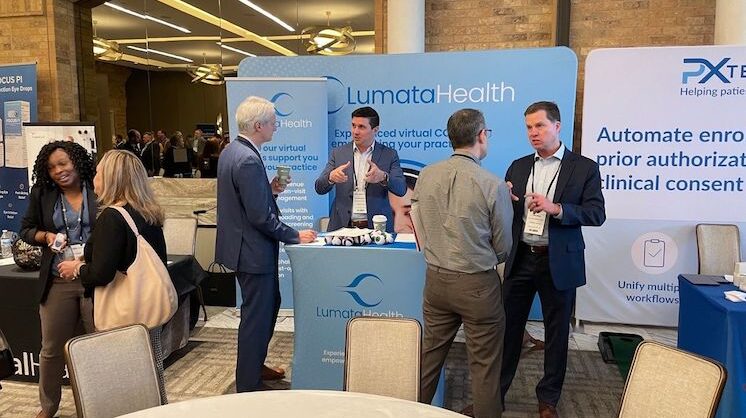
This is less glamorous than invention and more difficult to fake. A product can be demonstrated in ten minutes. A care operation proves itself across thousands of small encounters. Wills arrived with the memory of OptionOne: the knowledge that businesses become valuable not when they announce a service, but when they can deliver it consistently.
The numbers that changed the scaleCapital creates a to-do list
In 2022, Lumata announced $4 million in new funding led by Cortado Ventures, with participation from Wolfpack Investor Network and practicing ophthalmologists. Wills described the company's mission and the “technology-driven, human-led” model in a public note that again emphasized colleagues and backers. A year later, a local magazine named Lumata its Technology Innovator of the Year. Recognition arrived, as it often does, in a polished package. The actual work remained a series of handoffs.
The larger moment came in March 2025, when Lumata announced a $23 million Series B co-led by LRVHealth, McKesson Ventures and Cencora Ventures, with Cortado Ventures participating. Wills called it a “monumental milestone” and thanked the people around the company. A funding round is often treated as evidence that a startup has arrived. To an operator, it is closer to a heavily financed list of future obligations.
Capital must become hiring, systems, training, partnerships and measured capacity. It has to travel from a bank account into thousands of competent decisions made by other people. The round expanded Lumata's possibilities and the consequences of getting those decisions wrong. Wills had spent his career preparing for precisely this awkward translation.
“Your support fuels our work to ensure that every patient at risk of vision loss gets the care they need when they need it.”Matt Wills after Lumata's Series B
The connective-tissue job
Founder stories favor the visionary at the whiteboard. Wills represents a different and equally necessary character: the integrator. He has moved among disciplines that behave like neighboring countries. Finance wants evidence. Marketing wants clarity. Operations wants repeatability. Partnerships want trust. Each has its own dialect, deadlines and private definition of success. Someone has to translate.
His education looks newly sensible from this angle. Religion examined values and people. International study widened the frame. Banking supplied analytical discipline. Franchising showed how a concept repeats. Specialty pharmacy made service operational. The CFA charter reinforced standards. None alone explains Wills's role at Lumata. Together, they form a curriculum in connective tissue.
His volunteer work fits the same pattern. Wills served first on the Children's Hospital Foundation's Innovative Board, helping young professionals raise funds and awareness, and later on its statewide Board of Advocates. Civic work in Oklahoma City placed him among institutions that depend less on a single flash of brilliance than on durable coalitions.
Oklahoma, with a wider map
Lumata now lists Raleigh as its headquarters, yet Wills remains based in Oklahoma City, where the company has deep roots. In early 2025 he presented Lumata at Cortado Ventures' annual meeting, part of a founder showcase inside the city's growing investment community. The setting matters. His path has ranged to China and through national healthcare networks, but it keeps circling back to Oklahoma.
There is something fitting about building from a place outside the usual coastal startup mythology. Oklahoma City rewards a practical form of ambition. The work has to function in clinics and communities far from a venture conference stage. Wills's public persona is similarly low on theatrical founder mythology. The notable statements are about colleagues, patients, partners and next steps. Even excitement arrives carrying an operating plan.
The ampersand in his title remains the best shorthand. Matt Wills is finance and operations, mission and measurement, Oklahoma and a wider map. The companies change. The central problem does not. A promise has been made; people have organized around it; resources have arrived. Now what happens next?