The useful thing about a portable laser is contained in the adjective. It moves. In the 1990s, Stephen Fransen was treating retinal disease in Oklahoma and confronting a peculiar failure of modern medicine: the remedy could exist, the specialist could be ready, and the appointment could be booked, yet none of that guaranteed the patient could reach the room. People referred from tribal communities around the state were missing visits in Oklahoma City. Geography had acquired a veto.
Fransen's answer was literal and, in retrospect, revealing. If the patients could not reliably travel to the equipment, he would travel with the equipment. He loaded portable lasers into a vehicle, drove to local clinics, performed procedures, and coordinated care with tribal optometrists. He had begun working with the Chickasaw Nation in 1991, when it was establishing an independent healthcare system. Partnerships later grew with the Choctaw Nation, Muscogee (Creek) Nation, and Pawnee Nation.
This was not entrepreneurship in the polished, conference-badge sense. It was a doctor rearranging the logistics because the logistics were defeating the medicine. Fransen would later build a company, raise capital, and acquire the sort of vocabulary that comes with scaling. But the founding idea arrived on Oklahoma roads: care is only as effective as a person's ability to receive it.
I said to myself well, lasers are portable, so it makes more sense for me to go to them.Stephen R. Fransen, MD
A career aimed at the gap
Fransen came to ophthalmology by a route that made medicine feel almost familial. His father was a general surgeon; his mother was a nurse. He earned his medical degree from the University of Manitoba in 1985, then completed an internship and ophthalmology residency at the University of Oklahoma Health Sciences Center and Dean McGee Eye Institute. A one-year medical retina fellowship at Bascom Palmer Eye Institute in Miami followed. In 1990, he returned to Oklahoma and joined the Dean McGee and University of Oklahoma faculty.
The field suited both his temperament and his taste for applied science. He described ophthalmology, especially the retina, as a meeting of physics and optics with immediate consequences for daily life. It also offered interventions that worked. That promise made the failures around access harder for him to accept. He could see the distance between clinical possibility and ordinary reality, and it bothered him enough to become a program of work.
Technology entered the story early, but it did not become its hero. Fransen served as chief scientific officer of Inoveon, whose system used digital retinal images to evaluate diabetic retinopathy at a distance. In 2002, he was the lead author of a peer-reviewed clinical evaluation of the system's accuracy. The work belonged to an earlier era of telemedicine, when sending high-quality images for remote specialist review still needed to prove itself as a serious clinical method.
The progression makes intuitive sense. First he moved the doctor. Then he helped move the image. Each method answered distance, but distance was only one barrier. People also miss care because transport fails, schedules collide, prescriptions become confusing, money tightens, or the reason for another appointment is not clear. A clinic sees the empty chair. The patient lives the chain of events that produced it.
The company arrived after the lesson
In 2017, Fransen founded Retinal Care, later renamed Lumata Health. The company extends an eye-care practice beyond its walls. Its care coaches contact patients between visits, help with transportation and prescriptions, answer practical questions, and keep treatment plans from quietly dissolving into missed appointments. Data and software help decide where attention is needed; human beings deliver the attention.
There is a pleasing lack of drama in the mechanism. The central act might be a phone call, a ride arranged, or a misconception cleared up. Yet this is precisely the point. Much of care is won or lost in uncinematic moments, well after the physician has left the room. Fransen's company turns those moments into an operating system.
Lumata's model also distributes the work differently. A retinal specialist should not have to become a transport coordinator during a packed clinic day, nor should a receptionist carry the entire burden of tracking down everyone who disappears from the schedule. Certified ophthalmic care coaches take on the between-visit work as an extension of the practice. The company's engagement system combines clinical and behavioral information to identify who may need attention. It is an unusually faithful translation of Fransen's road experience: find the obstruction early, then send the right kind of help.
Fransen remained the clinical conscience of that translation while other leaders built the organization around it. His title, founder, chairman, and chief medical officer, is a three-part description of a changing job. The doctor who once carried equipment himself now helps define how care can be carried by a national team. The point is not to reproduce his personal stamina. It is to encode the judgment behind it.
By 2025, Lumata was no longer a modest extension of one specialist's practice. The company announced a $23 million Series B led by LRVHealth, McKesson Ventures, and Cencora Ventures, with Cortado Ventures participating. The round brought reported funding since inception to $36 million. Capital at that scale can make a small company sound suddenly inevitable. Fransen's history argues for the opposite interpretation. Lumata took shape slowly, out of accumulated evidence that the gap between visits deserved its own infrastructure.
The company's footprint now stretches well beyond Oklahoma, with a remote workforce operating across more than 40 states and partnerships with practices, health systems, and payers. Growth introduces a fresh version of the original challenge. A personal relationship is easy to praise and difficult to standardize. Software can make outreach efficient, but efficiency without trust merely produces more calls. Fransen's career keeps the standard awkwardly human: did the person on the other end receive help that made the next step possible?
That distinction matters. Fransen did not begin with software and hunt for a reason to deploy it. He spent decades observing the same failure in different clothes. The eventual product was a consequence of attention. In founder mythology, the flash of inspiration gets top billing. Here, the more persuasive virtue is staying annoyed by the right problem for a very long time.
The relationships in the rear-view mirror
Fransen's Oklahoma work also changed how he understood professional reward. When he first arrived at tribal clinics, he joked that he was the city doctor. With time, he became their doctor. The difference is a possessive pronoun and several thousand miles. It marks the passage from visiting expert to familiar presence.
He watched tribal nations strengthen their own healthcare systems, educate local clinicians, and build durable facilities. He was careful to describe his contribution as small. That modesty fits a collaborative model: the specialist brought a particular skill, while communities created the institutions that allowed the work to last. The relationships, he said, became as rewarding as the procedures themselves.
The same preference for useful partnership carried beyond Oklahoma. During a 2009 church mission trip to Nicaragua, Fransen met ophthalmologist Carlos Nunez. Their work together grew to include procedure training, staff education, remote consultations, fundraising, and help obtaining equipment. Fransen and his wife, Cindy, helped establish the Nica Eyes Project. Again the pattern was not parachute philanthropy. It was capacity, equipment, and a relationship maintained after the plane home.
The teacher, then the tinkerer
A founder title can eclipse the other nouns in a biography. Fransen was also a teacher for three generations of ophthalmologists. In 1993, residents chose him for the Edward and Thelma Gaylord Faculty Honor Award, given to outstanding teachers. He was later inducted into the Gold Humanism Honor Society for an empathetic and holistic approach to medicine. In 2023, The Journal Record named him an Oklahoma Health Care Hero.
Teaching and outreach reinforced one another. Residents saw a specialist whose definition of the job reached beyond diagnosis and procedure. Colleagues watched him share methods with local clinicians rather than guarding expertise at the center. His professional map accumulated collaborators: optometrists in tribal systems, ophthalmologists trained at Dean McGee, a colleague in Nicaragua, and eventually the engineers, data scientists, care coaches, and executives at Lumata. The connections were not decorative. They were the method by which a local practice became a repeatable one.
When he retired from Dean McGee at the end of 2023, after 33 years, the word retirement required an asterisk. He intended to continue his leadership at Lumata. The company had become the vessel for the work that a single physician, however committed, could not personally drive to every town.
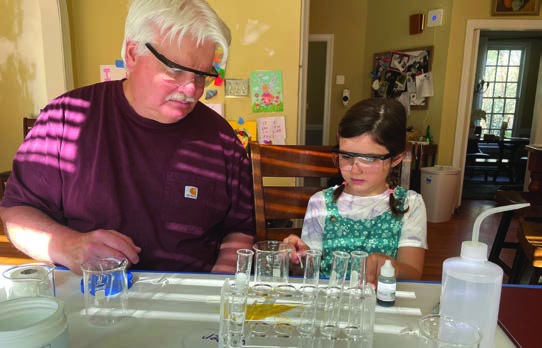
The rest of his plans were charmingly physical. He talked about woodworking, doing science projects with his grandchildren, and building “contraptions.” It is hard to imagine a better word for the off-duty habits of a clinician who spent his career asking how things might be made to work. A contraption is purpose before polish. It admits that the first version may be inelegant. It earns affection by being useful.
That instinct links the portable laser to the platform without pretending they are the same object. One fit in a vehicle. The other coordinates a distributed workforce and large flows of data. Both began by refusing to treat a barrier as somebody else's department.
Being a physician is a humbling experience.Stephen R. Fransen, MD
Fransen's career offers a restrained lesson for technology builders. Scale is not simply doing more. It is preserving the moral shape of a small, effective act while changing its machinery. In his case, that act was meeting a patient on the reachable side of the distance.
Today the vehicle is metaphorical. The care travels through a coach's call, a timely prompt, a risk signal, or a solved transportation problem. The road clinic has become a company. But the compass has not moved.