The most important piece of copy Jones Strategies wrote for Oklahoma may have been only three characters long. In 2022, a new mental-health crisis line was about to replace an 11-digit national number. The line was free, confidential and available by call or text. It was also useless if, during the hardest moment of someone's life, nobody remembered that it existed.
The assignment sounds simple until you consider its true shape: introduce 988 in six months, reach residents in all 77 counties, explain what the service was for, persuade people to use it and reassure 149 legislators that it deserved a future budget. The audience was simultaneously a teenager, a teacher, a rural parent, an employer, a health professional and the person holding a state purse string.
Jones was hired as account lead by the Oklahoma Department of Mental Health and Substance Abuse Services. It commissioned research into how Oklahomans talked about mental health, then built the machinery around the answer: brand guide, public-relations calendar, speakers bureau, advertising, community outreach, influencer activation, website and two rounds of public-service announcements. Insight Creative Group handled creative, branding, social and video under Jones's management. The slogan did not need to explain the mental-health system. It needed to make the next move feel possible.

The work after the clever idea
Jones placed the message where life actually happens: social feeds and television, certainly, but also gas pumps, coffee shops, phone booths, outdoor boards and community events. The first year closed with a Super Bowl spot. Across the wider effort, the agency reports more than 200 million impressions and 60 influencer partnerships; in the campaign's second year it logged 482 media hits, 63,448 website users and almost 130 million paid-media impressions.
The numbers that matter more are smaller. The six-month goal was 10,000 calls and texts. Oklahoma recorded 24,000. Mobile dispatches were supposed to rise by half; they doubled. Those are not vanity metrics pretending to be proof. They describe people taking the exact action the campaign was designed to produce.
Behavior beat the brief / index: goal = 100
The useful question is not “How many people saw it?” It is “What did they know to do next?”
A local firm with a long passport
Jones Strategies began in 2001 because Brenda Jones Barwick took a small piece of advice seriously. Barwick had worked in politics, in the White House West Wing and with the U.S. ambassador to Switzerland. She knew institutions. She did not know whether she could build a company. When she asked Ambassador Phil Winn how an aspiring entrepreneur could tell if she had the right stuff, his reply was pleasantly useless and exactly correct: “You don't know until you do it.”

She did it. By 2018, Barwick told a congressional committee, Jones had reached No. 109 in PRWeek's U.S. agency ranking, joined the PROI Worldwide network and landed on the Inc. 5000 four consecutive times. The company now says the Inc. count is seven. Its trophy shelf ranges from PRSA Anvils to a Cannes Gold Lion. The more consequential development was a position in the market: large enough to offer research, paid media, creative, video, public affairs and measurement; small enough to know Oklahoma's reporters, agencies, industries and rooms.
That hybrid matters when the subject is public infrastructure. A national firm can buy reach. A local shop can know why a message that works in Oklahoma City may land differently in a rural county. Through PROI, Jones can also call partner agencies across major world business centers. “National reach, human approach” is its own shorthand for this arrangement. The moat is not geography alone. It is fluency.
When the original plan meets reality
In 2020, Omni Hotels asked Jones to prepare the opening of its first Oklahoma property. Then travel became the wrong thing to sell. COVID-19 did not change the objective - fill the new hotel with interest - but it changed the audience and the story. Jones emphasized sanitation, planned a controlled ribbon cutting, supplied newsrooms with footage and recast the hotel's spa and seven dining outlets as reasons for Oklahomans to take a staycation.
The result was more than 200 media clips in under three months, nearly 15 opening-day media tours, 12 local influencer visits and a reported 33 million impressions, with entirely positive sentiment. What changed the agency's mind was not a focus group or a slogan. It was the borderless fact of a pandemic. The copyable move is to separate a goal from the first tactic proposed to reach it. Preserve the former. Be ruthless with the latter.
Name the behavior
Define what a person should remember, click, attend, call or approve before choosing channels.
Research the resistance
Test the language, stakes and local context. Mental-health stigma is not a media-planning problem.
Go where life happens
Use the gas pump and coffee shop when the message is meant for more than people already following an agency.
Measure the next move
Impressions explain exposure. Calls, dispatches, visits and return intent explain whether communication worked.
Sometimes the product is the room
Jones does not always promote an existing thing. In 2018, it decided Oklahoma's aerospace industry lacked a common stage and created the Oklahoma Aerospace Forum. The first gathering brought more than 200 executives and state leaders into a room with NASA administrator Jim Bridenstine, a congressional speaker, sponsors including American Airlines and a steering committee drawn from the industry. Nearly one million earned-media impressions followed. More importantly, the room came back.
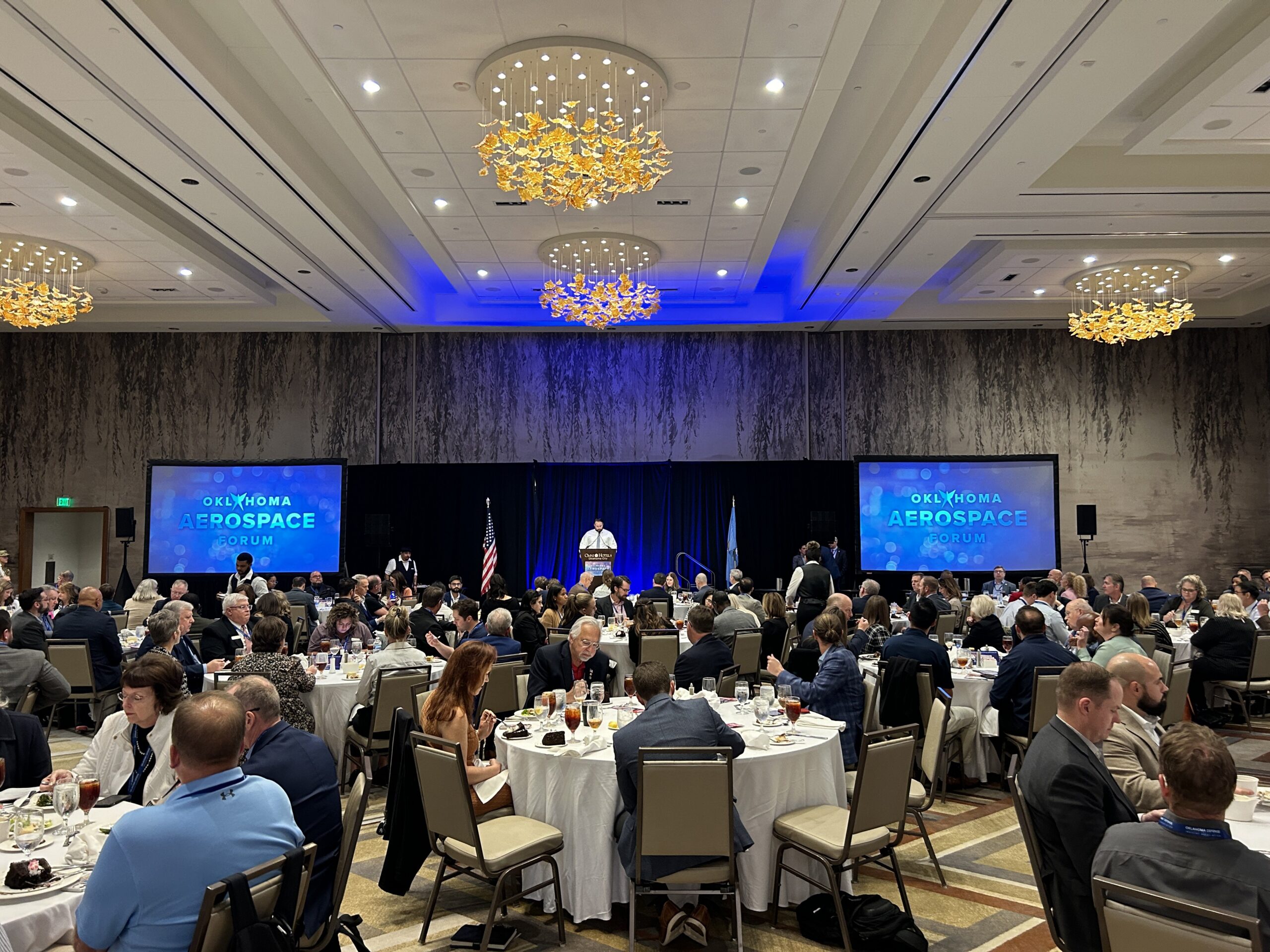
The 2025 forum drew 272 attendees representing 143 aerospace and defense companies. Jones says it will produce the ninth edition in 2026. This is agency work shading into institution building: a recurring event that generates relationships, visibility and business development for the sector while demonstrating the organizer's reach.
What the bill tells you
Private agency economics are usually hidden behind proposals. Government procurement offers a narrow window. A competed Export-Import Bank media-outreach award made to Jones in September 2024 carries a potential value of $124,341, with $25,000 initially obligated. An Oklahoma transportation report lists a separate $51,012 subcontract. The state also selected Jones for a mandatory advertising and marketing contract running from 2024 through 2029, covering web, social, creative, integrated marketing, media buys and outdoor advertising.
Potential value of one federal media-outreach award. Scope, duration and procurement route make it a clue, not a menu.
The business model is the familiar agency mix of retainers, projects, production, media and government work. The differentiator is how the pieces are assembled. Jones can train an executive, place an op-ed, buy an audience, build a brand system, manage creators, convene stakeholders and report on performance without handing the client a relay baton between specialist firms. In 2026 it added AI policy, workflow integration and team training to that list - less robot confetti, more operating procedure.
This approach is strongest when communication is not merely decorative: a public service must be used, a regulated project needs consent, a technical industry needs a constituency or a new destination needs local permission to matter. It is less distinctive for a company seeking a single clever ad, a quick commodity press release or global consumer scale without a local or institutional component. Jones's best work begins when the audience has reasons to be cautious.
The name finally caught up
At the start of its 25th year, Jones Public Relations became Jones Strategies, moved offices and refreshed its identity. The legal company still bears the old name. The public brand now describes the job more accurately. Public relations remains in the tool kit, but a 988 launch is also research, service design, coalition management, advertising and political durability. An aerospace forum is also a product. A hotel opening during a pandemic is also a lesson in changing the frame before reality changes it for you.
There is a temptation in communications to celebrate the message. Jones's more useful habit is to study the handoff between message and behavior. A person sees yellow, remembers three digits and makes a call. An executive enters a ballroom and meets an industry. A local resident looks at a downtown hotel and sees a weekend away rather than a trip they cannot take. Attention is only the opening. The business is what happens next.