A computer processor is a merciless place to learn about waiting. Every delay has a price, but the prices are not equal. Some missing pieces of data can be fetched while other work carries on. Another missing piece may leave the whole machine tapping its foot. Danny Lynch learned to distinguish between the two. Before he became the co-founder and chief technology officer of The Helper Bees, before his working vocabulary filled with insurance claims, provider networks and digital invoices, he studied the expensive little pauses inside computers.
That origin matters because Lynch’s career can look, from a distance, like a sharp turn: graduate research in computer architecture, chip design at Intel and NVIDIA, then a company concerned with the practical business of helping older adults remain at home. Up close, the line is straighter. He has kept asking a version of the same question. Where is the delay that actually hurts, and what would a system look like if it knew the difference?
01 / The costly pauseA researcher learns to rank the delays
In 2003, Lynch was a teaching assistant in a University of Texas at Austin computer architecture course. Two years later, he completed a Master of Science in Engineering in the university’s High Performance Systems group. It was a formidable neighborhood for someone interested in what happens below the surface of software. The group, led by computer architect Yale Patt, studied the intimate mechanics of performance: instructions, memory, prediction and all the bargains a machine makes to appear instantaneous.
Lynch’s most visible piece of that period arrived in 2006. With Moinuddin Qureshi, Onur Mutlu and Patt, he co-authored “A Case for MLP-Aware Cache Replacement,” presented at the International Symposium on Computer Architecture. The title requires unpacking. A processor keeps frequently needed data in a small, fast cache. When the data is absent, the machine suffers a cache miss and must look elsewhere. Traditional replacement rules largely cared about recency. The paper argued that the system should also care about context.
Not every wait blocks the room.
If several memory requests are already moving together, one delay may be absorbed by the others. An isolated miss can be far more expensive. Lynch and his co-authors proposed a low-overhead method that let the processor adapt its replacement policy to that difference. In their evaluations, the approach improved performance by as much as 23 percent.
The important word is not “cache.” It is “aware.” The work treated a blunt rule as a design failure. Cost depended on circumstance, and a better system could observe that circumstance while it operated. This is a compact lesson in engineering and, as it turns out, a rather good lesson in companies: the queue is not the experience. The person waiting is the experience.
02 / Leaving the labSilicon, then the unruly world
Lynch went on to Intel and NVIDIA, helping design the next generation of computer chips. The public outline is spare, but the nature of the work is legible. Chip architecture punishes vagueness. Decisions collide with physical constraints. A beautiful theory must survive power budgets, timing, heat and the expectations of software written by people who will never see the circuitry. The job trains an engineer to think in dependencies and bottlenecks, with little patience for magic.
Then, in 2015, Lynch co-founded The Helper Bees in Austin with Char Hu and Eric Corum. The founding team brought software backgrounds to an industry still rich in paper, phone calls and disconnected transactions. Hu and Corum had experience building services for older adults. Lynch brought the architect’s eye. Together, they began building technology that could help those services scale.
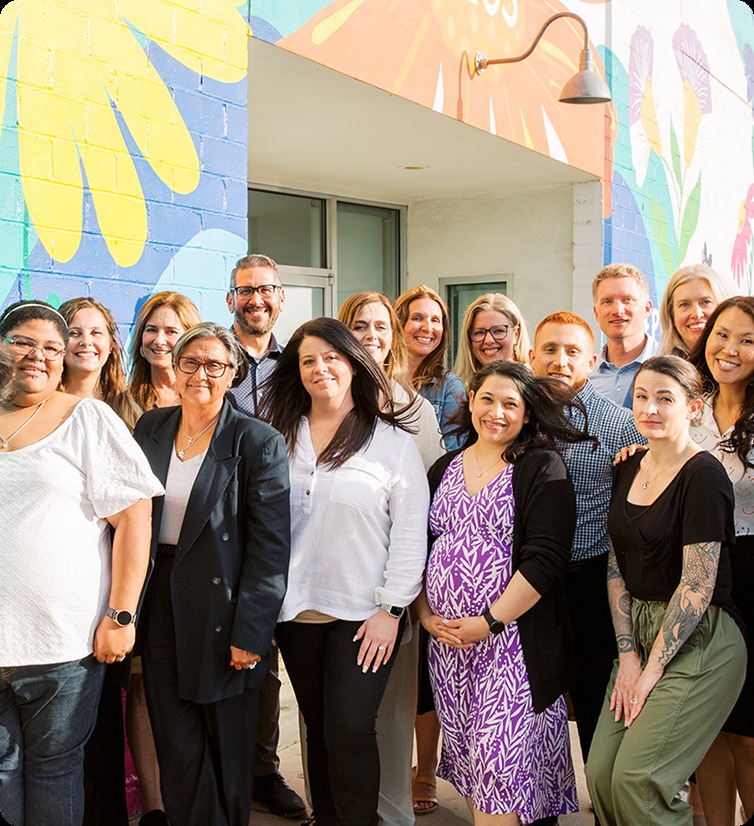
The problem they chose was almost perversely unlike a processor. Home services are local, variable and full of human exceptions. Insurance is regulated, documented and cautious. Providers must be found and checked. Services must be ordered and scheduled. Work must be confirmed. Invoices must make their way to the right payer. A product can look smooth on a screen while one broken handoff quietly ruins the day.
The architecture of a promise
The hard part is not drawing the arrows. It is making every arrow reliable.
03 / Coordination as productThe software must survive Tuesday afternoon
The Helper Bees grew around those handoffs. Its offerings came to include remote and in-person assessments, digital invoicing, provider credentialing, a marketplace for services, care coordination and payment tools. For long-term care insurers and other payers, the pitch was not technology as decoration. It was technology as connective tissue.
Lynch now leads all of the company’s software engineering development. His official description pairs “deep technical expertise” with “relentless curiosity,” then supplies a more revealing detail: he is as likely to descend into a small operational problem as a complex technical one if it improves the customer’s experience. It is easy to call that perfectionism. It is more useful to call it systems maintenance. A national platform is simply a local failure repeated at scale unless someone is willing to follow the small fault to its source.
His old research offers a helpful metaphor, though there is no reason to believe he walks around the office speaking in cache policy. A missed step in one workflow may be harmless because other work can proceed. Another missed step stops everything. The engineering task is to recognize the difference soon enough to do something about it.
Numbers make the scale visible, but they can also make it abstract. Twenty thousand providers are twenty thousand sets of credentials, specialties, schedules, service areas and transactions. Forty-three payers bring distinct rules and populations. The software has to make diversity manageable without pretending it has disappeared. The task is less like inventing a single machine than conducting an orchestra whose musicians are spread across the country and have never met.
04 / The next load testWhat $35 million is really buying
The Helper Bees’ financing tells its own compressed version of the story. A $6 million Series A arrived in 2020. A $12.8 million Series B followed in 2022. In January 2025, the company announced a $35 million Series C led by Centana Growth Partners, with participation from existing investors. The money was earmarked for expanding the platform, growing its provider network, developing payment tools and entering Medicaid.
A funding round is often reported as a trophy. For a CTO, it is closer to an incoming load test. More markets mean more rules. More providers mean more edge cases. Payment innovation brings its own demands for reliability. The architecture must stretch without turning every improvement into a fresh point of failure. Capital purchases time and people; it also purchases a larger set of promises to keep.
That makes Lynch’s path from chips to services feel less like reinvention than enlargement. The units changed from nanoseconds to appointments, from cache blocks to provider records. The consequences became easier to see. Yet the design discipline remained: observe the system under pressure, distinguish the critical delay from the tolerable one, and resist the comfort of a rule that treats every situation alike.
05 / The dog clauseA serious engineer, with one useful exception
There are small public clues to the person outside the architecture diagrams. His LinkedIn handle, “danny31415,” turns the opening digits of pi into a tiny signature. A startup profile lists interests in investing, breweries and technology. His company biography ends with a joke from his colleagues: given the choice, he might prefer the company of a dog over humans.
The line is funny because executive biographies usually sand away preference. They replace quirks with principles and turn people into laminated values. A dog, at least, has no interest in a roadmap. It offers a different kind of systems feedback: immediate, sincere and generally solved by a walk.
Lynch’s documented career leaves many of the usual profile ornaments off the table. There is no public manifesto, no stream of aphorisms, no personal brand competing with the company. What remains is work and a pattern within it. A graduate student studies why apparently similar delays have different costs. A chip architect learns to build under hard constraints. A founder applies software to an industry whose complexity lives in the handoffs. A CTO earns a reputation for noticing the small thing that could make the experience better.
The pattern is not glamorous, which may be why it is useful. Most consequential technology does not announce itself at the doorstep. It has already done its work when the right provider has been found, the paperwork agrees, the payment mechanism functions and the promised service arrives. The desired outcome is almost ordinary. Tuesday afternoon proceeds as planned.