The short version
- Home365 manages single-family rentals for owners who want fewer operational chores and more predictable cash flow.
- Profit Protect bundles management, rent protection and defined repair, leasing and turnover coverage into a property-specific monthly rate.
- The alternative Traditional plan costs less at baseline but leaves repairs and vacancy risk with the owner.
- The reusable idea is incentive alignment: when poor execution costs the manager money, the dashboard becomes more than decoration.
A landlord can plan for a mortgage. A landlord can plan for taxes. What the spreadsheet resists is Tuesday at 2:13 a.m., when a water heater develops a personality and the tenant discovers urgency. The repair invoice is only one cost. There is the empty unit, the missed rent, the second contractor, the uncertain week. Home365 began with a shrewd observation: rental ownership is marketed as passive income, yet its expenses arrive like improvisational theatre.
So the company made uncertainty into the product. Under its Profit Protect plan, Home365 quotes a monthly rate tied to the property and its rent, then combines ordinary management with guaranteed rent and a defined set of operating costs. Covered categories include work inside the four walls, major appliances, tenant turnover, leasing and the first eviction filing. The owner gets one number. Home365 gets the risk that its number is wrong.
The first thing to fail was the fee logic
Traditional property management has a familiar division of labor. The manager finds a tenant, collects rent, coordinates a repair and sends the owner the bill. It can work perfectly well. But the incentives become strange at the edges. A long vacancy hurts the owner first. A poor repair creates another paid repair. A weak tenant can still generate a placement fee. The manager is paid for doing things, while the landlord cares about what remains after those things are done.
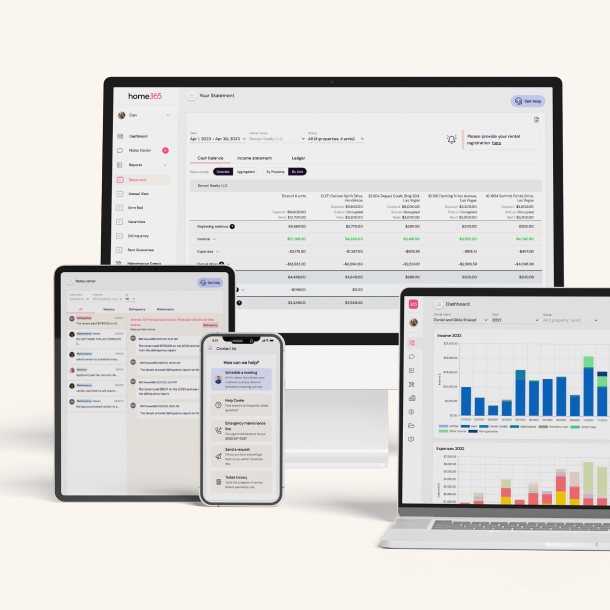
Home365 changed the unit of sale. It did not simply offer a faster maintenance ticket. It offered a narrower range of financial outcomes. That is why calling it “property-management software” misses the point. The software is the nervous system: owner dashboards, tenant payments, video maintenance requests, vendor bids, before-and-after evidence and property-level financials. The commercial idea sits one layer above it. If Home365 underprices a covered problem, Home365 feels the mistake.
The clever part is not predicting every broken appliance. It is deciding, in advance, who pays when the prediction is wrong.

The product is a loop, not an app
Founder and CEO Daniel Shaked describes a system that looks at a home’s age, location, renovations and appliances. Earlier company materials said the underwriting process used more than 40 data points. The quote creates a hypothesis about future cost. Then the operating platform observes what actually happens: which tenants pay, which systems fail, which vendors solve a problem once and which create a sequel.
The operating loop
Conceptual flow, not a disclosure of Home365’s proprietary model. The advantage depends on each pass improving the next quote and the next service decision.
This helps explain the 2021 purchase of SlateHouse Property Management and Realty. Home365 raised $16.3 million and acquired an operator that took the combined company to a reported 7,000 units across 14 metro areas. SlateHouse brought local operating density, people and properties. Home365 brought a common platform and underwriting ambition. One year later, the company raised a $26 million Series B led by Viola Growth, saying it would invest in technology, hiring and expansion.
What it costs depends on what might go wrong
There is no universal public rate card for Profit Protect. Home365 says it quotes each property and prices the plan as a percentage of rent. An owner can choose a higher deductible to reduce the monthly premium. Its portal is included with management at no added charge. For comparison, Home365’s own 2026 guide places conventional management at roughly 8 to 12 percent of monthly rent, often with separate tenant-placement and repair charges. That is market context, not a Home365 quote.
Profit Protect
Higher predictability. One property-specific rate bundles management with guaranteed rent and defined operating coverage. Best suited to owners who value a capped downside and less participation.
Traditional
Lower baseline commitment. Home365 still runs leasing, collection, maintenance and reporting, while the owner pays repair and vacancy costs as they occur.
The contract boundaries matter. Current guidance says Profit Protect may cover up to $10,000 in annual maintenance, while terms vary by agreement and property. Public program documents describe waiting periods, event and annual limits, deductibles and exclusions. Roofs, foundations, siding, landscaping, pools, pest control, trash removal and cosmetic upgrades sit outside the current headline coverage. This is not a magical house shield. It is a defined transfer of selected risk.
Read this before the sales call
Ask for the written fee schedule, deductible, waiting period, annual cap, appliance rules, termination fee and market-specific exclusions. Predictability is only as useful as the boundary around the promise.
Who buys the calm?
Home365 now says it focuses on owners of roughly one to ten single-family homes. This is an important constraint. A large institution can employ asset managers, negotiate national vendor contracts and hold cash for ugly quarters. A person with three houses has less diversification and no appetite for a surprise HVAC replacement during a vacancy. Home365 sells that person an operating department and, with Profit Protect, a budget.
The tenant sees a different product: a portal for rent, documents and maintenance requests. The service provider sees jobs, videos, scheduling and payment. A foreign investor can also encounter Home365 through Lendai, whose 2023 partnership joins U.S. financing with property search and management. The company’s marketplace has promoted related offers from landlord insurers and investment platforms. The ambition is not merely to manage the house after purchase. It is to remain in the workflow around the asset.
The part worth copying
A founder does not need an AI underwriting engine to borrow the most valuable parts of this model. The pattern is visible.
- Find the variance customers hate. Home365 chose vacancy, repairs and turnover, not a prettier task list.
- Narrow the promise. Single-family rentals and specified interior costs are underwritable in a way that “everything about every building” is not.
- Control the workflow. Pricing a risk without controlling screening, rent collection, maintenance evidence and vendors is an invitation to lose money.
- Make the boundary visible. Caps, waiting periods and exclusions are not footnote trivia. They define the product.
- Keep humans near the exception. Home365’s own formulation is sensible: technology enables its team rather than replacing the human touch.
The approach becomes less attractive when an owner has deep reserves, likes choosing every contractor, owns unusual or exterior-heavy properties, wants short-term or commercial management, or simply prefers the lowest monthly fee. It also depends on local execution. A national dashboard cannot tighten a loose valve. Vendors, response times and judgment remain stubbornly physical.
That is the useful paradox of Home365. The company raised money around AI, automation and predictive analytics, but its promise is tested in kitchens and basements. The landlord is not buying certainty. Houses do not permit that. The landlord is buying an agreement about which surprises belong to someone else.