The first thing Debbie Anglin's future company earned was not money. It was restaurant credit. In the late 1990s, Anglin worked at an Oklahoma City advertising agency that declined a would-be restaurant client. She could not quite decline him herself. She helped on the side, took gift cards in return, and watched the business gain traction. Then other founders heard. Within months, she was doing nearly 30 hours of freelance work around a job that already consumed more than 40.
The arithmetic was unpleasant, but the signal was clean. The market had a category of customer whose problems were real even when their accounts did not look large enough for a conventional agency. Anglin gave notice, transferred her duties and, in January 1999, opened Anglin Public Relations from her living room.
It is tempting to turn this into a story about entrepreneurial nerve. The more useful reading is about attention. The established agency noticed account size. Anglin noticed unmet need. The first thing that failed was not her campaign; it was the sorting mechanism that decided which clients deserved help.
“I figured that while I was betting on other businesses to succeed, I should bet on my own as well.”Debbie Anglin, founder and CEO
01 / The actual productClarity is sold by the hour, but earned in the field
Today, Anglin is a small, full-service marketing and PR firm with a broad menu: research, focus groups, communication planning, message development, media relations, crisis response, community outreach, websites, social media, paid digital, influencer work and creative production. But a menu is not a theory. Anglin's theory is that tactics should arrive after somebody has made the problem legible.
That sequence distinguishes the firm from a production shop hired merely to fill a feed, and from a traditional publicity boutique that stops at earned media. Anglin can interview an audience, help an organization decide what to say, coach the person saying it, build the website that holds it and buy the distribution that carries it. The customers are businesses and associations, but also nonprofits, housing authorities, economic-development groups and local governments - institutions that often need understanding before they need impressions.
Consider Watch for Me OK, a bicycle and pedestrian safety effort for the Association of Central Oklahoma Governments. The brief was not “sell more helmets.” It was to teach drivers, cyclists and pedestrians to share roads amid rising crashes, injuries and deaths. Since 2020, Anglin's work has included a refreshed identity, a website, original video and photography, influencer partnerships, paid and organic social media, media relations, municipal outreach and surveys. The campaign required many channels because the problem lived in many minds.
02 / A crisis-shaped instinctThe message has to survive contact with real life
Four years before she founded the firm, Anglin worked for the American Red Cross of Oklahoma. On April 19, 1995, the Alfred P. Murrah Federal Building was bombed. Her job changed immediately. She became a liaison to local, national and international media, explaining the response, the need and a community improvising care in public.
She remembers volunteers leaving mints on the beds of firefighters housed at the old convention center. It is a small image inside an enormous tragedy, which is precisely why it travels. Good public communication makes scale human without making suffering decorative. That experience helps explain the firm's comfort with assignments involving mental-health stigma, affordable housing, criminal-justice reform and public safety. These are not subjects improved by a louder adjective.
It also clarifies Anglin's market position. Oklahoma City has larger integrated agencies, specialist boutiques and in-house public information teams. Anglin occupies the middle: a compact firm with enough disciplines to execute a campaign, but a PR foundation that treats credibility, timing and stakeholder response as design constraints. Its local knowledge matters most when a message needs to move through city departments, community partners, reporters and residents without becoming unrecognizable.
03 / The numbers become visibleWhat public work costs
Agency prices usually disappear into private scopes of work. Anglin's government assignments offer a partial window. In December 2020, ACOG authorized a nine-month agreement for the road-safety campaign at no more than $76,000, funded through a federal safety grant. That covered branding, video, social marketing, print design and related services.
A separate 2025 expenditure record for the Oklahoma County Criminal Justice Advisory Council listed Anglin invoices of $3,450 for January social-media and website services, $2,450 for February and $3,450 for March. These are examples, not a rate card. They do, however, make the business model concrete: scoped campaigns sit beside recurring service work, while research, creative production and media costs expand or contract with the assignment.
A rare look at the invoice
Social-media and website services for one public-sector client. Separate example: up to $76,000 for a nine-month, multi-channel safety campaign.
The firm is privately held and has disclosed no outside funding. That makes its product people and process, not proprietary software. It also means growth has to be absorbed carefully. In 2019, Anglin said its staff had nearly doubled from the year before, adding capacity in strategy, research, data analysis, content and digital marketing. The expansion changed what the company could deliver without changing what it believed it was selling.
04 / The agency becomes the clientA rebrand is a management problem wearing a nice shirt
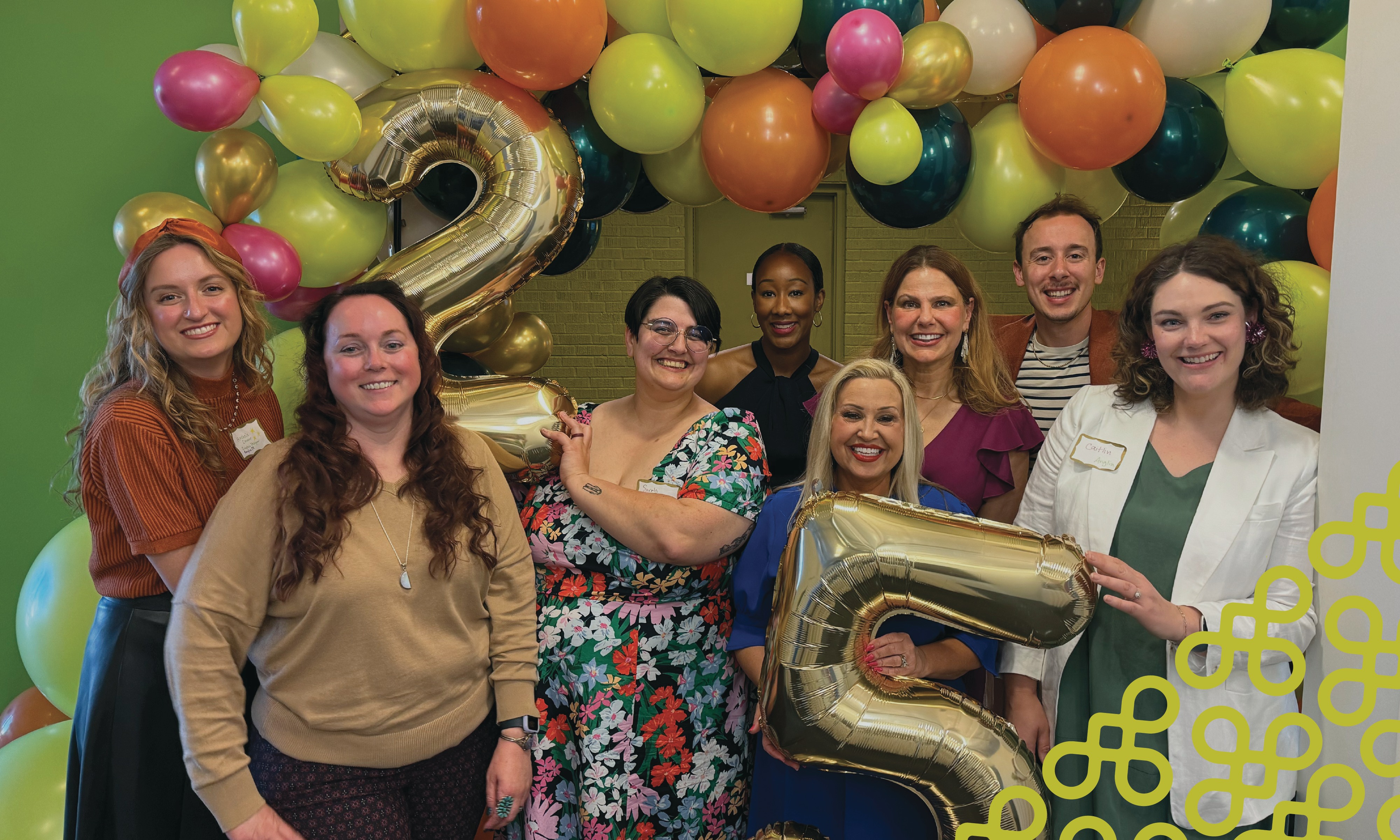
For its 25th anniversary in 2024, Anglin simplified its name, replaced its visual identity and updated the machinery around it: website, signs, stationery, social templates, email signatures, newsletters and presentation decks. Then it threw a party, because a milestone without catering is merely a deadline.
The amusing part was the role reversal. Debbie Anglin found herself wanting the identity to fit perfectly, watching expenses arrive and hoping the investment would lift the business. The experience changed no grand philosophy. It sharpened some practical ones. The team divided the rollout into discrete projects. Many people could offer input, but one person owned the final decision for each. They documented the making of the brand so the process itself became content. They used small artifacts - new-color macarons, custom prosecco labels, a time-lapse of the office logo being painted - to give an abstract change a physical life.
This is Anglin's most copyable playbook beyond branding: separate understanding from execution. Ask what the audience already believes. Name the behavior that must change. Decide who is credible enough to carry the message. Give one person authority over each moving part. Measure whether people noticed, understood or acted - three different questions that lazy campaign reports often collapse into one.
A candid fit check: this approach is strongest when an organization has multiple stakeholders, a complicated message or a need for local trust. It is less compelling for a company seeking only high-volume performance ads, a global 24-hour press office, or a vendor that will publish without asking inconvenient strategic questions. Collaboration is part of the product; a client unwilling to share context will buy only the surface of it.
05 / The durable ideaThe overlooked client was the strategy
Anglin did not begin because Debbie Anglin invented a medium. It began because she disagreed with a rejection. A restaurateur needed help; the agency model said no; she found a smaller exchange that let the work happen. The gift cards are a charming detail, but they also reveal the company's enduring logic: the value of a communications problem is not always visible in the first invoice.
Twenty-five years later, Anglin still talks about fit before volume. That is not pure altruism. A small agency cannot survive every mismatched account. Its advantage depends on choosing work where research, regional relationships and patient explanation have economic value. When that condition holds, the firm can do something a platform cannot: hear the knot in a client's story, understand the community around it and pull the correct end of the string.