There is a particular danger in becoming the boss of a fast-growing company: the higher the title, the farther away the work can become. Brad Diephuis has spent his career moving in the opposite direction. He has crossed from electrical engineering into computer science, from a hospital floor into a startup, from federal policy into company operations. Yet the thread running through those moves is remarkably consistent. He likes systems, but he distrusts altitude.
When Diephuis became chief executive of Thyme Care on September 1, 2026, he inherited a business that had ceased to be small in almost every measurable way. The company had more than 800 employees, 14 clients and over 125,000 members. Its services were available to 10.5 million people across all 50 states. Days after he officially took the chair, Thyme Care announced a Series E of more than $125 million at a valuation above $2 billion.
Those are balcony numbers. Diephuis prefers the view from the floor. He talks about understanding what a care partner experiences while using the company's software for 40 hours a week. He wants to know how a provider encounters the operation and how a member experiences the service between formal appointments. His stated task is not merely to make the organization larger. It is to make sure that size does not sand away the useful details.
“I’m not somebody who likes to fly at 50,000 feet and stay there.”Brad Diephuis, on his approach to the CEO role
A curriculum built out of detours
The neat version of a career is a ladder. Diephuis's looks more like a wiring diagram. At Harvard, he completed an undergraduate degree in electrical engineering and a master's in computer science through an accelerated program, finishing both in four years. He graduated in 2008 into a world suddenly short on easy career plans. His early work included a medical-device startup, product management, quantitative trading and mathematical-modeling research at Massachusetts General Hospital.
Returning to Harvard in 2011 for medical school did not mean abandoning the engineer's instinct. He joined the Harvard-MIT Health Sciences and Technology program, served as president of the medical-school student council and completed an MBA alongside the medical degree. He was already practicing an unusual kind of bilingualism: able to discuss a system in terms of both the human task and the mechanism underneath it.
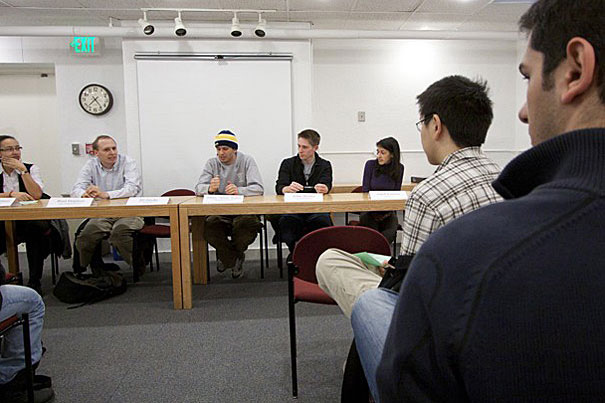
At an engineering alumni event that year, Diephuis told students, “Doing as many different fields as possible while you're here is a good idea.” It reads now like a line planted by a screenwriter who worried the theme was too subtle. The amusing part is that Diephuis did not merely sample fields. He kept turning the seams between them into jobs.
A hackathon with consequences
Herald Health began in 2015 during a hackathon at Brigham and Women's Hospital. The problem was mundane in the way that serious problems often are. Clinicians were surrounded by data but still had to hunt for what mattered. Herald's software sat on top of electronic medical records and allowed clinicians to create customized alerts. Instead of endlessly pulling information from a system, they could ask the system to push the useful signal to them.
The company was tiny. It was also unusually good at collecting institutional proof. Herald won the health and life-sciences grand prize in Harvard's 2016 Deans' Challenge, received $30,000 and time in the university's innovation lab, and won the federal Provider User Experience Challenge. It ran pilots at Brigham and Women's and Boston Children's. Persistent Systems acquired it in 2018.
That episode offers a compact preview of Diephuis as an operator. Start with the person's work, not the vendor's grand theory. Make the tool fit the existing workflow. Prove it inside demanding institutions. Then find a structure that can carry it farther. Even the product's affection for the pager, that sturdy cockroach of hospital technology, suggested a certain respect for reality. Digital transformation is easier to admire when it does not demand that everyone else transform first.
After the sale, Diephuis worked at Persistent as an associate vice president in healthcare and life sciences. He also completed his internal-medicine residency at Brigham and Women's Hospital. In 2021 he moved to the Center for Medicare and Medicaid Innovation, where he worked on the federal government's approach to total-cost-of-care payment models, including the program that became ACO REACH.
The route had now supplied him with four distinct vantage points: the engineer's system, the clinician's workflow, the founder's scarcity and the policymaker's incentives. Thyme Care offered a place where all four could become relevant before lunch.
The operator arrives
Diephuis joined Thyme Care in 2022 as chief business officer, two years after Robin Shah and Bobby Green founded the company. He is careful about this point. He did not invent Thyme Care. Shah and Green had already formed its thesis, assembled an early team and built a clinical model. What Diephuis joined was a promising machine that needed to become repeatable.
At the time, Thyme Care had about 70 employees, two payer contracts and fewer than 2,000 members. Diephuis worked on commercial partnerships and the mechanics of expansion. In 2024, he became president and chief operating officer, overseeing a broader sweep of operations as the business grew. By the time of his CEO appointment, the numbers had changed category.
The financial architecture grew with the operation. Thyme Care reported managing more than $7 billion in oncology spend by September 2026. The company said its model produced validated reductions of 5 to 10 percent in total cost of care and that it had reached profitability. These are company-reported figures, but they explain the caliber of investors around the Series E: Morgan Health led the round, with Humana, CVS Health Ventures, a16z Bio + Health and others participating.
Diephuis describes the expansion with the sobriety of someone who knows growth creates its own homework. Quality processes must become explicit. What worked through direct communication among 70 people needs another form at 800. The organization must become more sophisticated without becoming ceremonial. It is one thing to be close to the work when the whole company fits into a moderately ambitious group chat. It is another when the staff could fill a theater.
“We’ve always believed that growth should be the result of delivering value, not the goal itself.”Brad Diephuis
The promotion that rearranged the founders
The 2026 leadership change was designed as continuity with more room around it. Diephuis took charge of Thyme Care's core business. Shah, the outgoing CEO, became executive chairman and turned his attention to new ventures. Green remained president and chief medical officer. The arrangement acknowledged two different kinds of company-building: one that invents the next line of business, and one that makes the established line durable.
In September, the architecture acquired a name. Thyme Companies became the parent for a broader portfolio, with potential businesses aimed at drug affordability and clinical-trial access. Thyme Care remained the anchor, with Diephuis responsible for extending its existing work across Medicare and commercial markets while making the service deeper for current members.
His relationship with the founders matters here. Diephuis credits Shah and Green with willing the original vision into existence. They, in turn, handed him the operating controls. It is a succession story with little appetite for Shakespeare. Nobody had to be exiled, poisoned or discovered in a car park with a dagger. Shah stayed to build; Green stayed to lead the clinical work; Diephuis moved one chair over and accepted the accountability.
The harder drama will unfold quietly. Can Thyme Care keep its promised quality as the company expands? Can evidence keep pace with marketing? Can the chief executive still hear the small friction in a worker's day once strategy meetings, financing conversations and board materials crowd the calendar? Diephuis has supplied a clear standard for judging him: “Ambitious vision only succeeds if you pair it with disciplined execution.”
The useful distance
The most distinctive thing about Diephuis may not be the number of disciplines on his resume. Plenty of polished biographies are made from accumulated nouns. His career is more interesting as a repeated act of translation. He has moved information from records toward clinicians, policy logic toward operating models, and founder vision toward repeatable process.
He also has a dry line for the industry's habit of naming companies after friendly objects. With the good names apparently exhausted, he jokes, founders choose an inanimate object and add “care,” “health” or “well.” Thyme at least has the virtue of warmth, and of making an excellent pun under pressure. The charm of the joke is its small rebellion against the solemnity that can cling to healthcare executives.
Yet his central idea is serious. Scale should not become distance. A chief executive must see the whole system, but the view is worthless if people disappear inside it. Diephuis has spent nearly two decades acquiring ways to look: through circuitry, software, clinical work, payment policy and operations. The CEO job now asks whether he can hold those perspectives at once.
At 50,000 feet, a growing company can look wonderfully smooth. The useful view is lower, where every process has edges and every promise meets a person. Diephuis has made that altitude his declared territory. The next chapter will be measured by how close he can stay.