The first useful thing to know about Matt Kaufman is that he once billed his time in six-minute increments. Before startups and software launches, before conference stages and marketing teams, he practiced private-equity law at O’Melveny & Myers. It is difficult to imagine a better apprenticeship for taking words seriously. In law, a stray phrase can alter an obligation. In marketing, a stray phrase can alter a market’s understanding. Kaufman moved from one profession to the other without abandoning the central craft: making a complicated case coherent.
His career does not follow the tidy ladder that professional biographies prefer. It bends from a BA in psychology at the University of Virginia to a JD at Fordham, from a global law firm to Goldman Sachs, then across legal services, consumer internet, title-and-escrow software, financial planning technology and surgical technology. The sectors change costume. The underlying problem barely changes. Each is dense with specialists, rules and consequential decisions. Each needs someone who can translate without turning the substance into soup.
Kaufman’s early professional years supplied the grammar. He worked as a private-equity attorney in New York from 2004 to 2007, earning an Empire State Counsel Award for pro bono service, then joined the investor-relations and reporting side of Goldman Sachs’ Private Equity Group. One job trained him to interrogate the claim; the next trained him to explain an intricate financial machine to people with money and questions. Neither title contained the word “marketing.” Both jobs plainly involved it.
The brief became a product
In 2010, Kaufman joined Rocket Lawyer. The move put him inside a company trying to make legal services easier to obtain and easier for professionals to deliver. He led attorney services as a senior product manager, then directed marketing for small-business services. Here the résumé’s apparent swerve begins to look like a straight road. He knew the professional problem from the inside. Product work let him redesign it; marketing let him describe why the redesign mattered.
That duality became a habit. Kaufman does not speak of marketing as the department that arrives after the product is made, carrying adjectives and a launch date. He has said he treats a marketing organization like a product organization: experiment with new channels, test new tools, and keep creating opportunities for the people doing the work. The model is restless by design.
“The best thing you can do is to be unsatisfied with the status quo.”Matt Kaufman on building marketing teams
There is a practical reason for the restlessness. In a young company, he observed, marketing often consists of one person per discipline. One hire may carry product marketing; another, demand generation. Get the appointment wrong and an entire function limps. Get it right and the specialist still has to speak several neighboring dialects - product, engineering, sales and customer success. Kaufman’s marketer is less a megaphone than a switchboard operator with taste.
A career in translation
Twenty people, foldout chairs
Qualia was the long chapter. Kaufman joined the San Francisco company in 2017 as an early employee charged with building marketing from the ground up. The subject was the real-estate closing, a phrase that can drain a dinner party with astonishing efficiency. Beneath it sat a crowded network of title agents, escrow officers, lenders, real-estate agents, buyers, sellers, documents, payments and security obligations. Qualia’s ambition was to place that network on one digital platform. Kaufman’s assignment was to make the ambition legible.
When he later looked back, he did not reach first for polished corporate milestones. He remembered roughly 20 people, a tiny room and foldout chairs. He set those images against what followed: more than 400 employees, thousands of customers, millions of transactions, a progression from regional upstart to national company and from one product to several. The list included headwinds, tailwinds and debates over the Oxford comma. A neat growth curve is lovely on a slide. Living through one is more like reorganizing the plane during flight while arguing about punctuation.
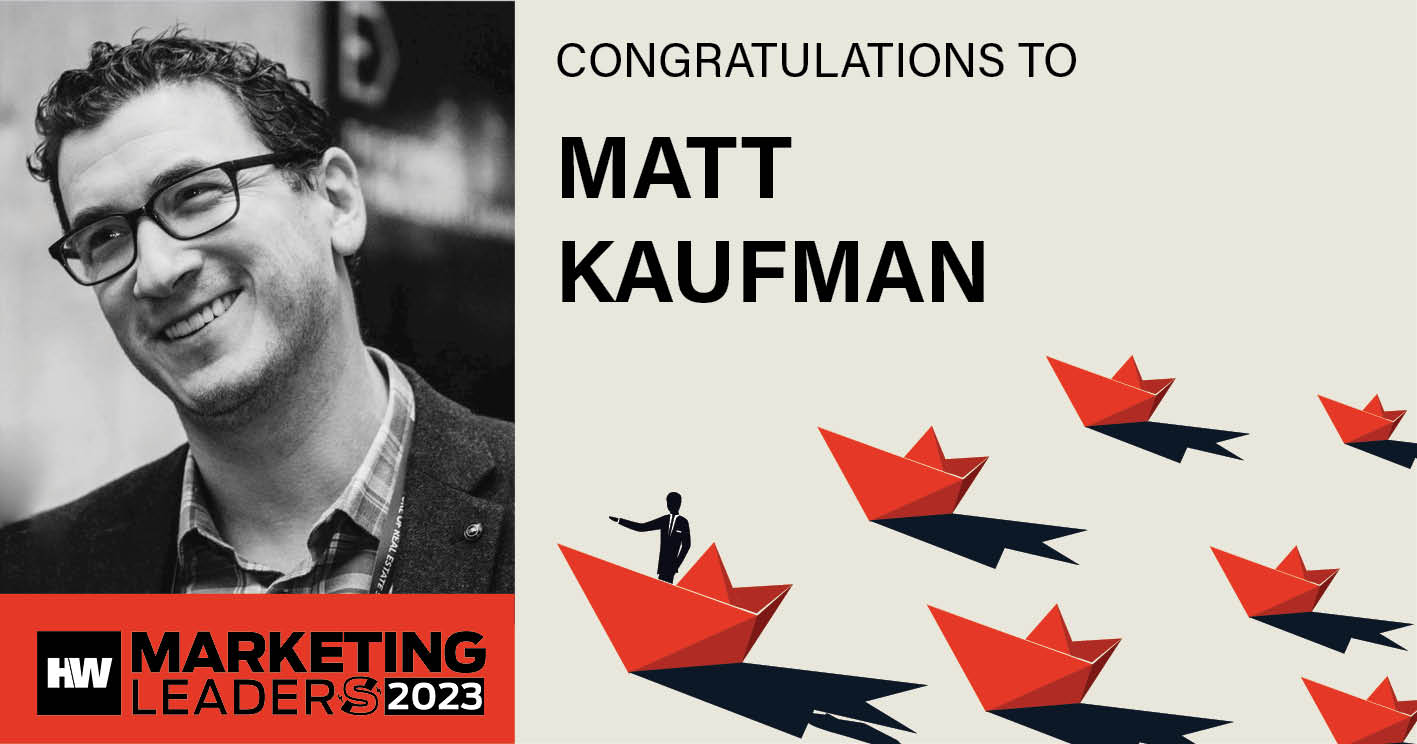
His remit grew across brand, product marketing, communications, demand generation, events and customer marketing. HousingWire credited his go-to-market and brand work as Qualia became a platform used by more than one million real-estate professionals and reached a valuation above $1 billion. In 2023, the publication included him among its Marketing Leaders. Those figures explain scale. They do not quite explain the move that made Kaufman’s work distinctive.
Build the room, not only the campaign
Kaufman designed and led the team behind the Future of Real Estate Summit, known as FORES. It began as an annual gathering and expanded into year-round programming. Economic experts and technologists shared the program with title and escrow leaders, lenders, proptech companies and brokerages. Kaufman moderated conversations, including one with Magic Johnson about business and community development. A software company had become a convenor.
This is category marketing at its most durable. The company does not spend all its breath praising the company. It creates a room where customers and partners can understand the forces changing their work. The product remains present, but the community gets the microphone. Trust accumulates in the space between the sessions.
The strategy fits Kaufman’s broader view of B2B marketing. A long customer journey contains many handoffs and many chances for confidence to leak away. Brand cannot be separated neatly from recruiting, customer education or product experience. During one hiring project, Kaufman praised recruiters who knew when to push and when to wait. The compliment is revealing. Momentum mattered; so did judgment.
A lawyer learns that every word carries a consequence. A marketer learns that every handoff does too.
His 2023 departure from Qualia carried the same combination of velocity and care. Kaufman wrote that mentors helped him decide when to leave and that he hoped to return the favor. He thanked Qualia’s co-founders, described a deliberate transition to a new marketing leader and said he would remain an advisor. He also wanted to invest in the alumni community. It was a farewell built around continuity, not a theatrical escape through the office window.
The industries change; the assignment stays
Kaufman next became chief marketing officer at Cube, the FP&A software company. The audience changed from closing professionals to finance teams, but the familiar ingredients remained: technical software, high-stakes numbers, multiple internal constituencies and a buyer with little patience for decorative fog. Cube described him as a storyteller, coach and operator who builds teams that partner closely with sales, product and customer success. It is an unusually accurate three-word sequence. Story without coaching remains copy. Coaching without operations remains encouragement. Operations without story is a spreadsheet nobody opens.
By 2025 he had moved again, this time to Proprio as chief marketing officer. Proprio develops surgical technology that combines imaging, computer vision and artificial intelligence to help clinicians see and navigate during procedures. Kaufman’s public announcement emphasized the technology, the team and the work still ahead. The setting is new; the translation problem is almost archetypal. Engineers, clinicians, regulators, hospital leaders and the public need different levels of detail, but they must still arrive at the same truthful picture.
Viewed from a distance, Kaufman’s career hops sectors. Viewed from the workbench, it stays put. He gravitates toward expert systems that ordinary people encounter at consequential moments: seeking legal help, running a business, buying a home, planning a company’s finances, entering an operating room. He builds the connective tissue around the product - language, teams, events, customer education and cross-functional habits.
There is also an evident preference for useful communities. He co-founded and served on the board of the Dave Nee Foundation, advised Fordham’s Entrepreneur Council, led Fordham Law’s Bay Area alumni chapter and has advised younger companies. His Qualia farewell dwelled on mentors and alumni. These are not the flashy parts of an executive biography. They are the parts that explain why an event becomes a program and why a department behaves like a learning system.
Clarity is an operating choice
Marketing complicated technology is often described as simplification. The word is slightly dangerous. Simplify too aggressively and the truth goes missing; preserve every technical qualification and the reader does. Kaufman’s background suggests a better verb: translate. Translation respects the original. It also respects the audience enough to make the meaning usable.
That work happens in public language, but it begins inside the company. A marketing leader has to know which promise the product can keep, which customer understands the problem most clearly, which experiment is worth running and which specialist the team is ready to hire. Kaufman’s product-team metaphor turns marketing from a production queue into a disciplined cycle of inquiry. What do we believe? What can we test? What did the market teach us? What changes now?
The law gave him an appetite for precision. Startups supplied motion. Regulated industries added consequence. The result is a career built less around making noise than around reducing confusion - and doing so without pretending that hard systems are simple. In a business culture addicted to louder claims, that is a pleasantly exacting ambition. The rules matter. So does knowing when they have stopped helping.
Keep reading and watching