David Malpass has a tidy way of describing an untidy career: he builds marketing organizations. The software keeps changing. Presentations became design collaboration, then workplace messaging, construction, sales and legal work. The recurring assignment was less glamorous and more useful than a campaign launch. Walk into a company where the go-to-market system is unfinished, work out what the product can honestly promise, then assemble the people and habits that can carry that promise into the market.
He says he has built or rebuilt six of those organizations. That number explains more about him than a conventional title ladder does. It suggests a taste for wet paint, missing processes and jobs whose boundaries have not yet hardened. In September 2025, he accepted another one, becoming Chief Marketing Officer at Eve, an AI platform made for plaintiff law firms.
The appointment arrived at a loud moment. Eve was projecting rapid revenue growth. Two weeks later, the company announced a $103 million Series B and a $1 billion valuation. Malpass's task was to give that momentum a language - and to explain a technical product to firms whose work is measured in cases, clients and courtroom outcomes rather than software novelty.
The lesson hidden in a Halloween email
Before the films, acquisitions and executive titles, there was an email subject line. At Prezi in 2011, Malpass was a marketing analyst preparing a Halloween newsletter. He gave his boss several candidates, including a playful “New Tricks & Treats” and a plain description of the product's new features. The team tested the options. It was a modest exercise, later used as a case study in a book about A/B testing, but it contains the seed of his operating style: a good instinct is a hypothesis, not a coronation.
Prezi's US office had only three people when he joined. He learned performance marketing by doing it, building demand generation from scratch while the presentation company spread widely. In a later interview, he remembered the product reaching around 100 million users. It was an education in numbers, speed and the satisfying clarity of a result you could count.
Then he moved to InVision and discovered the professional nuisance that has improved many careers: the old trick stopped working. The performance-led approach that had suited Prezi did not fit in the same way. InVision was selling a design collaboration platform, but its larger opportunity was cultural. Designers were gaining authority inside technology companies and still needed a vocabulary for explaining their work to everyone else.
“Marketing isn't a one-size-fits-all domain.”David Malpass on the lesson carried between companies
A film for designers - and their mothers
The answer was not another gated ebook. InVision helped make Design Disruptors, a feature-length documentary about how design was changing business. Malpass, then the company's vice president of marketing, was credited as an associate producer. The film examined the design work behind companies including Facebook, Google, Airbnb, Spotify and Twitter. It made no direct product pitch. Viewers were not asked to surrender an email address before watching.
This was marketing with the sales furniture removed. Malpass explained that the team wanted to elevate the role of designers and reach beyond the usual business audience. One designer offered the perfect measure of that ambition: his mother watched the trailer, called him and asked whether this was what he did for work. The audience, Malpass joked, included designers and their moms.
He still watched the numbers. InVision's marketing group had grown from three people to 25 by late 2015, and the trailer produced a burst of attention. Yet the project's point was harder to place on a dashboard. It gave a community a story about itself. It made the customer look important without forcing the product into every frame. It also revealed a creative appetite that colleagues later remembered alongside his data discipline and his taste for changing hairstyles and sharp outfits.
A/B tests + demand
brand + community
brand + demand + product
AI into legal work
The fighter jet lands
After InVision came a sabbatical in 2016, travel and consulting work with Nexmo and Typeform. Then came two startups that would be acquired: workplace messaging company Redkix by Facebook, and construction software company BuildingConnected by Autodesk. Malpass eventually led global preconstruction marketing at Autodesk and helped bring Autodesk Construction Cloud to market.
He once compared a startup to a fighter jet: fast, noisy, thrilling and forever conscious of fuel. An acquisition is the jet landing on an aircraft carrier. The carrier has greater power and stability, but it turns by collective effort. The image is funny because it is accurate. Founders often promise that an acquired startup will retain its autonomy. Malpass's more practical account was that integration always comes. So do new resources, processes, legal teams, training and politics.
At BuildingConnected, the portfolio expanded from three products to eight or nine under Autodesk without a comparable expansion in the marketing team. The job became one of preserving useful startup efficiency while learning how to move on a larger deck. This stretch of his career added institutional scale to the lessons from Prezi and InVision: measurement, brand and now the mechanics of an acquired business.
Sixty people, then one Main Street
Malpass returned to pure building mode at Apollo.io in October 2022. He joined as senior vice president of marketing and took responsibility for brand, product marketing and demand generation. He argued for an integrated team, with those disciplines working across one another rather than operating as adjacent kingdoms. Fast-growing companies did not have time for micromanagement, he said. Hiring capable people was the operating system.
By his account, Apollo's marketing group grew from two or three people to more than 60 during his two years there. He also led business development representatives, partnerships and growth, and reported that revenue rose 500 percent. In public recruiting posts, the scale of the build was visible in long lists of openings across product marketing, community, content, demand, design and engineering. His language was enthusiastic, informal and conspicuously personal. The executive voice sounded less like a brochure and more like someone waving from a moving train.
At the end of 2024, he stepped off. Four months later, he shared the delayed life update: he had left Apollo, become engaged and bought a home with his fiancee in a small Oregon town. It had one Main Street and a river behind the house where they could swim and fish. After 16 years in San Francisco, the move offered a gentler counter-image to the fighter jet.
He did not announce a grand reinvention. He traveled, advised two businesses and left room for the next role to prove that it fit.
Legal AI needs an operating story
Eve brought him back into a full-time build. The company serves plaintiff firms, whose economics and daily work differ from the large corporate law offices that dominate much of legal technology. Eve's products cover the case lifecycle, from intake and document work to review and analysis. In January 2026, the company introduced Agents, Auditor and Analyst, moving its language toward a proactive AI workforce that can execute tasks, check work and surface patterns across a firm.
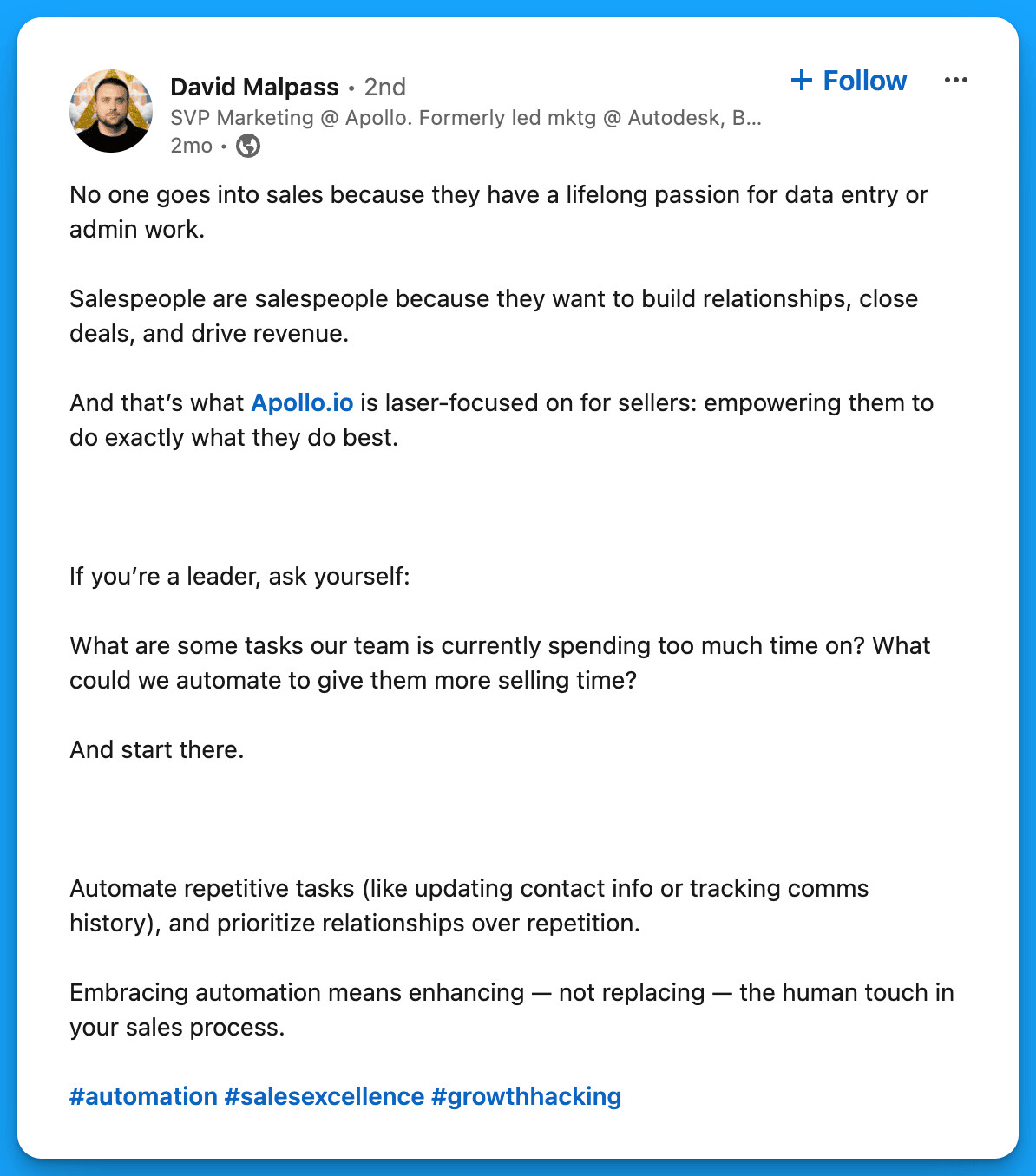
That requires more than explaining a model. It requires describing a different way for a practice to operate while leaving judgment with the lawyers. Malpass had explored a similar distinction at Apollo, where he argued that automating data entry should free salespeople to build relationships and close deals. The details have changed, but the human bargain is recognizable: give the repetitive work to software so professionals can spend more time on the decisions that justify their expertise.
His public language at Eve is sharper than the standard promise of efficiency. He talks about plaintiff firms as under-resourced opponents and about technology as a way to improve their competitive position. The aspiration is communal as much as commercial: build a group of firms willing to adopt a new operating model and equip them to take on better-resourced adversaries.
It is tempting to see the career as a sequence of growth figures: users, team sizes, valuations, revenue. The more durable pattern is adaptation. At Prezi, the answer was a test. At InVision, it was a story large enough for a cinema. At Autodesk, it was learning to turn the carrier. At Apollo, it was an integrated machine staffed at speed. Eve now presents the newest problem: how to make legal AI concrete without making it sound magical.
Malpass's answer, if the previous six builds are a guide, will not be borrowed whole from the last company. He keeps the principles - measure honestly, hire well, join brand to demand, respect the audience - and throws away the scenery. There are safer ways to make a career. Few are as useful to a company still deciding what it means.