Sean Stavropoulos needed a haircut. Matt Danna felt qualified to tell him so. The trouble was getting one into the diary: Stavropoulos remembered to book after the salon had closed, then forgot to call when it opened. Between the two of them, they had considerable experience building software. Neither could explain why arranging a haircut required such careful coordination with a telephone.
It was a small annoyance, with excellent prospects of remaining one. Instead, the two colleagues started asking questions. A receptionist’s appointment book eventually became the basis of Boulevard, the company Danna co-founded in 2016 and still leads as CEO. His early mistake was assuming he already understood what the salon needed. His more useful habit was staying around after that assumption fell apart.
The question behind the phone call
The obvious explanation was that salons had fallen behind. Perhaps they were still using paper. Perhaps nobody had given them an adequate way to put booking online. During their early visits to Los Angeles salons, Danna and Stavropoulos discovered something inconvenient for that theory: the software was already there. Owners were choosing to have customers call.
The refusal deserved attention. Making a customer pick up the phone introduced friction, but allowing appointments to land wherever a customer fancied could create gaps in the working day. The person answering the phone was managing those trade-offs. An apparently old-fashioned process contained a considerable amount of judgment. The founders had arrived with an opinion about convenience and encountered a problem about earnings.
For Danna, the lesson has lasted. He has argued that businesses slow to adopt technology can be short of suitable options rather than enthusiasm. That distinction matters when your prospective customer has already endured software that makes ordinary work difficult. A receptionist has every reason to be suspicious of a visitor promising an easier afternoon.
“Every business has a place for great technology.”
Matt Danna
A career spent close to the creative work
Danna’s path into salons makes more sense when traced through the people he had worked for. At DeviantArt, his work crossed software engineering and product design. At Fullscreen, he became the first product manager and eventually vice president of product, helping build tools for people making video online. There, he met Stavropoulos, who led engineering.
His formal education was at Rochester Institute of Technology, where he earned a bachelor’s degree in information technology and human-computer interaction. He also provided product and technology leadership for Wasserman and Awesomeness. Across those settings, the recurring interest was practical: how could people with creative skills use technology to build a working life around them?
The artistic interest preceded the job titles. As a child, he built with Lego, K’NEX and Lincoln Logs and enjoyed finger painting. He considered graphic design before choosing information technology, keeping design as an interest. The combination helps explain his attraction to product work. A system has to function, certainly. Someone also has to spend a day looking at it.
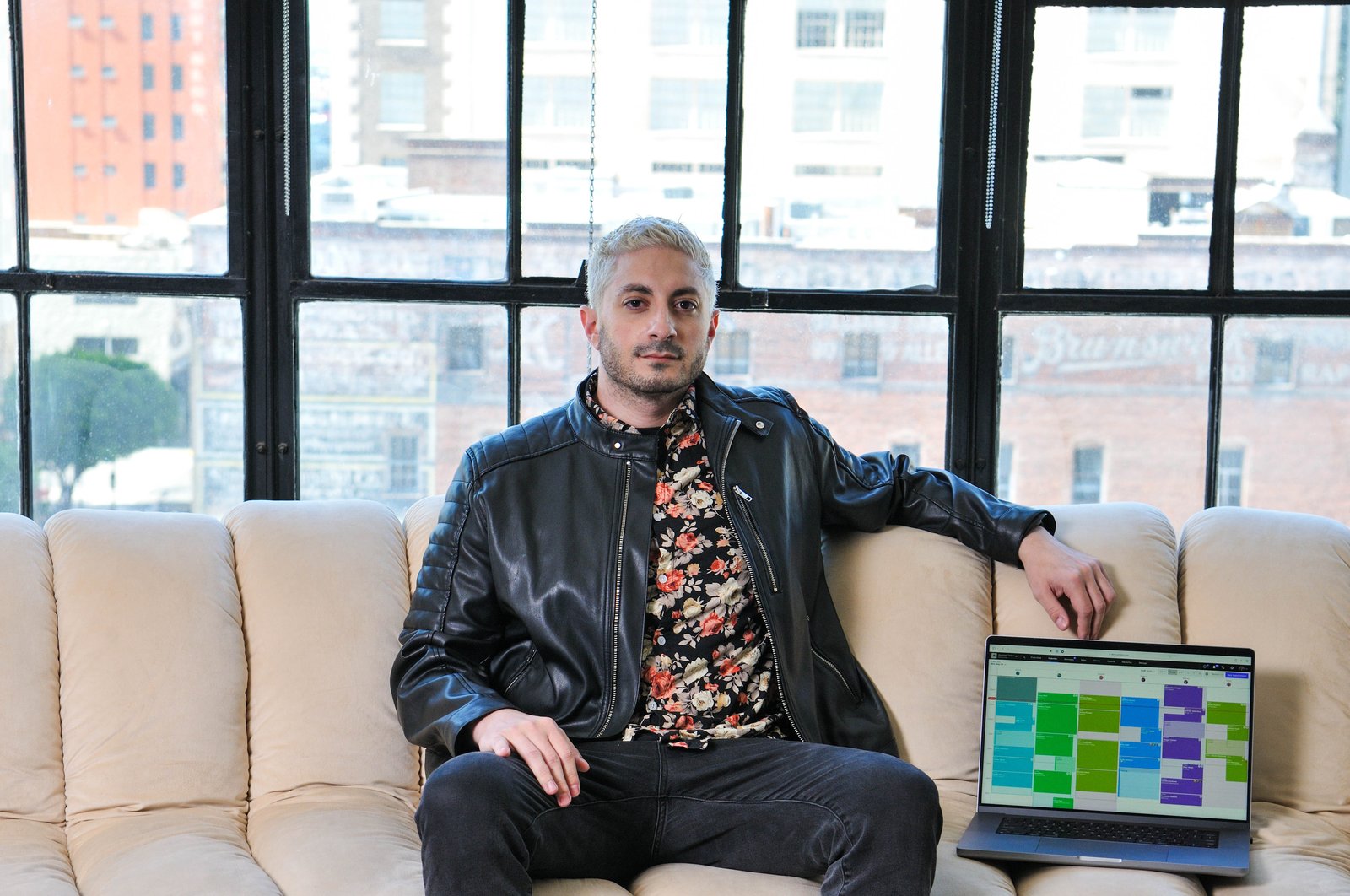
An apprenticeship with a ringing phone
The early research was resourceful, with a slightly mischievous introduction. Visiting salons in 2015, Danna and Stavropoulos presented themselves as UCLA students working on a project. They wanted people to explain their systems without assuming the visitors had come to sell a replacement. The borrowed student status opened conversations; it did not supply the answers.
Those came through sustained contact. They questioned owners, managers and front-desk staff, eventually talking with hundreds of people. With no beauty-industry background of their own, they needed operators to describe the day in its full, untidy detail. A booking demonstration could show what a button did. Working inside the business could show why someone hesitated before pressing it.
So they worked behind reception desks. Danna handled the front of house while Stavropoulos wrote features nearby. They observed how businesses operated and adjusted what they were building. That arrangement gave a complaint a short journey to the person who could fix it. It also made the founders accountable to the next customer walking through the door.
The commitment was personal as well as professional. Danna has said that they left their jobs and liquidated their 401(k)s. He remembers working from Stavropoulos’s couch. These details put some weight behind the familiar instruction to understand your customer. The founders were spending their own savings while learning a job whose difficulties they had initially underestimated.
What a quarter of an hour costs
Consider a simple illustration. A stylist has ninety minutes available and two half-hour appointments to arrange. Separate them carelessly and the remaining time may become two fifteen-minute gaps. Put them together and half an hour remains available for another booking. The rectangles on a calendar represent time that can be sold only once, before it passes.
Same 90 minutes. Different possibilities.
That arithmetic gives a receptionist’s decisions financial consequences. A customer experiences a choice of appointment times. The business experiences the resulting pattern of work, gaps and capacity. Boulevard’s scheduling approach considers appointment durations, booking patterns and provider availability when suggesting times. The promise depends on making those considerations manageable while the customer is still deciding.
It also explains why a generic calendar was an incomplete answer. A salon needed the booking to sit alongside information about clients and the practical business of getting paid. Boulevard grew into scheduling, payments, marketing and communication. Each additional function brought more of the working day into the product, and more responsibility for making the pieces fit.
The value of a third visit
Danna’s interest extends beyond securing the first appointment. In 2024, he explored a deliberately patient idea on Boulevard’s podcast: wait until the third visit to introduce retail product sales. The thinking was that an established relationship could support a better recommendation and a more durable customer connection. A quick sale might be available earlier. The repeat visit had its own value.
There is a welcome absence of glamour in that question. Much of a salon’s business happens after the dramatic reveal in the mirror. A client remembers whether the booking worked, whether someone recognized them, whether the follow-up made sense. For a software company, those interactions create a demanding brief. Efficiency has to coexist with the feeling of being individually attended to.
Danna’s introduction to Boulevard’s 2023 retention report put the argument plainly: “Yours is a relationship business.” The analysis drew on more than eleven million appointments. Its scale served a very familiar ambition for an individual owner: understand what persuades somebody to return. The data matters because the relationship is small enough for a person to notice when it goes wrong.
Three measures of company activity. Payments volume is money moving through the platform, not Boulevard’s revenue.
The numbers get bigger. The desk stays small.
The business eventually acquired the numbers that make an origin story look deceptively inevitable. Boulevard announced a $27 million Series B in 2020. In 2023, Danna received an EY Entrepreneur Of The Year award for Greater Los Angeles. His response credited the people around him: “Entrepreneurship is truly a team sport.”
By the end of 2023, Boulevard had brought in more than $50 million in annual revenue. It ranked 163rd on the 2024 Inc. 5000. In July 2025, an $80 million Series D led by JMI Equity gave it more capital for enterprise capabilities and AI development. These milestones came years after the first salon visits. Reception-desk research had become a substantial company.
The relationship with operators also led into financing. Boulevard Capital, introduced in 2024, used business performance data to inform funding offers. In March 2026, Boulevard said the program had delivered more than $40 million and received a FinTech Breakthrough award. For an owner considering equipment, staffing or another location, the practical question had expanded from filling today’s calendar to paying for tomorrow’s plans.
Another connection became formal in October 2025, when Connor Theilmann joined as Boulevard’s first independent board member. An early personal investor, Theilmann described Danna as a CEO whose decisions begin with the product. Their shared view was that the software company’s success should follow its customers’ success. That puts the operator’s results at the center of the relationship.
Keeping the screen human
Danna’s stated priorities now include serving larger businesses without allowing the software to become cumbersome. In an October 2025 interview, he argued that enterprise capabilities and thoughtful design should coexist. He also described a future of “anticipatory service,” with systems responding more intelligently to what a client has preferred before. The ambition still begins with an individual interaction.
There is a particular difficulty in preserving that attention as a company grows. An owner with several locations needs more oversight. The person at reception still needs to answer a question quickly. Both must be able to understand the screen. Danna’s career has placed him on the technical and design sides of that problem; his time inside salons gave him another way to judge the answer.
He has also described an early sales challenge that went beyond demonstrating features. Owners needed to believe that software built for their work could be dependable and understandable. That makes trust part of the product’s job before a client ever books through it. An elegant screen has limited value if the people responsible for the afternoon are afraid to rely on what it says.
The haircut at the beginning makes a tidy anecdote. What followed is more revealing: two experienced technology workers encountered a decision they did not understand, then took it seriously enough to learn the work behind it. Danna’s story earns its interest there, beside the phone and the calendar, where the next appointment was always about to arrive.