There is a small indignity in working with an AI assistant: it can help write a thousand lines of code on Tuesday, then ask on Wednesday which framework the project uses. A human colleague would be embarrassed. A machine simply opens a new session. MatrixOrigin, a company founded in 2021 around a cloud-native database, has found a business in that awkward gap between an agent's capability and its memory.
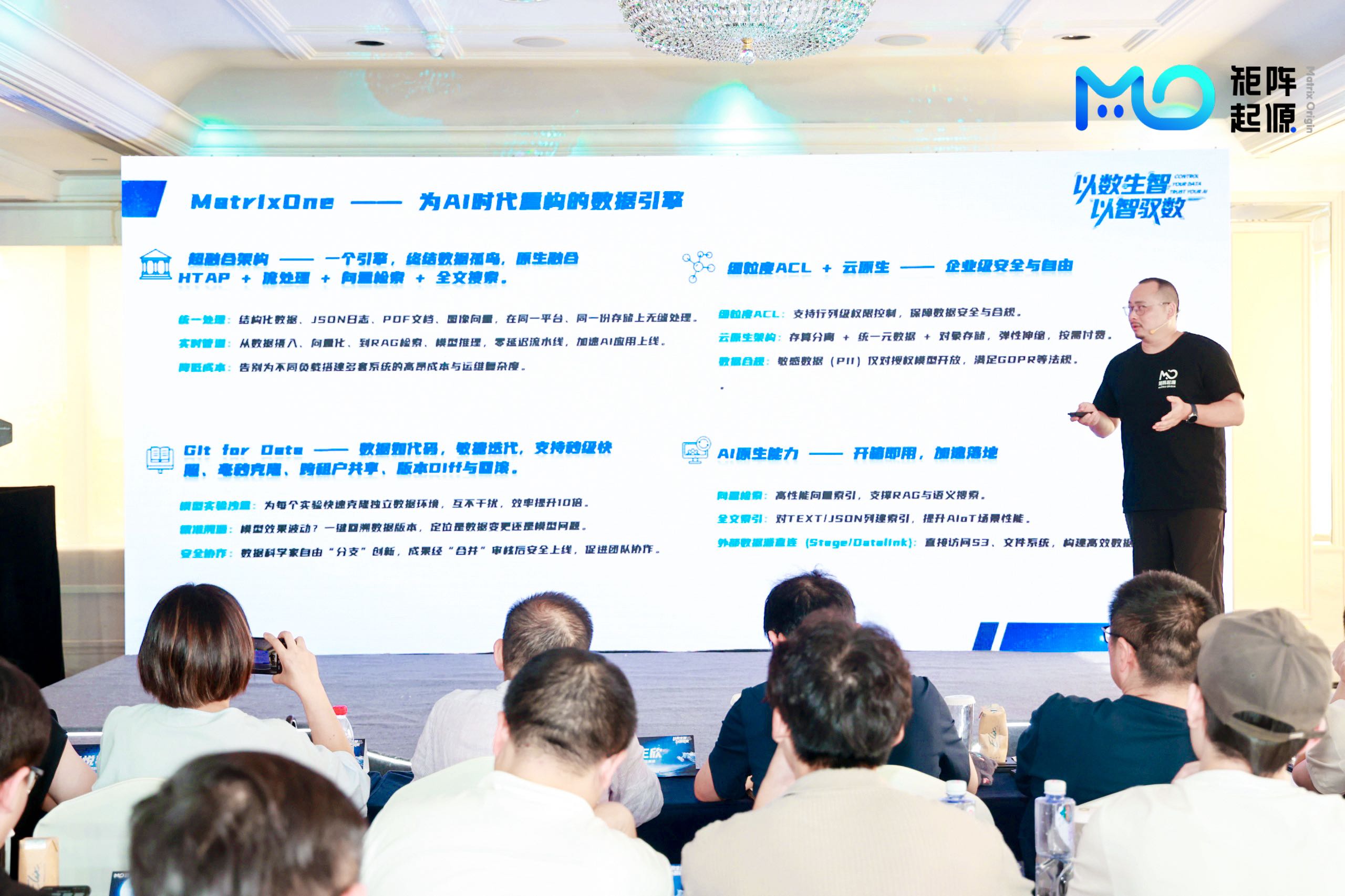
- MatrixOne puts transactions, analytics, vector search and full-text search in one database.
- MatrixOne Intelligence turns scattered enterprise files and records into material AI applications can use.
- Memoria gives agents persistent, searchable memory with branches and rollback.
- Astra is the runtime for testing and tracing agents in production.
The company did not start with memory. It started with a familiar engineering bill: one database for transactions, another for analytics, a search engine for text and a vector store for similarity. Every extra system asks for a connector, a copy of the data, someone to maintain it and an explanation when two answers disagree. MatrixOne's proposition is to combine those workloads in a MySQL-compatible, cloud-native database. Its unusual flourish is what the company calls Git for Data: snapshots, branches, time travel, merge and rollback at the data layer.
A stack of databases, reduced to one
A published customer example makes the pitch less abstract. TechAgent, an industrial data software provider, had been using MySQL, MongoDB, Elasticsearch, Faiss and ClickHouse. MatrixOrigin says TechAgent replaced the five components with one MatrixOne instance and cut customer delivery time from two months to one week. That is a customer case, not a controlled comparison, but its logic is easy to recognize: integration work shrinks when there are fewer systems to integrate.
ETAO Innovation offers another view of the same arithmetic. The manufacturing software company used MatrixOne to replace MySQL, InfluxDB and MongoDB in its manufacturing execution system. Its CTO said new developers no longer needed training on several databases and many cross-system analytical tasks could become SQL queries. This is the sort of gain that rarely makes a flashy demo: fewer handoffs and less code whose only job is moving data around.
Then the database met the documents
A database can simplify the plumbing and still leave the most awkward material outside it. A factory drawing is a PDF with dimensions and scribbles. A service ticket is part symptom, part history. A procurement decision may depend on a spreadsheet, a contract and an email thread that nobody remembered to attach. MatrixOne Intelligence, publicly launched in September 2025, is MatrixOrigin's answer to that unlovely collection. It ingests structured records and unstructured files, cleans and indexes them, then supports analytics, retrieval, model work and agent applications.
The customer list shows why this is an enterprise product. Hand Enterprise Solutions built an ERP support knowledge base that restricts retrieval to a customer's environment and software version, with answers tied to their source. Jinpan Technology used MatrixOne Intelligence in a bidding workflow; MatrixOrigin reports key information extraction accuracy of 95 percent, up from below 50 percent, and cross-department evidence lookup in five minutes instead of days. Zhongding Group built a department knowledge base from more than 200 PDF drawings to find similar designs using images, meaning and text together. These are different tasks with the same demand: the answer has to match the right evidence.
“What really blocks AI implementation is often not the model, but messy data.”MatrixOrigin representative Wei Xudong, discussing enterprise agent deployments
The quote has the ring of a sales line because it is one. It is also a useful test for any buyer. If source files are duplicated, permissions are vague or labels are wrong, a clever model can produce a polished mistake. MatrixOrigin's difference from a standalone vector database is the breadth of the system it wants to manage: transactions, analysis, search, multimodal processing and the agent's later decisions. Its difference from building a stack out of specialist tools is mostly operational: fewer seams, at the cost of committing more of the architecture to one supplier.
Give the agent a past it can revise
That data versioning idea has now escaped the database. Memoria, released as open source in March 2026, is persistent memory for AI agents. It connects through the Model Context Protocol to tools including Cursor, Claude Code and Codex. Memories are retrieved using vector and full-text search. A developer can snapshot a memory state, branch for an experiment and roll back if an agent learns the wrong lesson. The April backup-and-restore release gave the free version two snapshot slots.
The first failure Memoria addresses is not dramatic. It is the low-level repetition of re-explaining project structure, past decisions and diagnosed bugs after a session ends. A company developer's published account of building a sample store app described Memoria retaining API endpoints, startup steps and cart-design decisions across sessions and devices. The same account admitted limits: it did not replace Git or formal documentation, and memories were not yet proactively surfaced. That candor is useful. Persistent memory helps only when what it stores is worth remembering and when retrieval brings back the right thing.
The engineering story behind Memoria is more revealing than the slogan. MatrixOne technical lead Xu Peng wrote that he rebuilt the memory service in Rust after a Python version became cumbersome to package and run beside an IDE. His reported package size fell from roughly 300 MB to under 10 MB, and resident memory from more than 200 MB to about 20 MB. Those are developer-reported figures, but the motive is plain: a background memory service has to be small enough that people leave it running.

Founder and CEO Long Wang came from Tencent Cloud and VMware; the company's leadership also includes database researchers and engineers with experience at Snowflake and other infrastructure firms. The route from MatrixOne to Memoria was not a sudden pivot. In 2024, a US$10 million Pre-A led by VNET backed a broader AI infrastructure plan. In 2025 came MatrixOne Intelligence. By 2026 the product map had stretched to Memoria and Astra, a runtime designed to preserve the context of an agent's decisions and let teams test changes against isolated data. An August 2026 Series A of more than US$10 million, backed by a HAND-led fund, AsiaCom and Artesian Venture Partners, gave that expansion fresh capital.
The price of fewer seams
MatrixOrigin's commercial model is recognizable: a free open-source Community Edition of MatrixOne, paid enterprise software and support, and MatrixOne Intelligence offered through cloud service or private deployment. The cloud offer advertises a free trial and flexible usage pricing; private deployment and enterprise terms go through sales. Memoria is another developer entry point into the stack. A team can try the memory layer without first buying a company-wide AI platform.
The practical lesson is smaller than the entire product catalog. Pick a workflow where people already lose time reconciling data or repeating context. Count its systems, copies, manual reviews and recovery steps. Give the agent access to a bounded, permissioned slice of that work. Keep an audit trail and an undo path before asking it to act at scale. MatrixOrigin's strongest examples have narrow jobs - finding the right ERP answer, locating a similar drawing, assembling a bid - with evidence a person can check.
There are conditions under which the pitch weakens. A small application with one uncomplicated database may gain little from a new platform. A company with excellent specialist systems may prefer the flexibility of keeping them. And a memory service can preserve an error just as faithfully as a fact if nobody governs what enters it. MatrixOrigin's own answer is branching, review and rollback. That is a more interesting promise than an agent that never makes mistakes, because the latter has yet to show up for work.