agent-memory
(7)
Daniel Chalef and the trouble with remembering everything
From open-source software in Cape Town to AI memory at Zep, Daniel Chalef has kept returning to the same problem: information is plentiful, but useful context takes work.
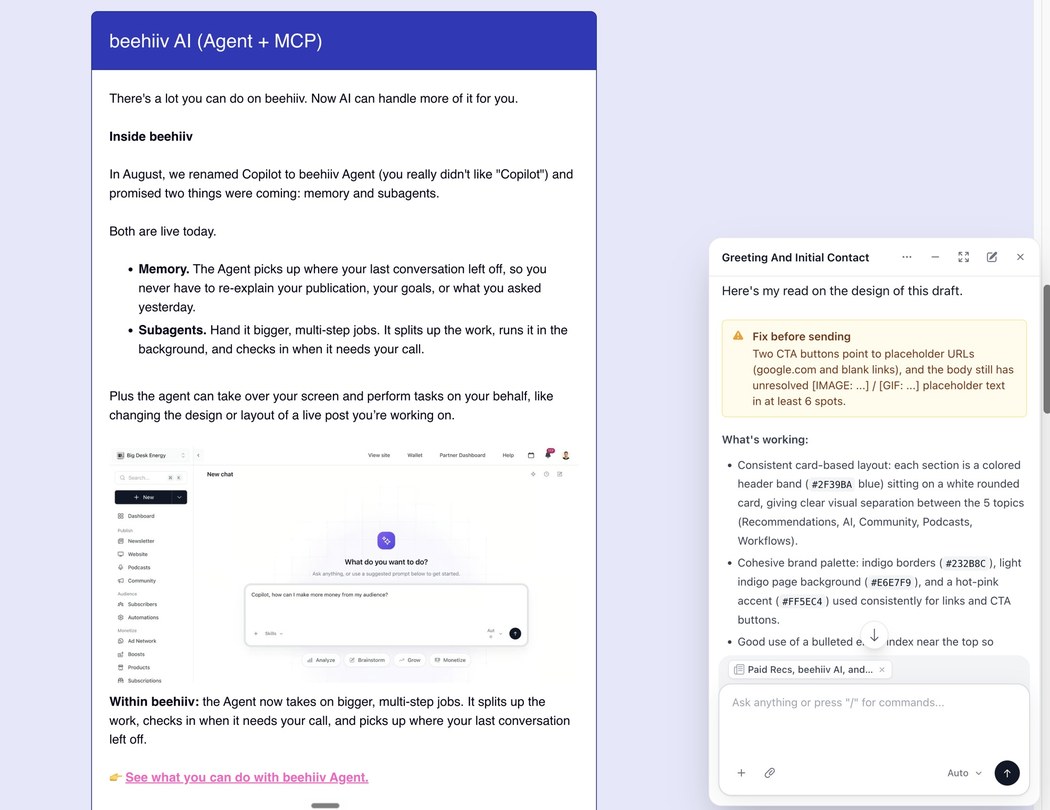
beehiiv’s AI Agent Remembers—and Takes on Bigger Jobs
Memory and subagents arrived on September 29, turning beehiiv’s AI Agent into a more persistent publishing assistant. It can work through bigger assignments and change a live post’s layout; the price of putting it to work deserves a closer look.

The Database That Learned to Remember
MatrixOrigin began by collapsing a database stack. Now it wants to give AI agents something harder to buy: a memory they can inspect, branch and undo.

Letta
Letta is a San Francisco AI research lab and platform for building stateful agents - AI that remembers, learns, and improves itself over time. Spun out of UC Berkeley's Sky Computing Lab from the viral MemGPT project, Letta gives developers an open framework, API, and cloud service where agent state (memories, messages, reasoning, tool calls) is persisted in a database rather than lost when it falls out of the context window. The company positions itself as the open alternative for developers who want to build agents that behave less like stateless chatbots and more like continuously learning digital collaborators.

Charles Packer
Charles Packer is the co-founder and CEO of Letta, the San Francisco startup building the memory layer for AI agents. He is the original author of MemGPT, the viral research project that reframed large language models as operating systems that manage their own memory. A UC Berkeley computer science PhD out of the BAIR and Sky Computing labs, Packer walked away from offers at OpenAI and Google DeepMind to build stateful agents that remember, learn, and improve after deployment - the layer he argues sits above the base models and separates a real agent from a chatbot with a nice interface.

Mastra
Mastra is an open-source TypeScript framework for building production-ready AI agents, workflows, and retrieval-augmented generation pipelines. Built by the team behind Gatsby, it gives developers agents, durable workflows, memory, RAG, tool calling, evals, and observability in one stack - so JavaScript and TypeScript engineers can move from prototype to production without leaving their language. Mastra is developed by Kepler Software, a San Francisco startup, and reached 25,000+ GitHub stars and 300,000+ weekly npm downloads with adoption at companies like Brex, Sanity, Replit, and PayPal.

Zep AI
Zep AI builds the context engineering infrastructure that makes AI agents actually useful. Their platform - powered by a temporal knowledge graph called Graphiti - gives agents persistent memory across sessions, letting them track what users said, what changed, and when. Founded in 2023 and backed by Y Combinator (W24), the San Francisco team hit $1M ARR within months of launch and now serves 240+ customers including Fortune 500 companies. With 25,000+ GitHub stars on Graphiti and a published arXiv paper, Zep is quietly becoming foundational infrastructure for the AI agent era.