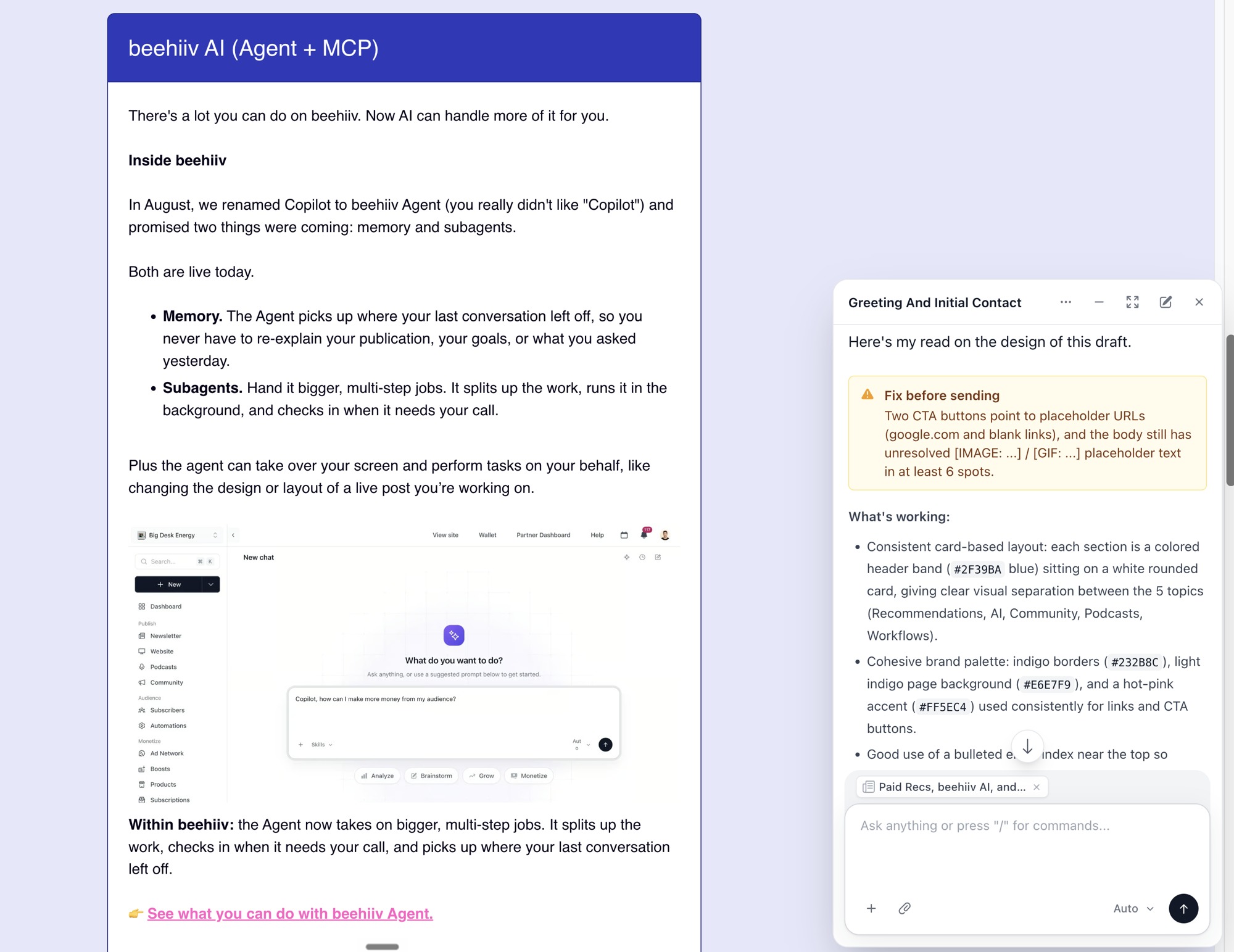
beehiiv’s release screenshot shows the assistant reviewing a post’s presentation. Image: beehiiv · September 29 release.
The assistant returns to work
A newsletter editor has two deadlines: the one on the calendar and the one imposed by all the little jobs that refuse to leave the desk. A heading needs moving. A layout needs attention. Yesterday’s instructions need explaining again. The issue may be short; the afternoon rarely is.
beehiiv’s September 29, 2026 release addresses that last indignity. Memory and subagents became available after their August announcement, when Copilot was renamed beehiiv Agent. Memory carries context between conversations. Subagents divide larger, multi-step assignments, execute work in the background and return when a decision is needed. The release also says the Agent can change the design or layout of a live post.
That final detail gives the story its teeth. Text generation produces something an editor can paste. An assistant that changes the publication itself participates in production. The question becomes whether it understands the assignment well enough to be trusted with the next step.
Sources: September 29 release
02 / WORKFLOWYesterday no longer needs an introduction
Publication-aware assistance already has a practical foundation. beehiiv’s Agent documentation says the assistant can use a publication’s name, description and metrics, and identify posts by subject line and send date when offering recommendations. It is accessible from the app’s side navigation or through ⌘J on Mac and Ctrl+J on Windows.
Memory adds continuity to that setting. Its value is the prospect of giving an instruction once and returning to the same conversation’s business later. For an editor, that might mean less time restating the audience, the purpose of an issue or a preference already explained. These are examples of the workflow benefit, rather than independently tested results.
A remembered instruction still needs to be a good instruction. If the audience changes, yesterday’s brief can become today’s mistake. A sensible editorial habit is to state what has changed before assigning the next job. Memory can preserve a premise; it cannot make the premise true. The release establishes continuity, not a guarantee that names, claims or quotations will be accurate.
Sources: Agent documentation · Memory release
Memory can preserve a premise; it cannot make the premise true.
From this feature
03 / WORKFLOWA bigger job needs a better brief
The attraction of subagents is easy to imagine on a crowded publishing day. Instead of asking for one isolated revision, an editor can describe a sequence of work and let the assistant handle the intervening steps. beehiiv describes background execution with check-ins when it needs the user’s judgment.
Consider a hypothetical assignment: review an issue’s structure, propose a clearer order and adjust its presentation once the editor has chosen a direction. The release supports the broad capabilities behind such a request; it does not promise that this exact sequence succeeds unattended. The useful distinction is between delegating effort and surrendering the decision.
A brief should name the post, the intended result and the point at which the editor wants to see the work. “Make this better” is an invitation to taste without a commission. “Improve the hierarchy so the main story is easier to find, then show me the changes” gives the assistant something an editor can actually judge.
Layout deserves its own inspection. The order of blocks can change what a reader notices first, even when every sentence stays intact. A conspicuous button or a buried qualification is an editorial choice expressed through design. When software makes that choice, the publisher still owns the result.
Sources: Subagent and live-post capabilities
How the work moves
Carry context into the next conversation.
Split up a larger assignment and work in the background.
The editor checks the result and makes the call.
Conceptual workflow · Review is an editorial practice, not an accuracy guarantee.
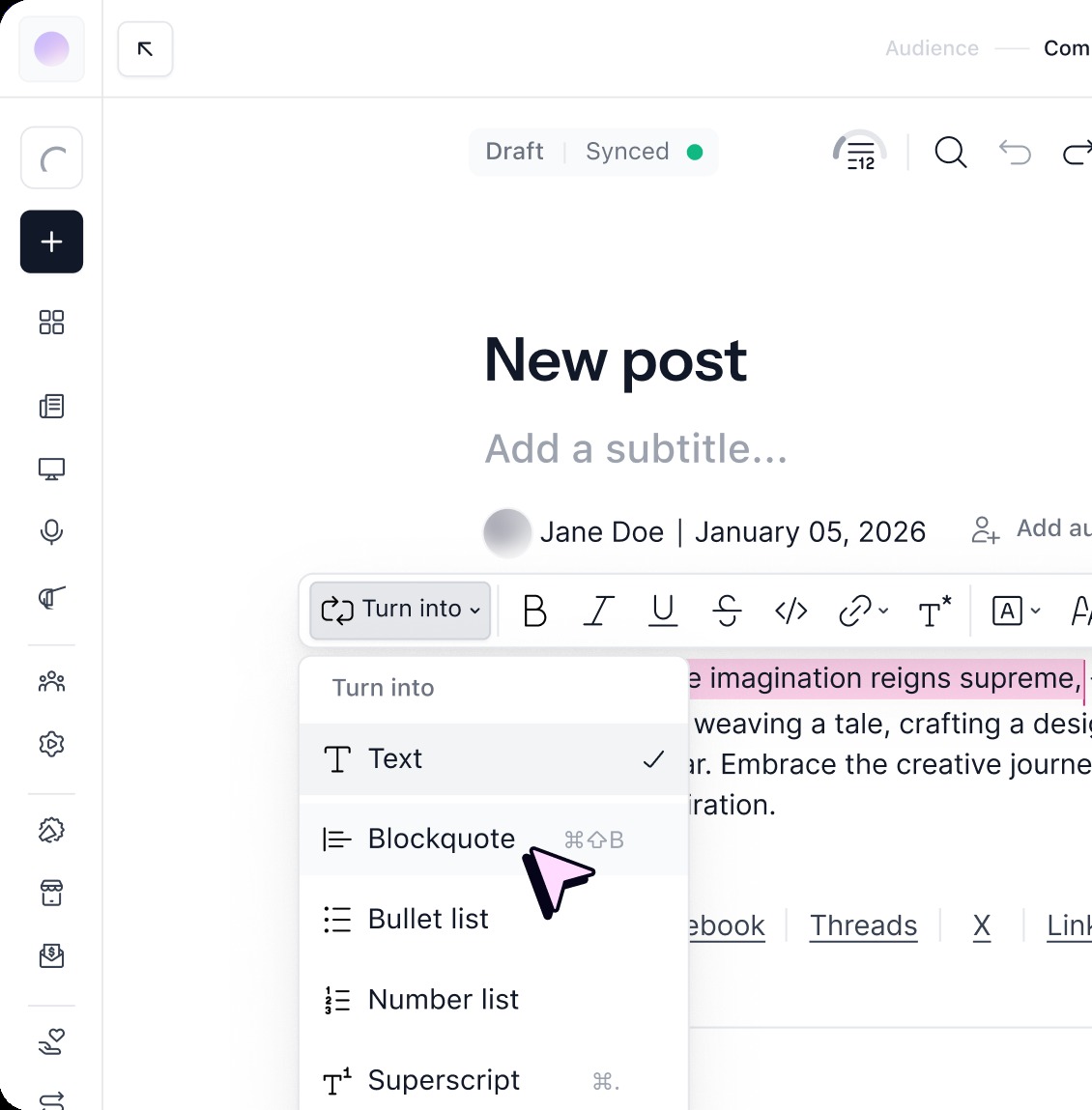
04 / CONNECTORSTwo entrances to the same publication
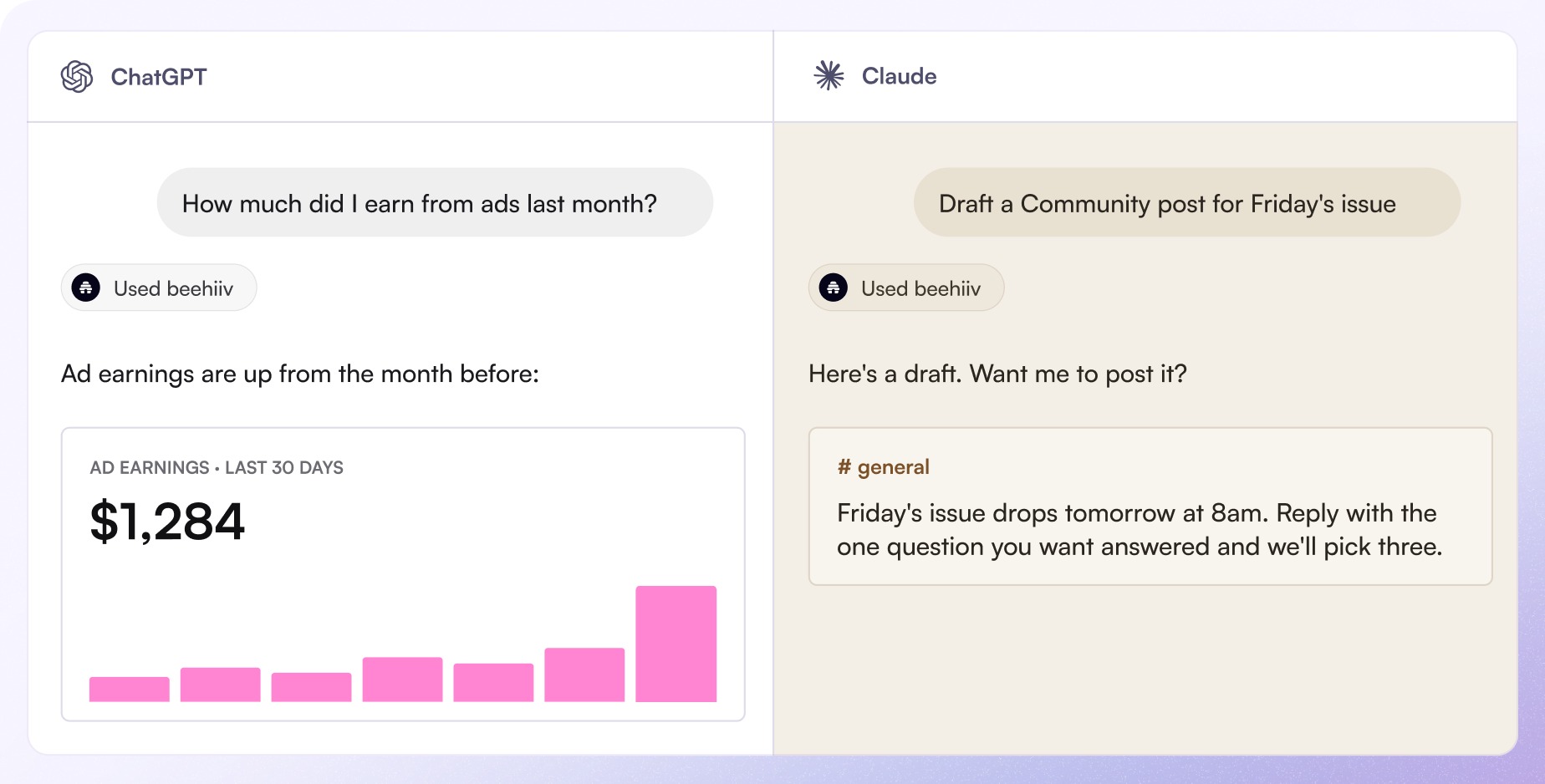
There are two ways into beehiiv’s AI story. The Agent lives in the platform. MCP, short for Model Context Protocol, connects external AI tools to the account. In its September release, beehiiv reported more than six million MCP requests since its March launch and announced official Claude and ChatGPT connectors.
The six million figure belongs to beehiiv’s account of MCP usage. It is a request count, not a count of publishers, completed articles or successful editorial decisions. A busy connection tells us that work is being attempted; it does not grade the work.
The MCP help page describes read-only access on Free and paid-plan access for write actions. It also says access follows the user’s workspace permissions. Connecting an external assistant therefore raises a different operational question from opening the built-in Agent: which account, which publication and which permitted actions are involved? Neither entrance removes the need to understand the assignment.
Sources: MCP usage and connectors · MCP access and permissions
A usage count, not an accuracy score.
05 / THE COSTThe bill has changed since the announcement
The launch is a September story. The purchase decision is an October one. beehiiv’s pricing announcement says new plans took effect for new customers on October 1, 2026; existing customers move at their first renewal on or after November 1. Launch, Scale and Max map to Free, Lite and Pro.
At the 1,000-subscriber setting checked on October 15, the live pricing page displays Lite at $49 a month and Pro at $95 a month, both with yearly billing. Free is $0; Enterprise is custom-priced. Those monthly equivalents depend on the subscriber tier and billing choice. The advertised plan ceilings are 2,500 subscribers on Free, 100,000 on Lite and 250,000 on Pro.
Pro’s AI credits are labelled “HIGH.” The current readable pricing page does not establish numeric daily allowances across the new plans. The former 10/25/50/100 daily-credit table should not be treated as a confirmed October entitlement. Before budgeting a recurring workflow, establish the account’s allowance and what the intended task consumes.
Human help is part of the calculation. Pro advertises 24/7 priority support; Enterprise adds a customer success manager and concierge onboarding. The Agent help page says support tickets are available on paid plans and free trials. Outside a trial, Free users have the Agent as their primary support route. A 14-day Pro trial offers a test window, but editor AI uses Lite credit limits during that trial.
Sources: Live pricing · October pricing changes · Support access · Trial limits
THE OCTOBER PLAN SNAPSHOT
Free
$0- 2,500 subscribers
- 1 team seat · 1 publication
Agent help; tickets during trial
Lite
$49 /mo- 100,000 subscribers
- 2 seats · 3 publications
Paid-plan support tickets
Pro
$95 /mo- 250,000 subscribers
- 10 seats · 10 publications
24/7 priority support
Enterprise
Custom- Custom subscribers
- Unlimited seats · custom publications
Customer success manager
06 / THE FINAL READThe editor’s desk gets a little quieter
The most convincing way to evaluate the upgrade is an ordinary issue with an ordinary deadline. Give the assistant a bounded task, inspect its work and record the time spent correcting it. A task completed in the background only earns its place if the resulting review is manageable.
That is an editorial test, not a benchmark reported by beehiiv. It asks whether fewer repeated instructions and fewer manual steps leave more room for reporting, selection and judgment. Those are the activities that make one publication worth reading when another covers the same news.
The glamorous promise is an assistant that takes bigger jobs. The more useful ambition is a publisher who spends less of the afternoon explaining where the furniture goes. Give the Agent the brief. Keep the final read.
The questions on the desk
When did beehiiv launch Agent memory and subagents?
September 29, 2026, following the August announcement and Copilot’s rename to beehiiv Agent.
What do memory and subagents do?
Memory provides continuity between conversations. Subagents divide and execute larger multi-step tasks in the background, checking in when user judgment is needed. Neither guarantees editorial accuracy.
Can the Agent change a live post?
Yes. The September 29 release says it can change the design or layout of a live post the user is working on.
Is the beehiiv Agent the same as the MCP connector?
The Agent is the native in-platform assistant. MCP connects external AI clients to beehiiv data and actions, subject to workspace permissions and plan access.
What do current plans cost and how many AI credits are included?
Checked October 15, 2026 at 1,000 subscribers: Free is $0, Lite $49/month and Pro $95/month with yearly billing; Enterprise is custom-priced. Pro credits are labelled HIGH. Exact numeric allowances for current plans are not verified on the readable live pricing page.
Your newsletter should be an asset you own.
beehiiv is the newsletter platform built for publishers who want to grow a list, send beautiful issues, and monetise without stitching five tools together.