The holiday party had enjoyed a respectable run. For its first ten years, Mary Verdin’s marketing firm gathered clients, vendors, media people, friends and family for a seasonal celebration. In 2014, the agency decided to spend those resources differently. A local nonprofit would get an entire rebrand, from its logo to its website, in 24 consecutive hours. The guests, in effect, were being offered homework.
The decision tells you something about Verdin. Plenty of business owners give money to causes they admire. She found a way to give the work itself, with a deadline sufficiently unreasonable to make people pay attention. Her agency could supply strategy, design and words. Partners could add production, websites and media. An organization with a small budget could emerge with tools it might otherwise struggle to afford.
It also suited a career built around a fairly practical question: what can you contribute here? Verdin founded her San Luis Obispo agency in 2003. Its first contract came from the Community Foundation of San Luis Obispo County. The equipment was a card table and a laptop. The connection to the place was already the point.
A small table in a town she had chosen
Verdin moved to San Luis Obispo in 1991. By the time she launched the company that bears her surname, she had put down roots in the region. Her professional life and her volunteer life would keep crossing paths: business organizations, charitable committees, students and clients all became part of the same local geography.
There is an appealing lack of stage scenery in the agency’s beginning. A card table makes a poor monument to executive importance. It does, however, hold a computer. The first client also matters more than the furniture. A community foundation works through relationships and public confidence; beginning there placed the young business close to the institutions and people that would recur throughout Verdin’s career.
She had studied psychology at the University of California, Davis, and later completed Leadership SLO’s fourth class and Leadership California’s Class 24. Those are distinct strands of her background: an interest in people, followed by programs concerned with leadership and place. Her agency biography also records more than a decade advising Cal Poly’s Public Relations Student Society of America chapter.
Her experience extends to supporting her husband’s family restaurant, Old Juan’s Cantina in Oceano. That gives the marketing work a nearby commercial reference point. A restaurant must persuade people to walk through a real door. An attractive idea eventually meets a customer deciding where to spend the evening.
“My passion is to make a difference.”Mary Verdin
The founder learns to share the work
A decade after the founding, the agency was changing its internal architecture. In June 2013, Ashlee Akers became a shareholder alongside Mary and principal Adam Verdin. Mary’s explanation emphasized Akers’s understanding of both clients and the company. Ownership followed an existing contribution to leadership.
That summer brought another change. The firm created a strategy division, promoting Whitney Diaz to digital brand strategist and Megan Rivoire to creative strategist. It also added staff in media, marketing and account coordination. The agency was assigning people explicit responsibility for research, ideas and the connection between a client’s aims and its public presentation.
Verdin was plainly pleased by the promotions. She described rewarding employees’ work and promoting from within as one of her favorite things to do. That is a useful detail in a founder’s story. A business carrying your name can easily become a business in which every decision waits for you. Giving other people authority is part of making the operation durable.
The work being recognized that year was unusually concrete. The agency received four PRSA Awards for Excellence for projects involving the city utilities department’s Facebook page, SLO Happenings, the San Luis Obispo Symphony’s California Missions Tour and a Regional Rideshare brochure. A social feed, a concert campaign, a transit publication: these were everyday channels through which a community found out what was happening.
The range helps explain the business Verdin built. Marketing here could mean selling a visit, explaining a service or helping an audience find an event. The practical test varied with the assignment. A good-looking piece of communication still had to do a job for the organization paying for it.
The party budget acquires a deadline
The first 24-Hour Give took place on November 20 and 21, 2014. The agency redirected the time and resources of its annual holiday party toward a nonprofit rebrand. Over time, recipients included Literacy for Life, Meals that Connect and Creek Lands. The undertaking gave the firm’s community commitments a specific form: a selected organization, a collection of deliverables and a clock.
In its own account, the agency puts the first event’s donated services at more than $80,000, assembled with media partners and local creatives. That figure describes contributed services, rather than a cash grant. The distinction helps show the mechanism. People were pooling the capabilities they already used in their working lives.
One nonprofit. A complete rebrand. The holiday-party resources went to work.
The event also had a taste for costumes. The third Give, held in 2016, borrowed its theme from H. G. Wells’s The Time Machine. Period clothing, references to the past and the agency’s own version of a time machine appeared in its promotional materials. In 2017, that campaign earned a gold MarCom award.
The agency earned another gold that year for donated work refreshing the Central Coast Tourism Council’s brand. Sidecar Agency collaborated on the website. The pairing is revealing: one award concerned the theatrical packaging of a charitable event; the other concerned the useful work being donated. Verdin’s team could have fun with the invitation and still take the assignment seriously.
By 2019, the Give had adopted a zombie theme. Verdin called the participants “marketing zombies.” There are worse descriptions of people still adjusting a website after midnight. The event’s published schedule ran from a planning meeting at 8 a.m. to a reveal at the same hour the following morning.
Partners mattered to that schedule and to the final package. Website developers and video producers added their specialties, while media support helped the finished campaign reach people. The exercise extended beyond handing over a new logo. Distribution was part of the gift.
A creek, a name, a wider audience
In 2018, Central Coast Salmon Enhancement won the fifth annual Give. The package included a website, advertising campaign and public-service announcement concepts. Community members had voted between two finalists. That process brought the public into the event before the creative work began.
The winner offers a useful glimpse of the range of organizations involved. Environmental work needs language and visibility, too. The people doing it may have expertise in a watershed rather than in a website. The Give made room for those different skills to meet around a particular assignment.
In 2021, the local Association of Fundraising Professionals chapter honored Mary Verdin and Verdin Marketing with its President’s Award for the program. The chapter pointed to the hundreds of hours of donated creative and strategic expertise behind the effort. Recognition came from people whose daily work involved helping nonprofits secure support.
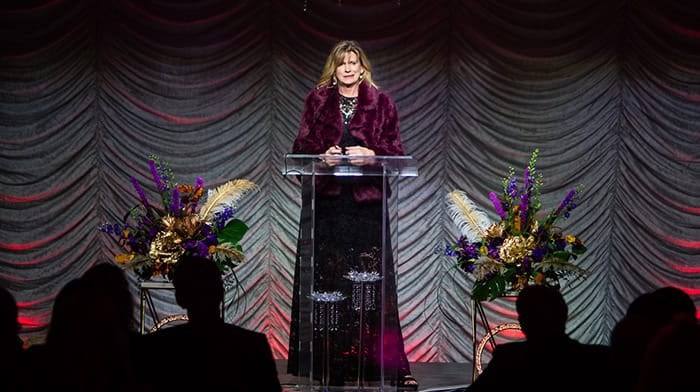
By January 2025, the accumulated donated services associated with the annual Give exceeded $800,000. At the San Luis Obispo Chamber’s dinner that month, Verdin received the 2024 Citizen of the Year award before nearly 600 attendees. The recognition joined the commercial and civic strands of her career in a single room.
The Better Betterment Bureau has entered the meeting
Inside the agency, the machinery of togetherness can be rather less formal. Verdin has described a weekly shared office day, with brainstorming and visual reviews often arranged for that time. Hybrid work makes those encounters something to schedule deliberately, rather than something to assume will happen beside a desk.
Then there is the Better Betterment Bureau. The employee-led group gets time and a budget for activities such as making bracelets and keychains or painting succulent pots. Verdin describes its name as an inside joke whose origins have been lost. An agency can preserve a brand’s history and still misplace the founding documents of its craft committee.
Her account also describes volunteer work with organizations including the SLO Food Bank and Woods Humane Society, alongside outside facilitators helping the team work together. The current team structure combines a deliberately small internal group with contractors added for particular assignments. Maintaining relationships inside the firm belongs alongside maintaining them outside it.
Still taking an interest in other people’s towns
Verdin has also made herself the interviewer. Her District Marketing Mojo series features people working in destination marketing and special districts, including Nichole Farley of Explore Butte County, Frank Johnson of Visit Gilroy and Cathy Cartier of SLO CAL. The subjects bring different places and professional experiences into the conversation.
That recurring curiosity fits the territory her agency serves: tourism destinations, municipalities, special districts and community organizations across California. A place has people already living in it as well as people who might visit. Learning how its leaders think is part of understanding what a campaign is being asked to accomplish.
The card table is a satisfying opening image, but the more telling one may be that abandoned holiday-party plan. Verdin had an established business ritual and chose to turn it into an assignment for the benefit of someone else. The company kept the occasion, supplied the expertise and made the deadline absurdly short. Somewhere in San Luis Obispo, a nonprofit had reason to be grateful that the marketing people had decided to stay up.