In the photograph, Denise Estopinal is at the far right, smiling beneath a tumble of pale curls, with beads hanging close enough to interrupt the view. She is with fellow Muses riders. The costume is doing its job. Anyone looking for the former mayoral communications director might need a moment.
It is a useful place to begin. A professional biography can make a life look like a procession of offices, each more solemn than the last. Estopinal’s includes journalism, New Orleans City Hall, the federal appeals court and a firm bearing her surname. It also includes years of helping the women of Muses tell their story. The wigs belong in the picture.
She founded The Estopinal Group in January 2001. In 2026, the firm is marking its twenty-fifth anniversary with a retrospective of clients, collaborators and projects. Read together, those recollections suggest a career organized around the places where New Orleans becomes a public undertaking: government, neighborhood institutions, infrastructure and Carnival. There is rather more human traffic between those places than an organizational chart can show.

Before her name was on the door
Estopinal’s work included journalism before taking her into government communications. The academic combination is revealing: a journalism degree from Louisiana State University and a Master of Public Administration from the University of New Orleans. Reporting and administration meet wherever someone needs to explain a public decision.
From 1994 to 1999, she directed communications for Mayor Marc H. Morial. She also became the first Public and Community Affairs Executive for the United States Court of Appeals for the Fifth Judicial Circuit, handling media and community relations for federal judges across Louisiana, Mississippi and Texas. These were jobs inside institutions with responsibilities extending well beyond the people employed by them.
A mayor’s administration and an appeals court have different rhythms. Yet each has to speak outside its own professional vocabulary. For a communicator, the challenge is partly one of audience: what can an institution assume people already know? What requires explanation? The sequence of Estopinal’s jobs gives her later business a clear professional background, without requiring a tidy moment of revelation.
The meeting before the meeting
The public sees the televised interview. Behind it are the arrangements, the briefing and the effort to make a complicated agenda intelligible before the discussion begins. During TEG’s work for the New Orleans City Council, the firm coordinated recurring interviews on WWL-TV and WVUE-TV ahead of regular Council meetings. Members received individual briefing documents on timely legislative and community matters.
The firm also developed the Council’s communications strategy, annual reports and a website intended to preserve information about its actions. Such assignments have a less theatrical side than the television appearance. Someone has to keep information current. Someone has to make yesterday’s decision retrievable after today’s news has taken over.
There is a modest democratic virtue in a working archive. A resident should be able to return to a decision without reconstructing it from memory. For Estopinal’s firm, communicating the Council’s work included creating that durable record as well as helping put its members on air. The audience could be watching breakfast television or looking up a legislative item much later.
An archived July 2009 message offers another glimpse of this work at the level of the calendar. Estopinal informed Council members and staff that a news conference for video streaming and a redesigned website had to move from August 7 to August 21. The time remained 10:30 a.m. She asked recipients to note the change and advise whether they could attend.
It is an ordinary administrative message, which is precisely its interest. The new public information service needed a launch; the launch needed people; those people had other demands on their schedules. Communication required a revised invitation before it could become a public announcement. A career measured only in finished campaigns would leave out this patient coordination.
The contrast between the two records is instructive. A website can give the public access to information, while an email gets the participants into the room to introduce it. Both tasks are part of the same assignment. In the archive, the invitation remains alongside the larger institutional story.
A public information piece, on the record
One glimpse of Estopinal at work sits in the September 16, 2010, minutes of the Southeast Louisiana Flood Protection Authority-East. She explained a special television program developed as a public information piece and designed as a foundation for outreach. It is a small entry in the formal record, surrounded by the business of a board meeting.
The detail matters because it places her inside the practical work. A television program becomes one way to introduce an institution and the matters it handles. Public outreach needs a starting point, something people can encounter before being asked to absorb a more elaborate explanation.
Board minutes are unlikely to acquire a reputation for sparkling characterization. They nevertheless offer a useful portrait here: Estopinal presenting a communications tool in the room where public business was being conducted. Her role becomes visible through the thing being discussed, rather than through a description of her own importance.
An editorial reading of the television and Council assignments.
The business of being somebody’s neighbor
For the Ninemile Napoleon-Derbigny transmission upgrade, a $30 million Entergy New Orleans project, TEG’s assignment included explaining construction to people living and working around it. The project was branded Power to Grow NOLA. Communications included maps, fact sheets, door hangers, media materials and a project website.
The outreach followed the work: prepare people, give them information to plan around it, then alert them to the timing and location. Those stages recognize an ordinary distinction. Hearing that infrastructure will be improved is one experience; discovering how the work affects your own day is another. The latter calls for particulars.
Estopinal’s firm was responsible for communication within a much larger project team. Keeping that distinction clear gives the work its proper scale. Engineers, construction crews and utility executives had their jobs; the communicators had to connect the project’s purpose and progress with the people around it. Even a well-designed map must earn its space on the kitchen counter.
And then there is the krewe
The Muses chapter brings Estopinal into a different kind of public organization. She is a founding member and spent more than twenty years promoting the krewe’s activities. The firm’s anniversary timeline lists Muses from 2001 through 2021. A February 2026 reflection identifies public relations specialist Jasmine Haralson as the person now performing that role.
That reflection also names the other work behind a parade: Staci Rosenberg’s leadership, Virginia Saussy’s themes and Dionne Randolph’s management of marching groups, bands and logistics. Publicity belongs beside those responsibilities. A parade has to be organized before it can be admired.
There is pleasure in seeing the professional divisions of labor laid out alongside the group photographs. The women have individual contributions and a shared occasion. Estopinal appears among them, rather than standing apart as the person explaining them. The publicist has her own place in the organization she helped bring to public attention.
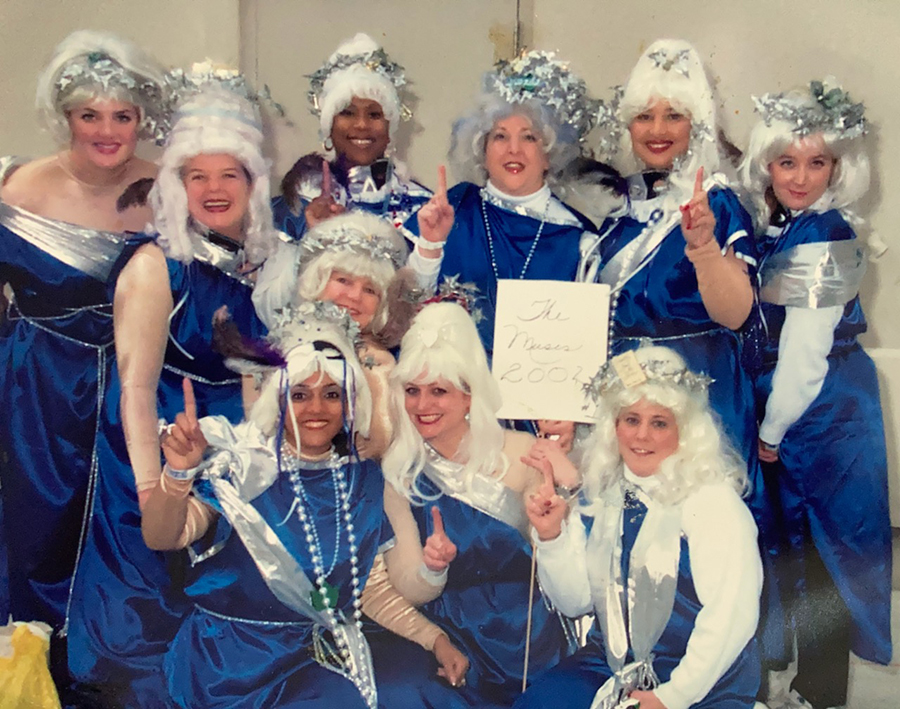
The costumes add something that a client list cannot. These are people participating together. After the briefs, plans and meeting schedules, there is a photograph worth keeping. The relationship has a social life as well as a professional one.
The women around the work
Estopinal’s connections also extend through civic boards and education. Her biography records service with the Women’s Professional Council, Parkway Partners and the University of New Orleans International Alumni Association. She has taught strategic communications, crisis communication and public relations writing as an adjunct professor at Xavier University of Louisiana.
Teaching places the work in another setting. A subject practiced for clients becomes something that has to be made understandable to students. The course titles describe concrete professional tasks: planning what to say, responding under pressure and writing for a public audience. Each can be discussed in a classroom before anyone is responsible for doing it on an organization’s behalf.
In the firm’s March 2026 reflection on Louisiana women leaders, Estopinal is also identified as a member of International Women’s Forum Louisiana. The piece acknowledges professional relationships and closes with a family tribute. Her mother, Kathryn LeSaicherre, receives a direct thank-you.
“Thanks, Mom, for setting the standard. I love you the most.”
Denise Estopinal, March 2026
It is a brief change of register. The discussion of public leadership ends with a daughter addressing her mother. No account of institutions quite contains the people who helped someone find her way into them.
A quarter-century, with company
The anniversary retrospective began in January 2026 with a reflection connecting the Morial years to a new mayoral chapter in New Orleans. It revisited a publication TEG created for Morial, New Orleans 1994–2002: Renaissance of an American City. The emphasis was on what public servants and residents could accomplish together.
Looking back through clients is a particular way of marking a company anniversary. It directs attention to the assignments that occupied the years, and to the people whose work the firm helped explain. For Estopinal, those connections stretch across the civic and cultural life of her home city.
The Muses photograph makes a fitting companion to the timeline. One records dates; the other records company. After twenty-five years of running a communications firm, both have something to tell us about Denise Estopinal. There are the offices she held, the business she founded and the work produced along the way. There are also the women gathered close enough that the beads get into the shot.