In Ecuador, rice is serious enough to be invisible. People buy it often, cook it by instinct and expect a package to make roughly the same arguments as the package beside it: clean grain, good taste, fair price. More than 20 brands crowd the market. The advertising problem is obvious. The product matters enormously, but the aisle gives a shopper almost no reason to pause.
Maruri’s answer was to make pausing the entire point. For Super Extra, the agency commissioned a Sri Lankan micro-artist named Dayananda to paint tiny prize symbols on individual grains using non-toxic vegetable ink. A grain might carry a cruise, a laptop, a television, a phone, a flight or a trip to the Galápagos. Those grains were slipped into more than 200,000 black promotional packs and distributed through Ecuador’s largest supermarket chains.
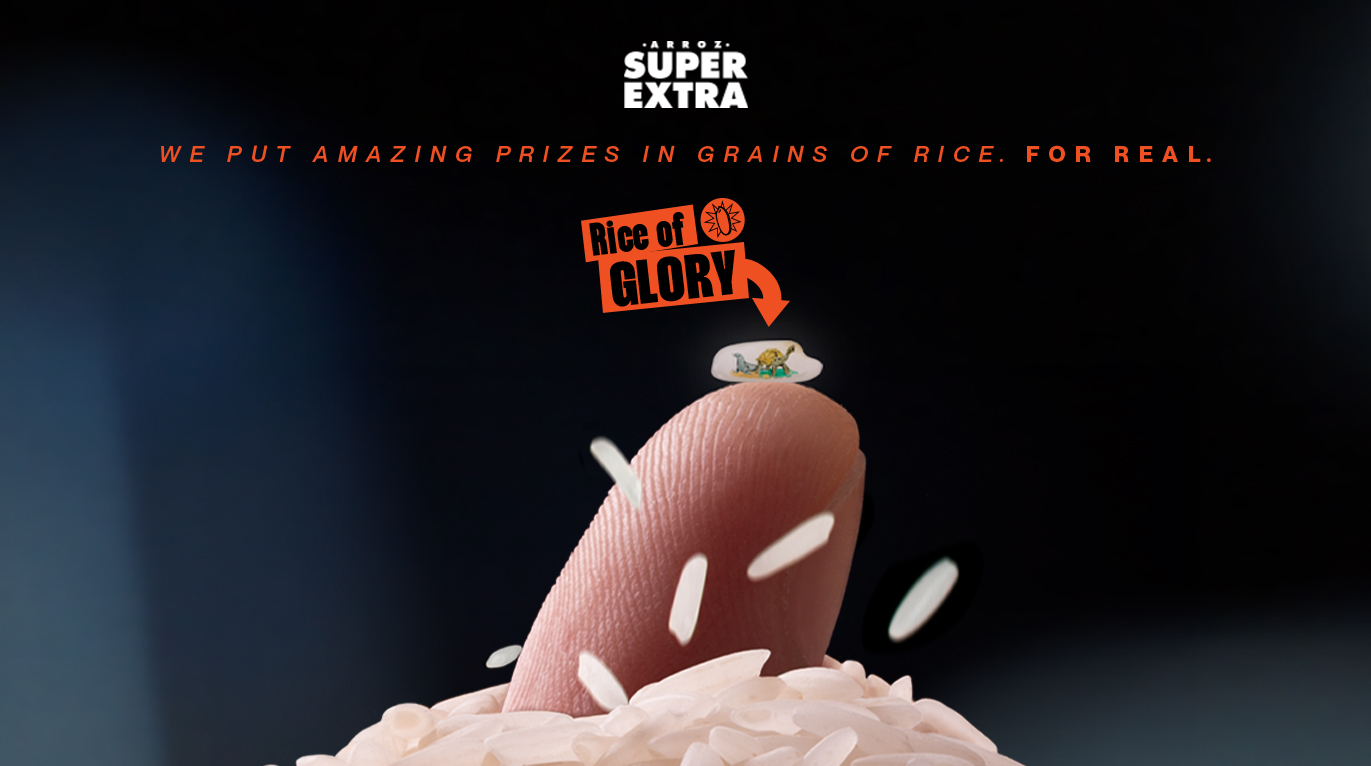
The campaign was called Rice of Glory. Television spots showed the ridiculous lengths people might go to for one grain. Billboards and social posts extended the joke. Influencers warned followers not to boil the winner into pudding or fried rice. For two and a half months, a routine purchase became a domestic treasure hunt.
All the promotional packs sold. Better still, the ordinary Super Extra pack sharing the shelf sold more than one million units - triple its default sales, according to the campaign’s London International Awards case. The stunt did not merely move the novelty package. It changed the attention paid to the familiar one.
The first thing to fail was the usual rice ad
The interesting decision came before the painted grain. The brand needed people to appreciate a difference in the product, but a normal price promotion would have trained them to appreciate a difference in price. Maruri chose an experience instead. The cost was not simply media. It was operational: a specialist artist, food-safe ink, prizes, custom black packaging, national retail placement, and enough coordination to put microscopic drawings into 200,000 bags without turning dinner into a compliance incident.
The default
Discount the bag. Win the transaction. Teach the shopper to wait for the next discount.
The Maruri move
Alter the ritual. Make inspection part of purchase and cooking. Let the product carry the media.
That switch is the piece worth copying. Start with the point at which a product disappears into habit. Then introduce a behavior that makes the buyer handle, inspect or discuss it differently. The object must be common enough for the disruption to feel surprising, and the reward must be simple enough to explain in the aisle. This is not a universal recipe. It weakens when the product is rarely bought, tightly regulated in a way that prevents alteration, difficult to distribute consistently, or unable to support the extra operational cost. A complicated mechanic will also die if a cashier has to explain it.
“The rice stayed ordinary. The buying ritual became strange.”The strategic idea in one line
A gold lion after the buyback
The timing made the grain heavier than it looked. Jimmy Maruri Rodríguez and his 25-year-old son Eduardo started De Maruri Publicidad with four other people in Guayaquil in November 1991. Jimmy brought 33 years of advertising experience. Eduardo had returned from the United States after studying economics, marketing and communication and working at Gillette. Grey approached the young shop early; the affiliation began in the 1990s and eventually put the Grey name on the door.
The arrangement delivered reach and status. Maruri won Ecuador’s first Cannes Gold Lion in 2012. In 2016, Grey bought a majority stake. At the time, the business employed 130 people across Guayaquil and Quito, served clients including DIRECTV, SABMiller and La Fabril, and had produced almost $10 million in revenue the previous year. Eduardo went on to lead Grey in Latin America and Europe.
Then the pendulum swung back. In 2024, Eduardo and his brother Fausto retook control of the agency. The Grey chapter ended, and the shorter name returned: Maruri. Rice of Glory, developed with collaborators at Grey Argentina and Grey Brasil, became the first Cannes Lion of the restored independent company. It was Gold. By then Maruri’s lifetime count had reached 44 Lions, nine of them Gold.
Awards can be a narcotic in advertising. Here, the commercial numbers are the antidote. A trophy says the jurors admired the idea. The sell-through says shoppers understood it. The million-plus ordinary packs suggest that interest escaped the special edition. That sequence - attention, action, halo - is a more useful account of creativity than a shelf full of metal.
The agency is really three companies sharing a reflex
Today Maruri presents itself as a global independent creative agency, with operations rooted in Guayaquil and Quito and a business presence in Miami. Its menu splits into Creative, Media and Pictures. Creative handles the familiar agency disciplines - brand experience, data, design, direct, health, innovation, outdoor, PR, promotion, radio and sustainability. Media plans and buys attention. Pictures develops long-form branded entertainment through production and distribution.
Clients buy the combination rather than a piece of software or a standardized subscription. The business is project and relationship work: strategy, creative development, production, media execution, public relations and activation. That puts Maruri against Ecuadorian network agencies such as Paradais DDB, Norlop VML, McCann and Ogilvy, as well as independent shops. The large networks can offer a ready-made map. Maruri’s case is that an idea can travel without being scrubbed of where it came from.
Its better-known projects have the same behavioral streak as the rice. Nature Represented, for environmental company Sambito, treated Ecuador’s constitutional rights of nature as an invitation to recruit legal professionals to represent ecosystems. Boomerang 104 worked for Quito Sin Minería. Born to Be the Last, made with Casta Diva Pictures for Born Free, gives Lonesome George - the last Pinta Island tortoise - a final confession about captivity and conservation.
Not “content” in the abstract. It sells a reason for somebody to do something: inspect the rice, volunteer legal time, reconsider captivity, or keep watching past the length of an ad.
From a thirty-second spot to a five-part story
The Pictures unit makes the next wager explicit: some brand ideas need more room than an ad break. In July 2026, Lavazza launched Family Blend, a five-episode miniseries developed creatively with Maruri Group. Francesca Scorsese directed; her father Martin starred alongside her, with Jason Biggs among the cast. The two-to-three-minute episodes follow family, coffee and memory through New York, released monthly on the brand’s global channels.
It is tempting to treat that as a glamorous departure from rice in an Ecuadorian supermarket. It is closer to the same trick at a different scale. A common object - coffee this time - becomes the handle for a story. The brand sits inside a ritual people already understand. Maruri’s job is not to shout the product benefit more loudly. It is to notice that a cup, like a grain, can carry more meaning than its dimensions suggest.
There are limits. Branded films fail when celebrity substitutes for an observation, when distribution is an afterthought, or when the audience can feel the strategy deck under every line. Physical promotions fail when novelty overwhelms trust. Purpose campaigns fail when an agency borrows a cause without changing an outcome. Maruri’s strongest work avoids those traps by making the mechanism visible and the participation concrete.
The company’s history now reads like one of its campaigns. It began as a family name, traded some independence for a global network, and then reclaimed the name when the brothers bought back control. The first international proof of the new arrangement was not a corporate manifesto. It was a black bag, a tiny painted symbol, and thousands of Ecuadorian households peering at dinner before putting it in the pot.