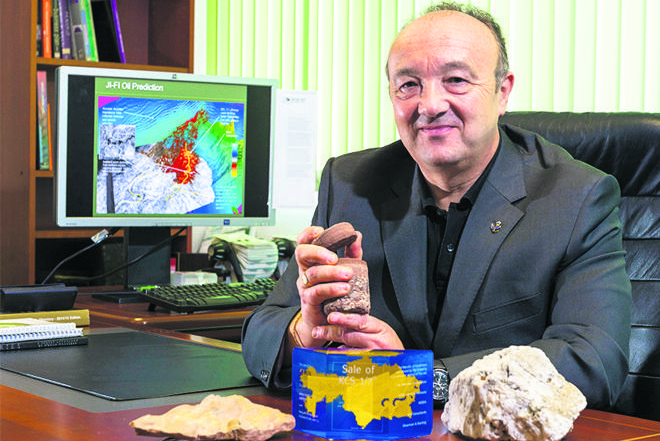
On Martyn Millwood Hargrave’s desk, the rocks get a seat at the meeting. In a photograph from 2014, he holds a sample between his hands. More specimens occupy the foreground; behind him, a computer displays a colourful subsurface model. The arrangement offers a tidy introduction to the founder of Ikon Science: something you can pick up, something you can calculate, and a business built around the relationship between them.
He founded Ikon in 2001. Its territory was the inconveniently invisible world below the surface, where an interpretation can carry expensive consequences. Today his work includes a visiting professorship at Oxford and an advisory role at EnergyPathways. The questions have widened from finding resources to storing energy and carbon. The rocks have kept their place in the conversation.
A useful model has to leave the laboratory
His route into the subject began well before the software. Born in Castleford and raised in Ferrybridge, he discovered science through a childhood chemistry set. Geology became a school subject, then a degree at Durham. A postgraduate qualification in geophysics at Queen Mary College, University of London, added another way to investigate what cannot simply be inspected on foot.
His early professional life included GSI and Enex UK. Later, as managing director of IKODA, he built an independent upstream consultancy involved in international transactions, including the North Caspian negotiations. The career brought technical interpretation into contact with commercial decisions. His ventures also included involvement in Fusion Oil & Gas, Virgo Energy and Ophir Energy. Ikon would give that combination a software business of its own.
RokDoc became a practical meeting place for measurements and geological interpretation. In 2005, Ikon released a pore-pressure module developed with Shell’s Houston research operation. Shell used the technology in training and project delivery. A problem encountered inside an energy company could become a product available more widely. For a specialist software supplier, that was a useful route from an idea to people who had reason to pay for it.
The partnerships grew. In 2015, Schlumberger and Ikon agreed to develop software together, bringing RokDoc workflows into Petrel. Ikon had developed nine plug-ins covering steps from matching well and seismic information to predicting pore pressure. The aim was to make related tasks work together more directly. Geoscientists already had enough underground complications; their applications did not need to add a fresh layer.
Recognition followed the technical work. In 2016, the Institute of Physics gave Ikon an Innovation Award for Ji-Fi, its joint inversion technology. The achievement belonged to the company and the people developing it. For Millwood Hargrave, still CEO, it also put a public marker on the proposition he had spent years commercialising: applied physics could become a tool people used in consequential work.
Ikon’s Queen’s Award for Innovation in 2019 described software connecting measured rock properties with seismic information to build subsurface models. Type of rock, porosity and fluid content all belonged in that picture. The point was to make geological interpretation more grounded in measurements. A pleasing image on a screen had to earn its keep.
The question in the interview room
For someone selling technical sophistication, Millwood Hargrave had a notably ordinary question for prospective colleagues: “what makes you happy?” He described asking it when discussing recruitment in 2007. Academic credentials mattered, but he also wanted evidence of independent thinking, energy and enthusiasm. An impressive qualification did not complete the interview on its owner’s behalf.
He spoke about giving staff flexibility and room to think. “If the environment is fun, people tend to work better.” That is a fairly economical management philosophy. It asks a scientific workplace to accommodate the people doing the science, including their curiosity and character. The recruitment conversation reveals a founder interested in how a team behaves as well as what its members know.
“If the environment is fun, people tend to work better.”
Martyn Millwood Hargrave, 2007
He could be equally particular about the language of software. Discussing linked modelling tools in 2007, he objected to calling a simple transfer of data “integration”. He wanted the word to describe a more active relationship, in which a change in one application could update the other. His comparison was between a dial-up modem and broadband. The geological model, in his account, ought to stay connected.
Giving the chief executive a different chair
In February 2017, the founder changed jobs inside his own company. Mark Bashforth became CEO; Millwood Hargrave became executive chairman. Bashforth brought experience from geoscience software businesses including CGG and Roxar. Millwood Hargrave continued to lead the board. The transition gave the growing company another executive’s commercial experience while keeping its founder involved in its direction.
The timing mattered. The industry had been through an oil-price downturn, and customers were working under tighter conditions. Bashforth described joining when Millwood Hargrave wanted a commercially minded leader to drive future growth. The account makes the handover concrete: the business had a particular need, and its founder recruited for it. A familiar title could give way to a different responsibility.
Great Hill Partners acquired Ikon in 2018, with Millwood Hargrave identified as chairman in the announcement. A later ownership chapter began when Carina Software acquired the company, completing the transaction on 27 December 2024 and announcing it in February 2025. Carina sits within Vela Software and Constellation Software. Ikon’s life as a specialist business continued through changes in leadership and ownership.
- 2001Founds Ikon Science
- 2017Moves from CEO to executive chairman
- 2021Joins Oxford as a visiting professor
- 2026Becomes EnergyPathways’ chief scientific adviser
He had also taken the industry’s questions into Parliament. In March 2009, he appeared before the Energy and Climate Change Committee alongside Steve Jenkins and Encore Oil chief executive Alan Booth. The inquiry concerned oil and gas resources in the North Sea and west of Shetland. He introduced Ikon as a technology and service provider, placing that part of the industry alongside the companies exploring for resources.
A classroom for the commercial questions
Oxford appointed Millwood Hargrave visiting professor in Earth Sciences in June 2021. The brief included helping develop the subject’s contribution to carbon and energy storage. His appointment brought a career in creating and growing businesses into a department considering how geoscience could serve a changing energy system. Entrepreneurship was part of that conversation from the beginning.
There was a classroom expression of it, too. The undergraduate handbook for 2023-24 scheduled him to teach entrepreneurialism and business ethics. It is a telling combination. Commercial decisions belong in a scientist’s education, alongside questions about the responsibilities that come with them. Students could encounter someone who had spent years taking scientific work into negotiations, products and companies.
The university renewed his visiting professorship for three years from June 2024. In describing the next period, he identified greenhouse gas removal, monitoring carbon capture and storage, and mentoring startup ideas among his interests. He also pointed to sub-Arctic and Antarctic questions. His phrasing left room for enjoyment: he hoped to keep having “serious fun”.
The carbon-storage work also had a public-facing counterpart. In March 2021, he was scheduled to discuss the subsurface background to carbon capture, utilisation and storage at a Geological Society Business Forum event with Storegga CEO Nick Cooper. The pairing brought geological understanding alongside the work of deploying and commercialising a project. Those two conversations had been meeting throughout his career.
A landing the sea declined
His interest in polar places has a more personal scene attached. After eight days sailing from Bluff, New Zealand, he reached Cape Adare aboard the expedition ship Ortelius. He wanted to land and see the remains of the hut established by Carsten Borchgrevink’s expedition in 1899. The weather was fine. The sea was too rough. The itinerary had failed to secure the ocean’s agreement.
The journey continued nearby, with a helicopter reconnaissance around Robertson Fjord. In his account, the glaciers and crevasses made the ship look tiny and sent his thoughts toward Scott, Shackleton and Amundsen. He marvelled at their journeys across such terrain. It is a pleasingly uncorporate glimpse: a geoscientist looking at a landscape and trying to imagine the experience of people who crossed it with far fewer conveniences.
The next job for the subsurface
On 26 May 2026, EnergyPathways appointed him chief scientific adviser to its CEO and board. His remit includes technical, strategic and policy work on MESH, a proposed integrated energy storage project in the Irish Sea with a connection to Barrow-in-Furness. The plans combine compressed-air energy storage with natural gas and hydrogen storage, alongside possible industrial opportunities involving graphite.
These remain development ambitions. Millwood Hargrave’s assignment concerns the subsurface systems and the connections between energy infrastructure, hydrogen and industrial uses. He is advising Ben Clube and the wider team on a project whose questions extend beyond a single reservoir or software product. The attraction is recognisable: several kinds of knowledge need to become useful together.
That offers a way to read his career. A sample on a desk, a model on a screen, a recruitment conversation, a university class and an offshore storage proposal each require someone to connect scientific understanding with a decision. Millwood Hargrave has kept returning to that work. The underground still supplies the complications. He is finding it another set of customers.