The shovels are polished. The ground is less cooperative. In a photograph from a September 2026 construction event in Laval, Martin Raymond stands at the left of a group of four, in a blue jacket and tan trousers, beside a sign advertising Le Marius. Behind them are the practical furnishings of a building site: equipment, temporary barriers, a road, and a very large promise printed on a board.
The property once housed a business selling and renting recreational vehicles. Now Velyon and the Fonds immobilier de solidarité FTQ are developing 238 rental homes there. The seven-storey building is expected to welcome its first tenants in spring 2028. A place associated with getting away will become a place to come home. Real estate occasionally supplies its own joke, without charging a consulting fee.
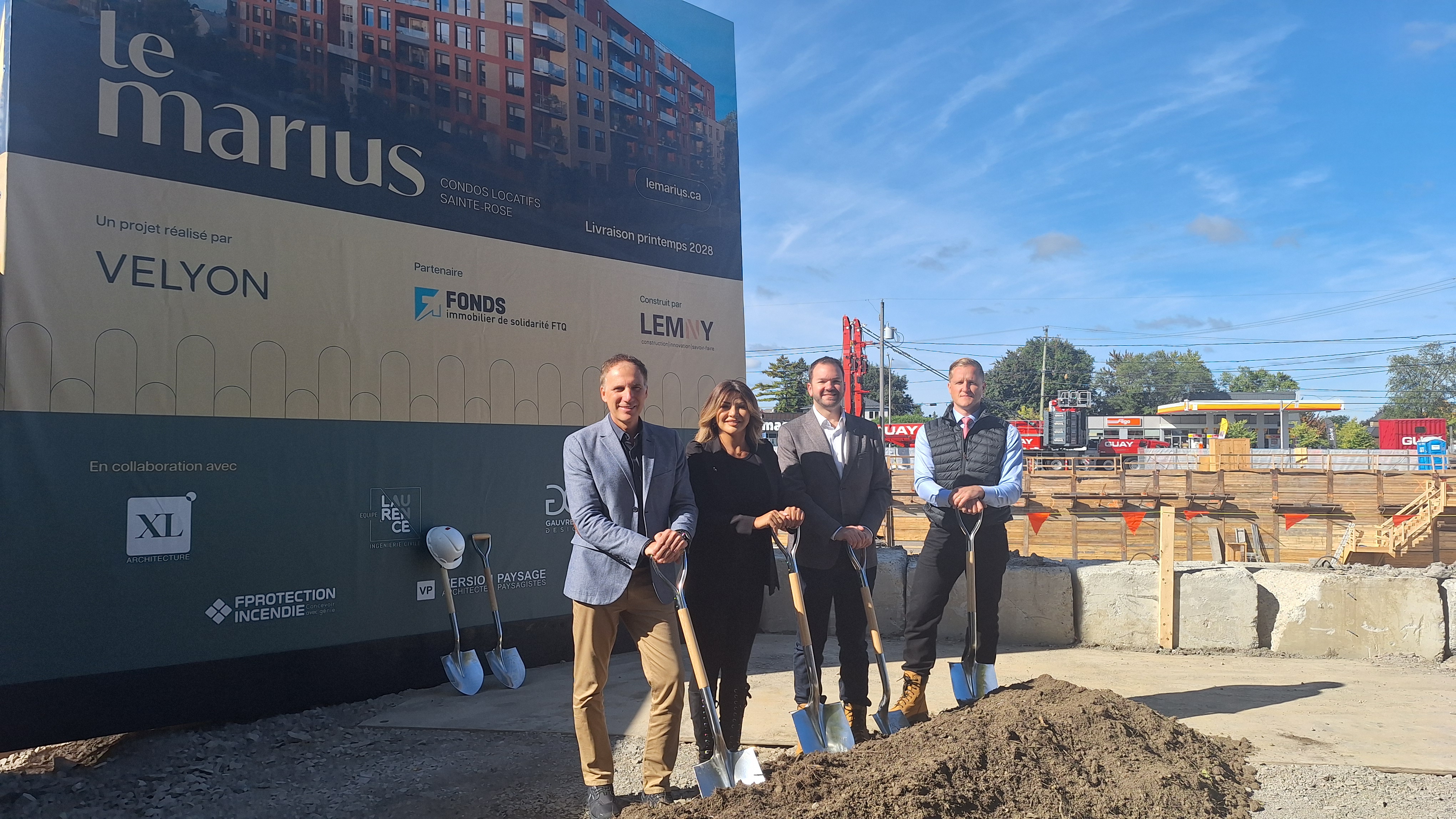
Raymond, the Fonds immobilier’s president and CEO, draws attention to the location: services nearby, the old Sainte-Rose village within walking distance, and access to natural spaces. Those details bring an investment announcement down to the scale of an ordinary day. A building has a budget and a delivery schedule. Its residents will also need somewhere to walk.
The scene is a useful entrance to his career. Raymond’s work has covered appraisal, acquisitions, investment, and asset management. The recurring question is what a property might support next. In Laval, the answer is visible on the construction sign, though the finished homes remain ahead. The distinction between a project announced and a project occupied is the distance his organization must travel.
Learning to read a property
Before Raymond led a Québec real estate investment organization, he worked across several parts of the property business. His career includes Deloitte, Cushman & Wakefield, Ivanhoé Cambridge, and Kevlar. The projects in his professional record extend beyond Québec to other parts of Canada, Europe, and emerging markets. His experience spans more than twenty-five years.
There is a technical thread through that record. He is a chartered appraiser, with recognition from Québec’s professional order and the Appraisal Institute of Canada. He graduated from ESG-UQAM and holds an executive MBA in real estate. Valuation and management both appear in his background, bringing the assessment of a property together with the work of operating an investment.
A 2022 professional presentation gives more texture to the earlier positions: acquisitions and asset management at Kevlar, a senior managing role at Cushman & Wakefield, investments in growth markets at Ivanhoé Cambridge, and investment and asset management at GWL Realty Advisors. The job titles describe a career moving among transactions, portfolios, and the decisions that follow a purchase.
That range matters to the role he eventually accepted. The Fonds immobilier finances development, but its activities also involve construction and the management of real estate assets. Experience in those different stages supplies relevant preparation. It does not make a future project inevitable. Buildings retain an irritating ability to require work after the spreadsheet has been admired.
Real estate investments
and CEO
in Terrebonne and Laval
Three years inside, then the top job
Raymond joined the Fonds immobilier in 2020 as senior vice-president of real estate investments. He initially led professionals working in investment and construction, with responsibility for the performance and growth of the development portfolio. His arrival put an internationally experienced property executive inside an organization whose development mandate is rooted in Québec.
On June 19, 2023, he was appointed president and CEO. He succeeded Normand Bélanger, who had led the organization for fourteen years. The succession came from within: Raymond had already spent three years working with its people, portfolio, and partners. The appointment connected an existing investment responsibility to leadership of the wider business.
At the time, Raymond spoke about roughly fifty partner-developers and multidisciplinary teams covering investment, development, property management, finance, law, and marketing. That list is revealing. Property development depends on people whose disciplines do not share a vocabulary, even when they share a meeting room. A legal condition and an architectural preference can occupy the same sentence quite uncomfortably.
His leadership therefore sits among several kinds of expertise. The organization’s mandate includes residential projects, social and community housing, affordable homes, industrial space, offices, and mixed-use developments across Québec. The job reaches beyond choosing a promising site. It involves an institution that must keep a variety of projects and relationships moving at once.
“I am truly honoured to take up this position.”
Martin Raymond · June 2023
The work between the cheque and the keys
Raymond has described the Fonds immobilier as involved throughout development, from land valuation and acquisition through construction, management, and sale. That account gives a practical meaning to his frequently used idea of a catalyst: the investor remains involved while the project changes shape. Capital arrives with a continuing relationship attached.
In a 2025 interview, he outlined an approach based on shared equity with a developer partner. Both sides contribute to the venture, and the Fonds participates across its stages. The arrangement makes the choice of collaborator consequential. An investment organization needs development expertise close to the site; a developer needs financial backing that can accompany a lengthy process.
His public commitments also extend to affordable housing. He has framed those commitments alongside environmental performance and the economic purpose of investment. The interesting tension is the number of demands a project must carry simultaneously. More housing, a workable financial structure, and durable buildings all require decisions before anyone can turn a key.
Raymond’s involvement reaches into the discussions surrounding those decisions. He served on the Institut de développement urbain du Québec’s board from 2017 to 2023. Montréal’s 2023 real estate facilitation action plan also lists him among its members, and the Chamber of Commerce of Metropolitan Montreal included him among the people consulted for its housing study. These are forums where the mechanics of building become a shared civic problem.
Twelve storeys, with another way to build
On Earth Day, April 22, 2026, Raymond joined Janie C. Béïque, Terrebonne mayor Mathieu Traversy, and project partners at the launch of a twelve-storey mass timber rental building. Planned for Lucille-Teasdale Boulevard, it is intended to add 164 homes. Its first units are expected in spring 2028. Here, the proposed change begins with the structure itself.
The building uses prefabricated mass timber and targets Zero Carbon Building - Design certification. Its timber comes from Nordic Structures - Chantiers Chibougamau. The project also incorporates Upbrella, a Québec-developed system that shelters construction and protects materials from the weather. The method brings questions about materials and the building process into the investment decision.
Raymond’s remarks at the launch connected the structure to material reuse, energy performance, and the carbon intensity of the real estate portfolio. These are stated aims of a project under construction. They are useful to examine as intentions with a timetable, rather than as results already achieved. An environmental target acquires its substance through design, execution, and eventual operation.
The broader ambition is repeatability. A construction method that can be applied again offers a different prospect from a single demonstration building. Terrebonne gives Raymond’s investment approach a specific test: can a development supply homes while helping establish a method other projects can use? The answer will depend on the work that follows the ceremonial digging.
Mass timber structure · Zero-carbon design certification targeted
A drive-in’s next screening
Housing occupies much of Raymond’s public discussion, but his portfolio responsibilities also include industrial property. In September 2025, MONTONI and the Fonds immobilier launched Écoparc Laval 15 on the former site of the Laval drive-in cinema. The announced investment was C$325 million, for five buildings totaling 1,067,000 square feet. The property’s next audience is businesses.
The plans target LEED Silver and zero-carbon design and performance certifications. Raymond emphasized modern, flexible infrastructure and access to major transportation routes. The location, at highways 15 and 440, supplies the logistical argument. The environmental targets supply another part of the brief. Both belong to the same development, with neither doing the other’s job.
The plan also reserves more than thirty percent of the site for green space, including a protected wetland. A former leisure destination becomes an industrial campus with environmental commitments. For Raymond, this project sits beside residential development in the same investment mandate. The reuse of land can serve different purposes, even when the financial machinery has familiar parts.
The long interval before moving day
Raymond also takes the discussion into public forums. In June 2022, he joined Alain Dumaine of Otéra Capital and Luc Maurice of Le Groupe Maurice for a UQAM webinar on innovation in real estate development and financing. The event was part of the university’s series inviting the industry to reconsider how property is developed.
By the end of 2025, his public updates described new residential partnerships and more than 2,300 market-rate units under construction as of November 30. He thanked partners involved in operating eighty-four assets and developing further projects. The wording returns to the people around him. The portfolio is presented as work carried out with collaborators, rather than a collection of solitary bets.
There is a long interval between a convincing proposal and an occupied apartment. Raymond’s career has given him responsibilities at several points in that interval. Today, the sites associated with his leadership include a former dealership, a former drive-in, and a timber building rising toward twelve storeys. Their announced futures differ; their need for sustained execution is shared.
At Le Marius, the photograph leaves him beside a shovel and a rendering. The sign has already furnished the building with a name. Tenants are expected later. For now, the story is in the ground: a familiar commercial corner being prepared for another use, and an investor whose work will be judged in part by what people can eventually do there.