A house can be a home, a construction job, an investment, and a tax question, all at once. The people paid to understand it usually arrive with different business cards. Andrew Canter built his career around getting them into the same conversation. It is an unglamorous starting point for an entrepreneur: a coordination problem. Yet it has taken the San Diego founder from private banking to California renovations, from brokerage to wealth management, and from property investment to backing a park made to move.
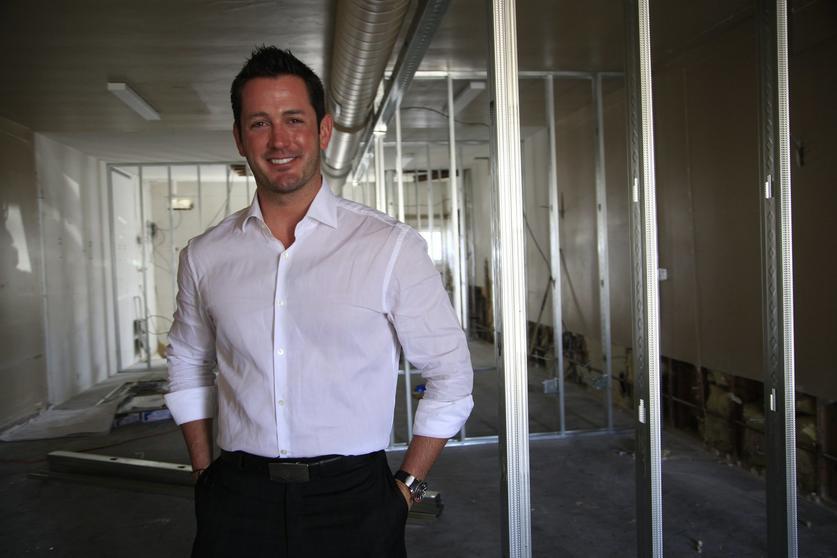
Consider the photograph of Canter in an unfinished office. He is smiling in a white shirt, standing among metal studs and exposed ductwork. The ceiling has yet to acquire its manners. It is a useful image for a career spent working across the polished presentation of finance and the less presentable business of making buildings ready for people.
His company’s organizing idea is that assets have relationships, even when their advisors do not. A property belongs on the same financial map as an investment account. Making that connection has become the work of Canter Companies, and the thread through its founder’s rather varied professional life.
The banking job that opened another door
Canter’s early education in investing happened while he was studying business at San Diego State University. He worked in Wells Fargo’s private banking investment group. After graduating, he traveled to Europe, where he met investors interested in his banking background. They hired him to work on development projects in Las Vegas. A trip after college had acquired a job description.
The work eventually brought him back to California and into buying, fixing, and reselling houses with a former colleague. He later described that period as an education in diversification during a falling market. The sequence is revealing without requiring a myth about a single flash of inspiration: banking experience introduced him to investors; development work introduced him to property; property exposed him to a wider set of financial decisions.
Each step carried practical consequences. Buying a building, improving it, and finding its next owner require different people and different judgments. Canter’s later businesses would bring more of those activities into the same orbit. The career began to take its shape through the work itself.
A brokerage, then a wider circle
In 2009, Canter founded Canter Brokerage. As the business expanded, he brought in leadership with experience in development, construction, restoration, and sales. Luke Middleton’s appointment as managing director was one such move. The brokerage offered agents access to services including marketing, legal guidance, and escrow, drawing on the company’s other divisions.
That matters in a founder’s story because a company grows through the work it hands to other people. An investor can pursue a deal personally. A brokerage needs a structure in which agents can pursue many deals. Canter was assembling both the business and the professional support around it.
His team eventually grew beyond a hundred agents and joined Compass. The real estate business now operates as Canter Real Estate Group. His Compass biography identifies him as a broker associate and describes the group as its leading San Diego team by sales volume for 2019-2020. The dates belong beside the achievement: they record a particular chapter of the brokerage’s growth, rather than an eternal position on a leaderboard.
The space between the appointments
Canter’s explanation for the broader company starts with a familiar household arrangement. Investment advisors manage money. Accountants prepare taxes. Estate attorneys handle trusts. Real estate agents advise on property. Those responsibilities overlap, but the professionals may work separately. The client becomes the person carrying information between appointments.
Canter Companies was built to coordinate more of that work. Its real estate operations sit alongside wealth management and private capital. Canter Wealth offers fee-only financial planning and investment management; the company’s development and investment activities address another substantial part of the picture. The intended result is an approach in which decisions can be considered together.
It is easy to enjoy the language of integration. Doing it requires people to share information, understand another profession’s priorities, and recognize where their own assignment ends. The appeal of Canter’s idea rests on something more modest than a grand theory of investing: fewer decisions made in isolation.
“Simply put, we focus on controlling the things we can actually control.”Andrew Canter, 2017
A connected business still needs clear boundaries
The company’s public description includes development, distressed single-family funds, notes, loans, multifamily projects, mixed-use buildings, and land. This is a collection of activities with different demands. Some involve an operating property. Others involve construction or a financing relationship. Having them within a wider organization does not make them interchangeable.
The relationships also deserve clarity. Canter Wealth’s regulatory disclosures describe affiliated businesses and explain that some representatives are licensed real estate agents with an independent brokerage. The disclosures identify potential conflicts from additional transaction compensation, require those relationships to be disclosed, and leave the decision to use particular services with the client.
That is part of the substance behind the company’s premise. Coordination can make information easier to share; the client still needs to understand who is being paid for which task. Canter’s model puts the connections on the table. Its credibility depends on those connections being useful and legible to the people whose assets are involved.
Buy · sell · develop
Goals & decisions
Plan · manage investments
The city is part of the portfolio
Canter Development’s focus on urban infill makes the business visible in existing neighborhoods. Infill starts with sites inside the city’s built fabric, where a new project has neighbors before it has tenants. The company has pursued projects across San Diego, including Hillcrest, Little Italy, North Park, and Solana Beach.
Those locations give the career a scale that a list of divisions cannot. C2 Lofts and Uptown Lofts in Hillcrest, Ten on Columbia in Little Italy, Elevon Lofts in North Park, and 3 on Cedros in Solana Beach were among the developments Canter named in his account of the company. They put street-level consequences beside the financial work.
One Little Italy site found an extra use before redevelopment. Three houses scheduled for demolition became a training environment for the San Diego Fire Department. Approximately 400 firefighters participated over two days, practicing searches, escapes, rescues, and breaching techniques amid simulated conditions. The planned ten-unit development could wait while the existing buildings did one more job.
Approximate number of firefighters who trained over two days at the Little Italy development site.
Before the buildings came downA park with an exit plan
In 2013, graduates of the NewSchool of Architecture and Design were working on a different kind of infill. Their firm, RAD Lab, wanted to make an East Village vacant lot into Quartyard: a temporary public gathering place with uses including a beer garden, coffee shop, food trucks, and a dog run.
The plan was to lease the land and build with shipping containers. When the site was needed for something else, the structures could be moved. A park had acquired an exit plan, a quality more often associated with its investors.
Canter invested enough to help the project move toward completion, following money already raised through Kickstarter. He liked the reusable concept and the possibility of replicating it elsewhere; he also wanted to help the graduates bring their work to life. The investment amount was not publicly specified in the contemporary account.
Quartyard gave his interest in the city a different form. A development opportunity could include temporary occupation and public activity. The graduates needed a financial partner, and the site needed a use. Canter helped connect the two.
When property meets software
Canter Capital extended the investment activity beyond real estate. In 2014, Canter discussed backing HouseCall, then an app connecting customers with local home-service professionals. The connection to his existing work was practical: a brokerage encounters the need for those services repeatedly.
He described looking for founders and employees with aligned interests and complementary skills, alongside a product that filled a need and could scale. He also emphasized talent and participation in San Diego’s startup community. His investment interests were widening while retaining a local point of reference.
A company built around houses had found a reason to consider software. The user still needed someone to do a job at a property; the app changed how that person could be found. It is a concrete example of how an investor’s operating experience can make a neighboring business intelligible. Canter’s later company biography lists connections across HouseCall, escrow, property management, pest control, distribution, and brewing.
Integration followed him home
There is an unusually domestic episode in this career. In September 2013, Qualcomm used Canter’s modern home for a photo shoot featuring connected-home technologies. The demonstrations covered media streaming, networking, and augmented reality. For someone building a business around coordination, a house full of technologies designed to communicate was a fitting setting.
His interests extend beyond the property business, too. He qualified as a private pilot in 2022, is a certified scuba diver, and enjoys skiing with his family in Vail. They are ordinary biographical details with welcome specificity: a cockpit, the water, a ski slope. They need no conversion into management slogans.
Recognition has remained rooted in San Diego. He was honored in the 2013 Emerging Generation: 25 in Their 20s awards. In 2026, readers selected him in San Diego Magazine’s La Jolla real estate agent category. Between those dates lies the less ceremonial work of building companies, finding partners, and handing responsibilities to a team.
Canter has described success in terms of helping others and creating jobs. His career gives that ambition several settings, from a brokerage to a construction site to a temporary park. The people, professions, and buildings are particular. So is the problem he keeps returning to: a great deal can happen when the specialists begin talking.