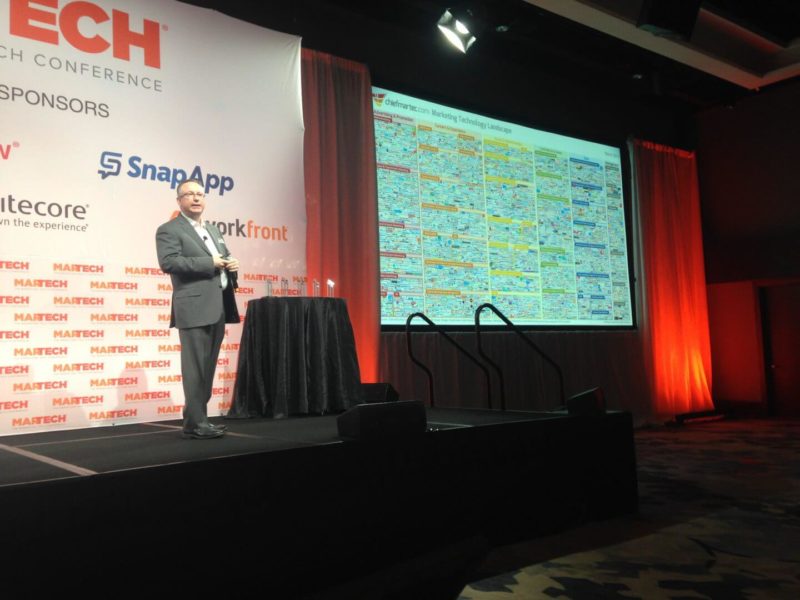
In San Francisco in 2016, Scott Brinker stood before an audience of marketers with a chart containing 3,874 vendor logos. He suggested that vendors might give away magnifying glasses. “This is the squinting conference,” he said. It was a good joke about a serious purchasing problem: the industry was producing choices faster than people could make sense of them.
That predicament explains MarTech, the publication and conference business built around the intersection of marketing strategy and technology. Its readers are the people expected to turn software into working campaigns: marketing operations specialists, technology buyers, department leaders and practitioners. They need to understand what connects, what costs money and what happens after the sales demonstration ends.
- Media and events for marketing technology buyers.
- Free reporting; paid training and vendor programmes.
- Will another tool improve the work?
Two titles. One increasingly obvious idea.
The current MarTech publication arrived in May 2021, when Third Door Media combined Marketing Land and MarTech Today. The reasoning was editorial: marketing strategy and the systems used to execute it belonged in the same conversation. The conference had already adopted the slogan “MarTech is marketing” in 2019. The merger gave that argument a single home.
Its events had an earlier beginning. During the 2012 holiday period, Third Door Media founder Chris Elwell emailed Brinker after discovering his chiefmartec blog. Had he considered a trade show? Brinker replied in about ten minutes. The first MarTech conference followed in Boston in 2014. A specialist conversation had become a gathering, then a publishing identity.
The 2021 launch also brought weekly technology-procurement contributions from Real Story Group and cartoons from Tom Fishburne’s Marketoonist. That pairing makes sense. Buying enterprise software requires sober questions and a tolerance for absurdity. MarTech made room for both, rather than treating marketing technology as an endless procession of product announcements.
A reading habit with a purchasing department
The core offering is a stream of news, analysis and practitioner advice, distributed through the website and free newsletters. Research adds a second layer: the Replacement Survey tracks technology changes; the Career and Salary Survey examines the profession; Intelligence Reports explain software categories and prospective purchases. The catalogue spans customer data platforms, digital asset management, email and other specialist systems.
These resources meet different moments in a reader’s working life. An article can explain a development over breakfast. A buyer’s guide can structure questions before a procurement meeting. A conference session can put a practitioner’s experience beside the theory. The connection between editorial coverage and event programming is part of the design, with themes and contributors moving between the two. A reader can revisit the same problem through reporting, a survey discussion and questions put directly to a speaker.
By 2026, the conference programme advertised four virtual editions, plus Master Classes. November’s conference is free to attend. The Master Classes FAQ lists a standard price of $299 per class, with discounts available; registrations include 365 days of replay access. That creates a route from free reading to focused, paid instruction without airfare or a hotel bill.
the category.News + buyer’s guides
peers do.Surveys + conferences
the skill.Paid Master Classes
The software stayed. The problem moved.
MarTech’s own research supplies a useful complication to the technology story. In its 2025 State of Your Stack survey, 65.7% of respondents identified data integration as a management challenge. Budget constraints were the leading adoption barrier, cited by 51.5%. The survey drew 169 completed responses from the MarTech, chiefmartec and MarketingOps.com communities. These are community findings, not a census of every marketing department.
A later analysis of the 2025 Replacement Survey found falling replacement rates for core tools. Marketing automation declined from 31.1% in 2024 to 19.4% in 2025. CRM fell from 22.1% to 9.7%. Yet another analysis found that 62.9% of respondents who replaced a platform also increased their total application count. Keeping the foundation did not stop people adding another floor.
This is where the publication earns attention. The interesting question becomes whether the next tool creates enough value to justify another integration, another training exercise and another bill. Reading the research together suggests a practical sequence: identify the business problem, inspect the existing workflow, then ask what a purchase would actually change. That sequence is an editorial inference, not a promise of savings.
Less ripping. Less replacing.
Readers on one side. Vendors on the other.
The business has two constituencies. Practitioners want useful information; software companies want access to practitioners who may buy. Third Door Media sells advertising, sponsored content, webinars, content syndication and lead-generation programmes. It says its wider portfolio engages more than a million digital marketers each month. That figure covers the portfolio, including sibling properties, rather than MarTech alone.
The competitive alternatives depend on the task. CMSWire covers overlapping customer-experience and technology subjects. Marketing Dive offers broader industry news. Vendor documentation answers product-specific questions, while analysts and specialist consultants can examine a particular purchase. MarTech’s proposition combines accessible reporting, category guides, community surveys and recurring events. Its utility comes from the connections between those formats.
The company also experiments with the technology it covers. MarTechBot puts its archive into a conversational interface. A 2024 update introduced specialist personas and image generation. Its author profile explicitly acknowledges mistakes and invented information, and says human editors review its articles before publication. The experiment makes the limits of automated advice unusually visible inside a marketing publication.

Now the guide has a software owner
In October 2024, Semrush acquired Third Door Media, including MarTech, Search Engine Land, SMX and Digital Marketing Depot. The announcement said the brands would continue separately and the editorial and conference teams would remain. Adobe completed its acquisition of Semrush in April 2026. MarTech now sits within a much larger marketing-software ownership chain.
That relationship matters when the subject is software selection. MarTech states a commitment to independent journalism and publishes ownership disclosures. Readers can use those disclosures alongside the distinction between editorial articles and sponsored material. A guide is most useful when the reader understands who publishes it and why a particular piece of content exists.
For a team facing a purchase, the copyable habit is modest: use a guide to sharpen the shortlist, compare survey findings with your own constraints, and take specific questions into a demonstration. Reading cannot clean a customer database or give an understaffed team implementation capacity. But it can improve the questions asked before the contract. In a room full of tiny logos, that is a worthwhile place to start.
MarTech · Research & buyer’s guides · Master Classes · Inside the stack survey