At Energizer’s annual shareholders’ meeting in January 2015, Mark LaVigne had a rather precise job. Ward Klein, then chief executive, handed him the formal business. LaVigne explained the voting arrangements, established that a quorum was present and moved the meeting along. For a corporate lawyer, it was familiar territory: rules, shares, procedure. Within months, he would be helping run the business that emerged from one of the company’s defining transactions.
The distance between those two assignments is the interesting part of his career. A lawyer can help a company buy something, sell something or separate into pieces. An operator has to make the resulting arrangement work on Monday morning. LaVigne crossed that distance at Energizer, becoming chief operating officer in 2015, president in 2019 and chief executive on January 1, 2021.
Today, the St. Louis executive leads a business whose products are familiar enough to escape much thought: batteries, portable lights, car-care products. Familiarity is a peculiar commercial achievement. People can recognize the rabbit immediately and still postpone buying batteries until the remote control has become a small, rectangular disappointment.
A client before it was an employer
LaVigne’s connection to Energizer began before his employment there. He started his legal career in 1998 at Bryan Cave, the firm now known as Bryan Cave Leighton Paisner. His work involved business and transactional advice, including mergers and acquisitions. He became a partner in 2007 and remained one until joining Energizer in 2010.
Among the transactions on which he advised Energizer were the Playtex and Edge/Skintimate acquisitions. That is a useful detail in a career easily reduced to a sequence of titles. He had already encountered the company at moments when it was changing its shape. He knew it as a client making consequential decisions before he became an employee responsible for them.
His education had taken him through the University of Notre Dame for a bachelor’s degree and Saint Louis University for his law degree. His early professional training then placed him close to the practical questions that surround acquisitions: what belongs in a business, how ownership changes and what obligations travel with it. Those questions would return, with considerable force, in his next chapter.
He joined Energizer in March 2010 as vice president, assistant general counsel and corporate secretary. In April 2012, he became vice president, general counsel and corporate secretary. The progression put him inside the organization’s decision-making machinery. Soon, that machinery itself would need rearranging.
The separation became his apprenticeship
Energizer was preparing to split its household-products and personal-care businesses. LaVigne served as separation lead and sat on the executive steering committee while also carrying his legal responsibilities. In July 2015, the battery and lighting business began life as an independent public company, while the former parent became Edgewell Personal Care.
The word “separation” sounds tidier than the assignment it describes. A public company needs governance, financial arrangements and people with clear responsibilities. Its customers still expect deliveries. Its employees still need to know who makes decisions. The announcement can occupy a morning; the work behind it occupies rather more of the calendar.
LaVigne emerged as executive vice president and chief operating officer. The planned remit included commercial operations, legal and human resources. The move gave him responsibility for executing strategy across functions, extending his work beyond the legal architecture of the transaction into the business it created.
There is a revealing symmetry here. He had helped Energizer add businesses while working as an outside lawyer. Now he had helped it divide, then accepted an operating role in one of the resulting companies. His career followed the consequences of transactions past the point where a deal lawyer might ordinarily close the file.
Learning the business behind the rabbit
During LaVigne’s years as COO, Energizer expanded its portfolio. In 2019, it completed acquisitions of Spectrum Brands’ battery and portable-lighting business and its auto-care business. Rayovac, Armor All and STP helped make the corporate name a less complete description of what sat inside the company.
A battery and a bottle of car-care product perform different jobs. At the company level, both require decisions about brands, retailers, distribution and price. Bringing such businesses together gives an operating executive plenty to do after the transaction announcement has disappeared from the news. The portfolio has to reach shoppers, and the combined organization has to function.
When Alan Hoskins promoted LaVigne to president in November 2019, he pointed to the separation and the implementation of Energizer’s integrated operating model. It was recognition of work already performed inside the organization. LaVigne would continue as COO, now with the presidency added to his responsibilities.
“I am confident in our team, strategy and innovation”
Mark LaVigne, on becoming president, November 2019
His language at the promotion was collective. He spoke about working more closely with Hoskins and contributing to the company’s future. The public record offers a career built through successive responsibilities within an existing business. The rabbit already had a drum. LaVigne’s assignment concerned the organization supporting the performance.
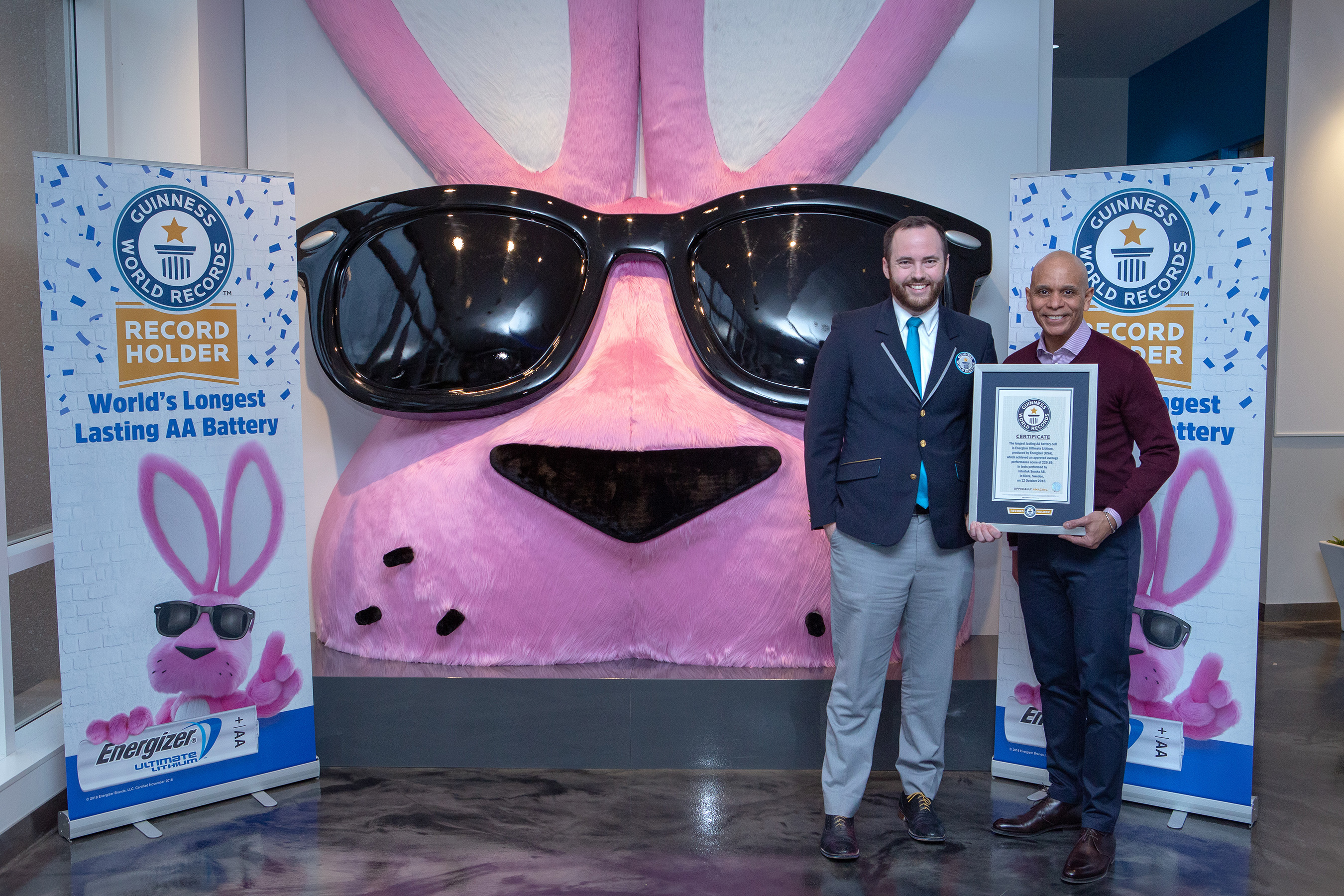
The distinction between a recognizable brand and the work behind it was visible in 2018, when Energizer announced a Guinness World Records title for its Ultimate Lithium AA battery. Technology executive Terence Calloway accepted the certificate. The photograph is cheerfully theatrical; the product achievement belonged to the technical work behind the display. LaVigne was then the company’s COO, one member of the leadership team responsible for the wider business.
A succession with the homework done
In November 2020, Energizer announced that Hoskins would retire as CEO and LaVigne would succeed him at the start of 2021. Chairman Pat Moore described a rigorous succession process. Hoskins emphasized his successor’s understanding of the company’s markets, operations and colleagues. The board was choosing someone who had spent a decade inside Energizer and several years running its operations.
The handover also included continuity: Hoskins was to remain an adviser through September 2021. Leadership changes are often narrated as abrupt entrances. This one was arranged around an existing working relationship and an extended transition.
LaVigne’s own announcement contained a useful admission: “We recognize we have hurdles to overcome.” It was a modest sentence in a setting that tends to reward confidence by the paragraph. It also set a fair test for the years ahead. Knowing a business thoroughly does not exempt its chief executive from difficult conditions.
When momentum needs a spreadsheet
By November 2022, LaVigne was announcing Project Momentum, a profit-recovery program intended to restore margins, improve free cash flow and strengthen the balance sheet. The company initially expected benefits over two years. The initiative gave a name to the kind of work that rarely features in consumer advertising.
A battery packet can promise performance in a few words. A chief executive has to account for the cost of producing it, the cash tied up in the business and the debt the company carries. For LaVigne, the operating brief had become inseparable from the financial one. Familiar products could still require substantial changes behind the shelf.
In November 2023, he reported that Project Momentum had delivered more than $50 million in efficiencies during the fiscal year. He connected those savings with restoring gross margin, generating cash and reducing debt, while also investing in capabilities for future growth. That combination matters: savings have to support a business that can keep competing.
By August 2026, management described the program as nearing completion. Its continuing emphasis was on converting earnings into cash and using that cash for debt reduction and dividends. Across these updates, the recurring concern is the business’s capacity to finance itself and meet its obligations over time.
The latest quarter resists a tidy ending
Energizer’s third fiscal quarter of 2026 brought $734.1 million in net sales, up 1.2% from a year earlier. Organic sales, which exclude specified acquisition, currency and other effects, rose 2.7%. Within that measure, Batteries & Lights grew 0.3% and Auto Care grew 9.5%. The two parts of LaVigne’s portfolio were moving at distinctly different speeds.
Organic net sales growth
Growth came with qualifications. The company moved its full-year adjusted earnings-per-share and adjusted EBITDA outlook to the low end of its original ranges. A growing sales line and a constrained earnings outlook can coexist. For the executive in charge, both belong in the same account of the quarter.
That makes the current chapter more interesting than an uncomplicated turnaround story. LaVigne has to keep distribution and product development moving while managing margins and cash. The operating questions that followed him out of the legal department remain open, now with quarterly results attached.
Another boardroom, the same practical questions
La-Z-Boy added LaVigne to its board in February 2023, initially assigning him to the audit committee. CEO Melinda Whittington highlighted his experience with branded products, routes to consumers and digital transformation. He became lead independent director on December 10, 2025. Its July 2026 proxy also places him on the compensation and talent oversight committee.
The appointment places his operating experience in another consumer business, alongside the responsibility of overseeing management rather than running it. Batteries and furniture make different demands on a household budget, but both companies must persuade people to buy, organize production and distribution, and account for the results.
Back in 2015, LaVigne’s task at the annual meeting was to establish that the business could formally proceed. His career since then has made that phrase rather more demanding. A quorum settles a procedural question. Keeping a company moving requires the next decision, the next delivery and, eventually, the next set of numbers.
Follow the work
Continue with LaVigne’s Energizer biography, his LinkedIn profile and La-Z-Boy’s board.