Mark Hughes kept the rejection emails. At Solidroad, the refusals from venture investors became office decoration: printed out and stuck on a wall. It is an unusual choice of wallpaper for a company trying to persuade people that it has a future. Most businesses prefer photographs of mountains. Hughes and his co-founder, Patrick Finlay, gave the people who had declined to invest a small, permanent exhibition.
The wall belongs to an early chapter of Solidroad, when two experienced founders had decided to work together and were still working out precisely what to build. Their credentials had not made the answer obvious to investors. Nor did persistence immediately open the door at Y Combinator. Hughes says they applied six times before getting in.
By 2025, they were in the accelerator’s winter batch, living and working in San Francisco. In June that year, Solidroad announced a $6.5 million seed round led by First Round Capital. A $25 million Series A, led by Hedosophia, followed in April 2026. The rejection wall had acquired a different audience.
That would be a tidy place to end the story. It would also miss the more revealing decision. In September 2026, Hughes announced that Solidroad was retiring its quality assurance product. Customers had bought it. The company had spent considerable effort building it. Now the chief executive was explaining why it had to go. After years of asking other people to say yes, he was saying no himself.
A graduate needs a guide
Before the funding rounds and the San Francisco office, there was a business graduate trying to get a first job. Hughes studied at Trinity College Dublin and spent a year at HEC Paris. He finished Trinity with first-class honours. The academic result did not come with instructions for entering the technology industry.
He spent six months out of work after graduating, determined to join a technology business but unsure how to get there. A mentor a few years further along helped him find a route in. In 2017, he joined Intercom. Later, he began helping other graduates with CVs, interviews and introductions. Advice that had been useful once became something he could pass along.
Gradguide grew out of that experience. Hughes built it initially alongside his jobs at Intercom and Chargify, bringing together graduates, mentors and employers. His co-founders included childhood friends Ian Guerin and Matthew Brennan, and Dave Martin, whom he knew from Intercom. The people offering guidance were often only a few career steps ahead of those receiving it.
The arrangement addressed both ends of an awkward introduction. Graduates needed access; companies needed people. In 2021, CluneTech announced a majority investment and €2 million backing for Gradguide. The programme was free for graduates and mentors, with employers paying to participate. By the time Native acquired it in late 2022, Gradguide reported more than 20,000 registered graduates and 300 mentors.
For Hughes, the link between that business and Solidroad is explicit: helping people acquire skills that create opportunities. The delivery has changed considerably. A human mentor and a simulated customer are very different companions. Both, however, offer a way to prepare before the consequential conversation begins.
- 2017Joins Intercom after help from a mentor
- 2022Gradguide acquired by Native
- 2026Solidroad concentrates on AI training
First choose your co-founder
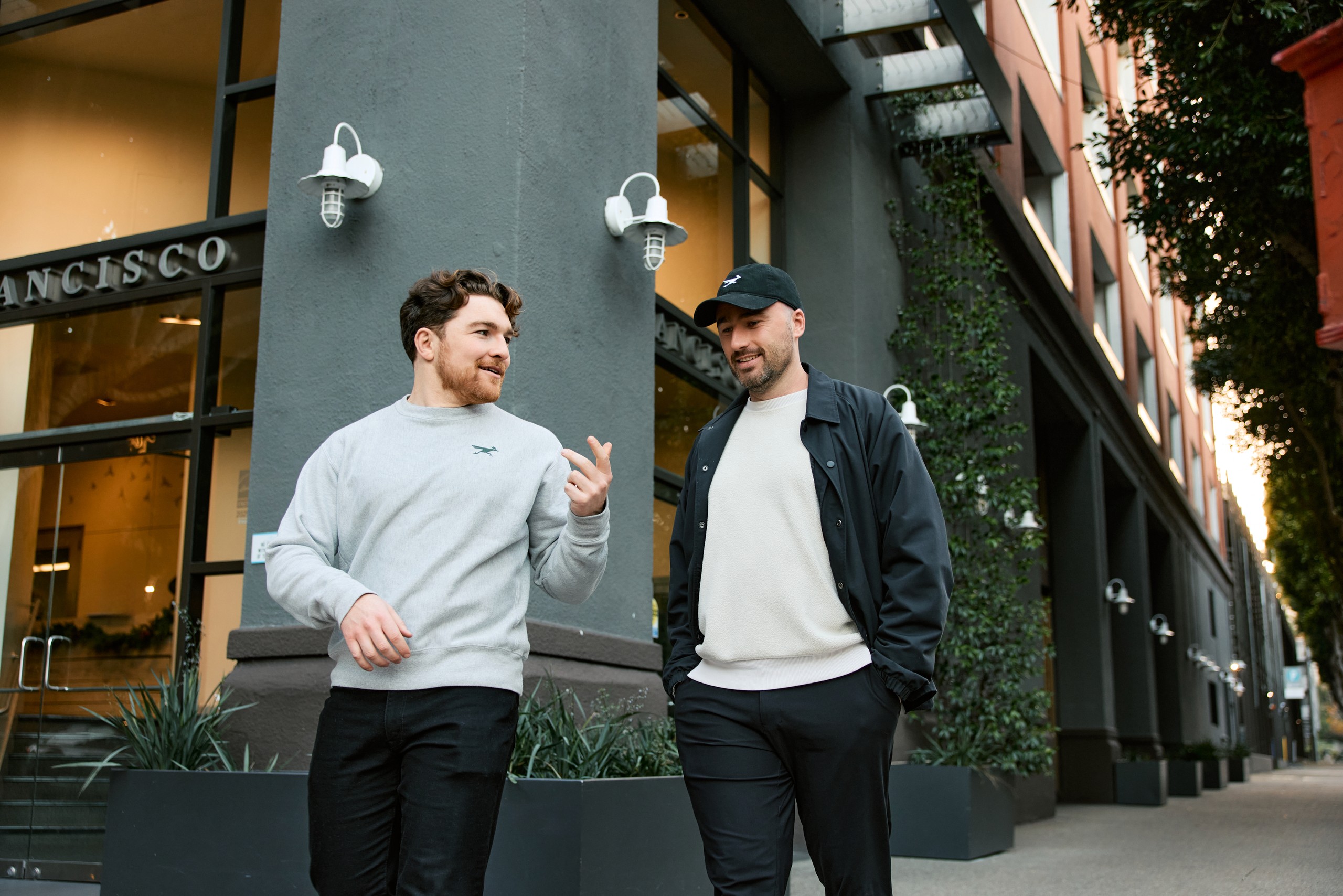
Hughes and Finlay knew each other from Trinity and worked closely at Intercom. Their division of labour was already visible there. Finlay built features; Hughes tried them with customers. It was a practical rehearsal for a company in which one founder would lead product and engineering and the other would sell.
Hughes subsequently led sales, support and customer success for Chargify in Europe, the Middle East and Africa. Finlay had his own experience of founding a company, Monaru. By the time they began Solidroad, both had enough experience to know that a second attempt does not arrive with immunity from first-time mistakes.
The partnership preceded the product. In his account of Solidroad’s first year, Hughes described three starting commitments: work together, use generative AI, and serve customers they understood. They incorporated in February 2023. The confidence was in the pairing; the business still needed to earn its shape.
That makes the early period rather less magical than the usual startup origin scene. There was no single immaculate idea waiting to be typed into existence. There were conversations, experiments and a search for a problem worth solving. A year after incorporation, Hughes was still openly describing the pursuit of product-market fit. The polished pitch came after the untidy work.
A ticket to the customer
One useful intervention at Y Combinator involved an aircraft rather than an algorithm. The founders were discussing Podium, a customer in Utah, with their group partner, Brad Flora. The advice was straightforward: go and meet the people using the product.
Hughes recalls that they arrived at Podium and were welcomed warmly, then spent three days meeting users and gathering feedback. There is a considerable difference between knowing that an account uses your software and watching the people whose working day depends on it. The visit gave the founders a much closer view of the work they were trying to improve.
They repeated the exercise. Hughes says he took 56 flights for customer visits in 2025, a year that also included transatlantic travel before his full-time move to San Francisco in September. He kept a list in his phone. For a founder selling artificial intelligence, a surprising amount of the job involved departure gates.
The travel had a commercial purpose as well as a product one. Meeting customers helped the company deepen relationships and move beyond small, monthly subscriptions. By the seed announcement, Solidroad said it served more than 50 customers. Its account of that period included Podium cutting new-hire ramp time in half and ActiveCampaign recovering the equivalent of a year of coaching time. Those are company-reported customer outcomes, rather than promises for every buyer.
Customer-related flights in 2025, by Hughes’s own count.
Some product feedback comes with a boarding pass.
Practice before the queue
Solidroad’s training idea is easy to understand if you have ever been the new person answering a difficult question. Knowing the policy and handling the conversation are separate skills. One can be learned from a document. The other requires an attempt, a response, and another attempt when the first one goes badly.
The platform lets customer-facing staff practise with simulated customers and receive feedback. In an April 2026 interview, Hughes put the premise plainly: “You don’t want someone’s first experience handling a difficult situation to happen in front of a real customer.” The attraction is permission to make a mistake while the consequences are still contained.
At that point, Solidroad also evaluated live conversations. Quality assurance and training formed a connected proposition: examine customer interactions, identify gaps, and use those findings to guide practice. The April Series A announcement presented that combination as the company’s direction. Hughes’s argument for training also rested on a harder future for human support staff: as AI takes routine requests, people increasingly inherit the complicated conversations.
The later change in direction matters because it tests the founder’s own reasoning. A company can believe strongly in improving customer service and still discover that two adjacent products demand very different businesses. The common customer does not automatically make the workload manageable. In September, Hughes decided the balance had become untenable.
“I knew sales and he knew product”
Mark Hughes · February 2024
The expensive side quest
His account was unusually specific. Solidroad had become a 35-person company building both training and QA. Training was growing faster. Yet he estimated that roughly 90 percent of effort across engineering, sales, support and customer success was going into QA. These were his estimates of the company’s internal allocation, not an industry benchmark.
He called QA a “side quest”. The phrase makes the problem sound almost recreational. The allocation of a growing team’s time was anything but. Work already completed gave the product a claim on the future; Hughes decided it could no longer have quite so much of it. Solidroad spoke to QA customers and made arrangements to help them move.
Meanwhile, the team had developed System Simulations: interactive replicas of workplace software created from screen recordings. The training could now cover actions inside a tool as well as words spoken to a customer. A learner could complete a workflow, make an error, receive feedback and try again. The company’s October update confirms that AutoQA was retired in September.
This places a useful limit on the funding story. Raising money had not settled the question of what Solidroad should build. It had increased the resources behind the question. Hughes still had to choose. The company’s current pitch centres on conversation and system simulations, with the ambition of becoming a place to rehearse knowledge work before doing it for real.
Hughes’s estimate across engineering, sales, support and customer success before retiring QA. An internal workload estimate, not a revenue split.
Six inches, then ten years
Hughes has an affectionate description of the difference between the founders. He concentrates on the next six inches; Finlay can imagine the company ten years ahead. He credits Finlay with pushing early visits to San Francisco, including a trip before their YC acceptance when their partners came too. The eventual move was easier to picture once they had seen it together.
Inside the company, Hughes says he values ownership and openness. He has described making work accessible across teams, including sales calls, so colleagues can understand what is happening beyond their own projects. His commercial background is useful here: a customer conversation contains information for far more people than the person trying to close the sale.
The public version of Hughes has room for a joke. He has teased himself about writing in the third person and meeting a daily LinkedIn posting quota. At SaaStock, he credited T-shirts and free coffee with starting useful conversations. There is something reassuring about a founder of AI training software acknowledging the enduring sales technology of a complimentary hot drink.
His career keeps returning to preparation: a graduate getting an introduction, a new employee practising a conversation, a founder visiting a customer to discover what the software really needs to do. Hughes has made a business of giving people another attempt. His own story includes enough revisions to suggest he intends to keep taking them.