Hydrogen has always arrived carrying a large suitcase. Inside are promises about clean transport, industrial power and a grid that keeps its manners after sunset. The luggage is impressive. The trick is unpacking it into a machine that starts on command, fits through the door and can be repaired without summoning a symposium. Mark Huang has built his career in that less theatrical part of the story.
Huang, known in Chinese as 黃治文, founded YC Synergy in Taiwan in 2012 with a group of partners. By then he had spent years around fuel cells and had formed a view that differed from his former employer's: the useful opportunity lay in applications. A stack on a bench was chemistry. A stack joined to tanks, motors, batteries, controls and a customer schedule could become transportation or power.
His company set up in Xindian, New Taipei City, and chose an early proving ground that was almost comically demanding: boats. Water is a stern product manager. Space is tight, weight matters, vibration persists, corrosion lurks and passengers have little interest in beta testing. Taiwan, however, had serious boatbuilding capability. Huang saw a local industrial advantage and a problem worth solving.
The boat was the argument
In 2014, visitors at the Taiwan International Boat Show could queue for a ride on Mu Yang, an electric yacht powered by YC Synergy's fuel-cell system. The company combined hydrogen technology with batteries and a boat motor, treating propulsion as one coordinated system. The point was not to make a prettier stack. It was to give boatbuilders a package they could actually design around.
Another project carried the idea into public view. Star of Hope was a 17-meter sightseeing vessel designed for as many as 91 passengers at Sun Moon Lake. Its fuel-cell power train offered a path to longer electric range without loading the boat with enough batteries to make Archimedes nervous. YC Synergy and its collaborators also worked through the rules needed for the vessel to operate. Regulation joined mechanics on the founder's list of systems that required integration.
The home market did not develop in a smooth upward line. Huang has said that policy momentum slowed around late 2015, disrupting hopes that more boats at Sun Moon Lake would convert. YC Synergy shifted attention overseas, particularly toward commercial vehicles, distributed generation and bus programs in China. It was a founder's education in timing: technology can be ready while procurement, infrastructure and policy are still finding their shoes.
“We don't innovate just to say we've done it. We start with a problem that needs a solution, then work to find the right answer.”Mark Huang, on practical R&D
Some assembly is always required
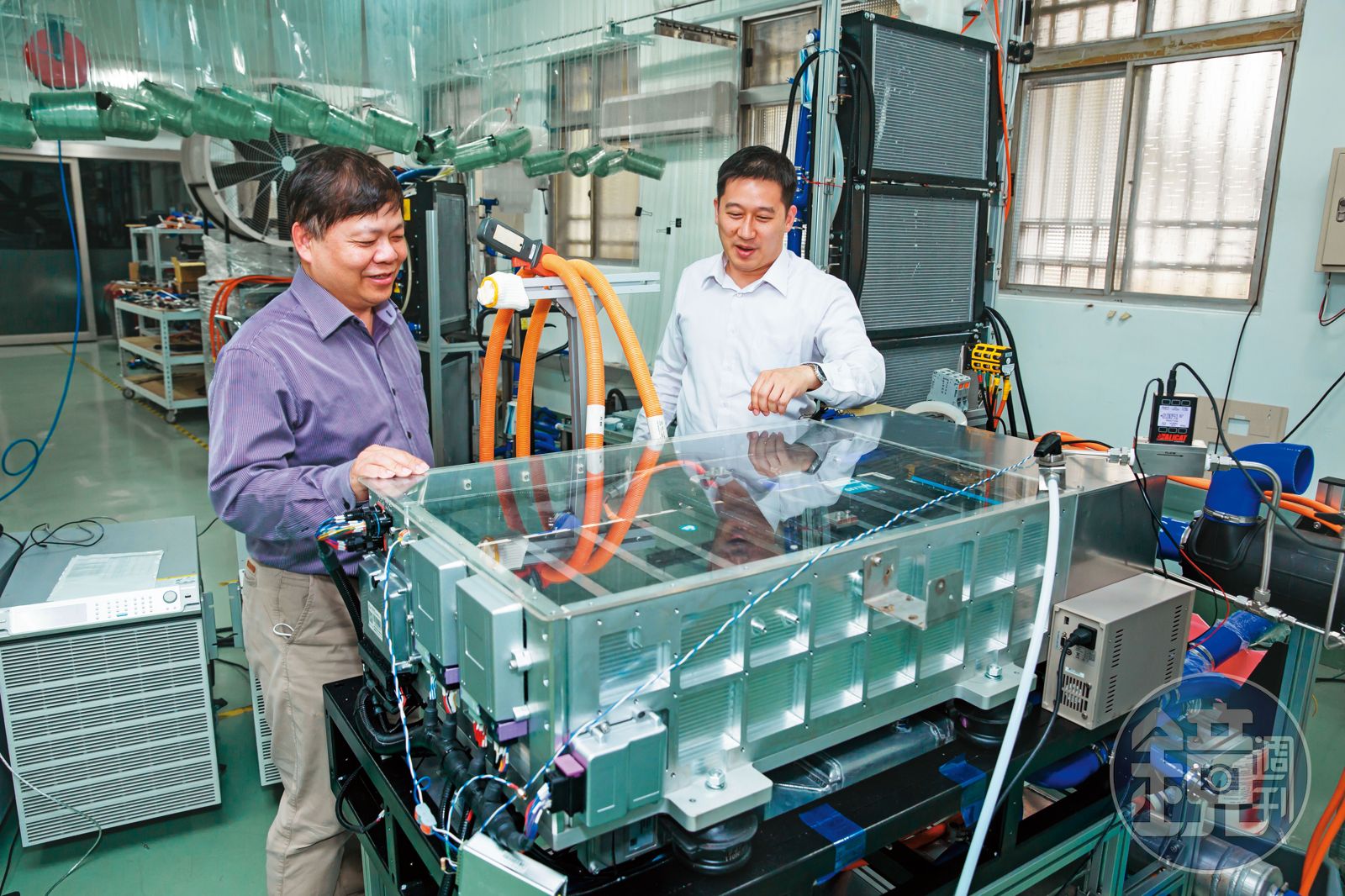
Huang's recurring idea is system integration. A commercial fuel-cell machine needs a stack, certainly, but it also needs hydrogen storage, air supply, cooling, power electronics, batteries, motors and software controls. Each component may come from an accomplished supplier and still behave like a houseguest who has not met the others. YC Synergy's work is to introduce them, settle the arguments and make the complete power train answer to one switch.
The system integrator's desk
In 2016 the company presented its YCS-MB109 series, a modular system with more than 15 kilowatts of net output from one module. Units could be combined for larger boats, buses and trucks. Modularity also gave maintenance a vote in the design. A field technician could replace a component without treating the entire power system as a single expensive patient.
The engineering brief kept widening. Vehicle systems had to endure shock and vibration. Semiconductor facilities presented polluted air that could impair fuel-cell performance, prompting the team to develop air purification around the system. Customers brought their own operating quirks. Huang's team drew experience from solar, batteries, lighting, electric vehicles and chemicals, a mixture that made sense because the final machine crosses all those departmental borders.
This is Huang's useful lesson for any emerging industry. The celebrated component is often surrounded by uncrowded opportunities. Someone must design the enclosure, translate standards, qualify suppliers, absorb customer constraints and remain present after installation. The work sounds like a list of chores until the list becomes the company.
The founder as translator
Integration is partly engineering and partly diplomacy. A stack maker speaks in power curves and operating windows. A shipyard thinks about hull balance, certification and where a mechanic can place a wrench. A fleet operator counts minutes off the road. A factory manager asks what happens at 2 a.m. Huang's role sits between those dialects. The product has to translate every answer into dimensions, connectors, alarms and service intervals.
That helps explain the breadth of his public calendar. In 2017 he spoke at a Wuhan forum about motive fuel-cell modules and the company's four generations of development. In 2020, he and colleague Weiche Huang joined a small-company meeting with the head of Air Liquide Far Eastern Asia. The following year he appeared in a Taiwan-UK hydrogen cooperation program alongside industrial suppliers, researchers and transport specialists. In 2023 he addressed fuel-cell vehicle systems and supply-chain opportunities at an industrial seminar. Each room held a different piece of the same machine.
Huang's language tends to pull conversation back toward use. Which application needs the power? How will the customer refuel? What does the surrounding air do to the stack? How quickly can a broken module return to service? These questions deny technology the luxury of performing alone. They also reveal an operator's temperament: impatient with novelty for novelty's sake, patient with the long work of qualification.
There is a quiet commercial logic here. YC Synergy does not need to invent every membrane, compressor or tank. It needs to know enough about each one to select it, test it and make it behave inside a complete system. That allows a small company to coordinate technology from larger international suppliers while preserving its own judgment at the system level. The scarce asset becomes applied context - knowing why a component that looks excellent in a catalog may sulk inside a humid engine room.
Hydrogen gets a supporting role
Huang does not frame hydrogen as a duel with solar or wind. His case is complementary. Weather-driven power is abundant when conditions cooperate; a fuel-cell system can supply dependable electricity when they do not. That makes hydrogen interesting for factories pursuing renewable-energy targets, stationary generation, marine transport and heavy logistics where battery weight or charging time can become restrictive.
The distinction disciplines the product strategy. YC Synergy concentrates on stationary power, maritime systems and heavy-duty vehicles. These are places where uptime, range and energy density can justify complexity. In the Porrima vessel collaboration announced in 2024, the company's assignment stretched from onboard PEM fuel cells and electrolysis to carbon-fiber storage and an onshore refueling station. The boat was once again the visible object; the real project was an ecosystem small enough to draw on one page.
Huang and partners establish YC Synergy around complete fuel-cell systems.
Mu Yang appears at the Taiwan International Boat Show; Star of Hope brings fuel-cell passenger service to Sun Moon Lake.
A modular platform expands toward buses, trucks and larger motive applications.
The Porrima collaboration broadens YC Synergy's maritime role from onboard power to hydrogen production, storage and refueling.
Huang is listed to speak on maritime applications of hydrogen energy at a national technology forum.
Partnerships are therefore part of the architecture. YC Synergy works with stack suppliers from Germany, Canada and Japan, while engaging boatbuilders, vehicle makers, industrial clients and public agencies. Huang attended a Taiwan-UK hydrogen cooperation program in 2021 and has appeared at industry forums to discuss systems and supply chains. A small integrator cannot manufacture an economy alone. It can make the pieces legible to one another.
The patience to be practical
The public record around Huang is unusually consistent. In 2014 he talked about relationships with yacht makers. In 2016 he described integrators as the bridge between technology and commercial use. In 2024 he spoke about starting R&D with a real problem. The vocabulary changes; the operating system does not.
There is also optimism, though it arrives wearing safety glasses. During the difficult years, YC Synergy kept reducing size and weight, increasing output and looking for applications that could bear the cost of a young energy technology. Buses, cold-chain trucks and heavy vehicles followed boats. Stationary systems joined transport. The address stayed modest while the system boundary grew.
Recognition came in 2024 when Energy Tech Review selected YC Synergy as its APAC Fuel Cell System Company of the Year. Awards make pleasant shelf furniture. Huang's stated destination remains more operational: expand green-hydrogen offerings in Taiwan and across Asia-Pacific, helping industrial customers cover the stubborn final stretch toward renewable-energy and carbon goals.
That final stretch is where his story earns attention. Energy transitions are often narrated through breakthroughs, but they are completed through interfaces. A pipe meets a tank. A controller meets a motor. A supplier meets a shipyard. A policy meets a machine that has already logged hours on the water. Mark Huang made a business in those meetings. The future, in his telling, still requires assembly.