At a dinner party in Mexico City, Alexandra Rasch Castillo found herself discussing the fuel that kept infrastructure running. She had been working with batteries and electric vehicles. Here was another place to apply that knowledge: the equipment behind communications, still drawing on fossil fuels. A conversation over dinner had acquired the inconvenient properties of a business idea. It would require considerably more work than settling the bill.
She co-founded Caban with Brian Pevear in 2018. Their company took on the power supply behind telecommunications, combining energy storage with the controls and services needed to keep infrastructure operating. For Rasch Castillo, the attraction was both environmental and commercial. Equipment consuming fuel offered a possible customer, a technical problem and an opportunity to reduce dependence on that fuel.
Most of us encounter a mobile network through a small collection of bars in the corner of a screen. Her work begins further back, with the electricity that allows the network to exist. It is an unglamorous dependency with excellent job security. The conversation cannot continue if the equipment carrying it has switched off.
Before the batteries, a backhand
Long before she had telecom customers, Rasch Castillo had opponents across a net. She grew up in Guatemala and played for the country’s Fed Cup squad in 2007. By the following summer, she was preparing to study and play tennis at Rice University in Houston. Her training had included the Nick Bollettieri Tennis Academy, and she spent part of that summer competing in Germany.
There was a semifinal in Hamburg and quarterfinal appearances in Arusberg and Dusseldorf. Looking ahead to Rice, she described a wish to improve with every match. There is no need to retrofit a childhood prophecy onto that ambition. At the time, she was talking about tennis. It is a useful glimpse of how she described the work in front of her.
“My goal is to get better every time I play.”
Alexandra Rasch, preparing to enter Rice, 2008
Her college record has the texture that abbreviated biographies tend to lose. In her freshman season, she went 13–6 in singles, winning nine of her first ten matches and closing the year with three more victories. In 2010–11, she and doubles partner Dominique Harmath posted a 14–9 record. She appeared on the conference commissioner’s academic honor roll in 2009, 2010 and 2011.
The details are worth keeping because they restore a person to the résumé. Before the financing announcements and conference stages, there were draws, doubles partners and the ordinary arithmetic of a season. Her later career would take her well beyond the court. The court remains a real part of the route.
The engineer follows the electricity
Rasch Castillo earned a bachelor’s degree in civil and environmental engineering at Rice and a master’s degree in engineering at the University of California, Berkeley. Her professional work then took her into electric vehicles at Proterra, where she worked on high-voltage batteries and vehicle design. Her responsibilities covered hardware and software development, energy storage, vehicles and charging infrastructure.
That combination matters. A battery belongs to a larger system: something must charge it, something must control it, and a customer must be able to use it. Her experience included bringing products toward commercialization, where a promising design encounters manufacturing, schedules and the requirements of an actual buyer. Caban would ask her to work through those questions in a different industry.
California supplied an early test of the company’s manufacturing ambitions. In its 2020 EPIC project highlights, the state’s energy commission described Caban’s work scaling battery systems for telecommunications infrastructure. The program reported a thirtyfold increase in production capacity. It also described systems that could be installed and commissioned at a tower in less than a day.
These are the less photogenic milestones of an energy company. A factory produces units rather than announcements. Installation time determines how easily equipment reaches the field. For a founder working on physical infrastructure, the distance between a working prototype and a repeatable installation can occupy an entire business.
The customer still needs a reason to buy
Rasch Castillo’s approach to selling clean energy includes an insistence on explaining the economics. Customers need to understand how the proposed system fits their costs and operating requirements. The environmental purpose gives the business direction; the customer still has a budget, a network and somebody asking why a purchasing decision should change.
That is where Caban’s combination of hardware, software and financing becomes important. Solar generation and batteries address the electricity supply. Monitoring and controls help manage the equipment. Energy-as-a-Service adds a commercial arrangement around the infrastructure. The proposition reaches beyond handing over a battery and wishing the buyer an agreeable afternoon.
Software monitors and controls the system. Energy services provide the commercial framework.
Capital has its own requirements. On January 4, 2023, Caban announced that it had closed $43 million toward an initial $51 million Series B target. BCP Ventures led the round, with participation from investors including Ember Infrastructure, Portfolia and Inspiration Ventures. The distinction between money closed and a fundraising target deserves to survive the headline.
For a company building equipment and expanding internationally, financing belongs close to the engineering story. Deployment requires resources before the finished system can begin doing useful work. A founder has to persuade people to support that sequence, then deliver something that performs after the presentation has ended.
Representation, with engineering attached
Recognition arrived early in Caban’s development. Rasch Castillo was included in the Forbes 30 Under 30 Energy class for 2020. ALPFA subsequently recognized her as an Entrepreneurial Icon in 2021 and again in 2022. In the second year, she also took part in the Latina Disruptors panel at L’ATTITUDE, discussing business alongside other Latina chief executives.
Her Guatemalan background belongs inside this story. In 2021, she described Caban’s innovation, technology and design operation in Guatemala and spoke about creating opportunities for technical workers in Latin America. She also expressed the ambition to see critical infrastructure become carbon neutral. The company’s geography connected her country of origin with the markets she wanted to serve.
Her public speaking has continued to follow the technical problems. In March 2026, the Barcelona event agenda listed her for discussions of climate technology, artificial intelligence and network resilience. Those subjects now share a rather practical constraint: whatever new capabilities a network acquires, somebody must arrange its power supply.
Jamaica puts the idea to work
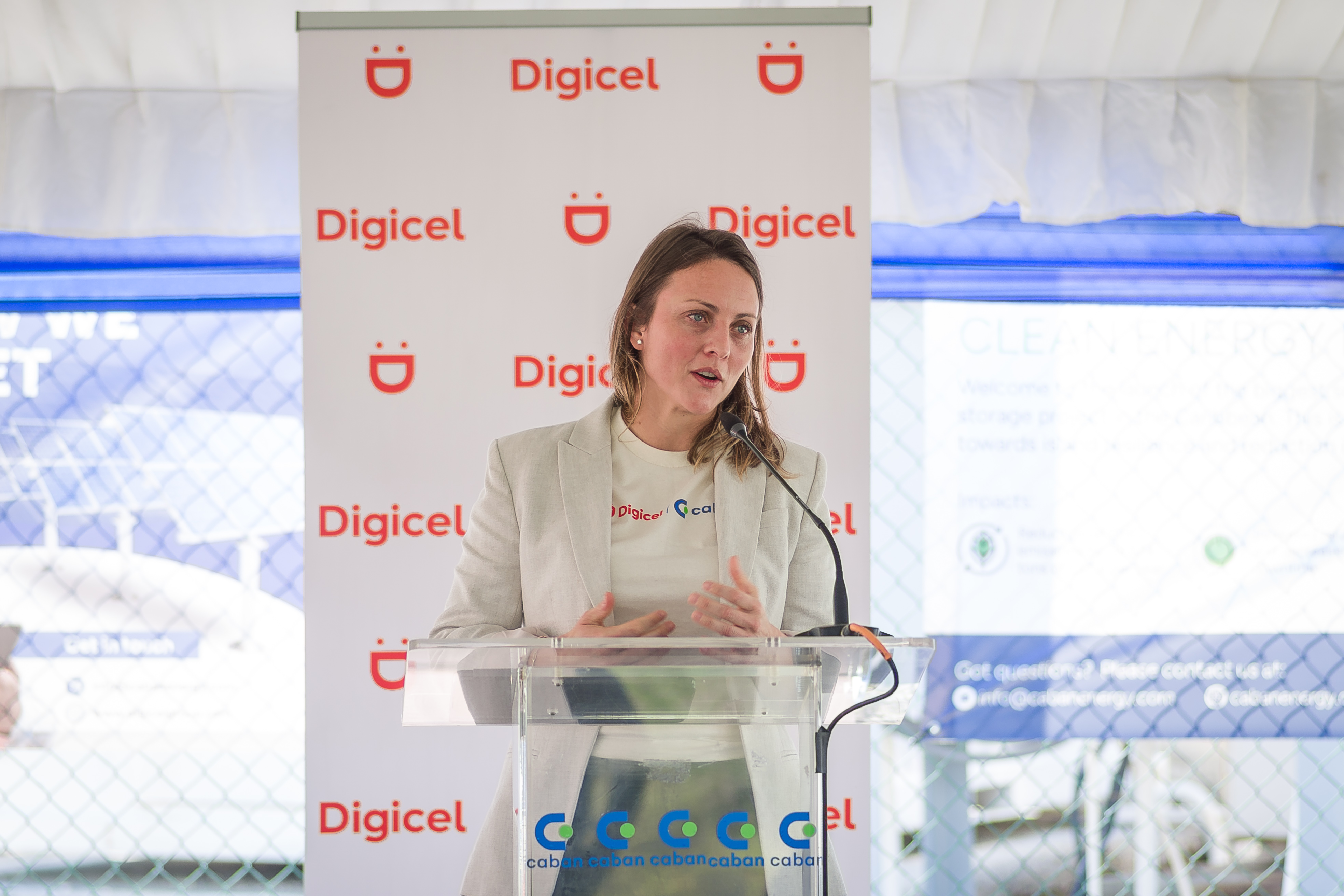
In September 2025, Caban and Digicel announced a plan to install solar and battery systems at 511 of Digicel Jamaica’s nearly 900 cell sites. The target was up to 55 percent of the network’s sites. It was a deployment plan, with the intended benefits tied to everyday operations as well as interruptions to the electricity supply.
Hurricane Beryl had exposed the vulnerability of power supplies supporting Jamaican telecommunications. The partnership aimed to reduce dependence on the grid and on diesel, using onsite solar generation and stored electricity. A battery at a cell site has a plain assignment: supply energy when the immediate source is unavailable. Everything people want to do with the connection comes after that.
September 2025 partnership plan
Rasch Castillo and Digicel Group chief executive Marcelo Cataldo also co-authored an argument for more resilient Caribbean connectivity. They linked the infrastructure to families, businesses, banking and government, and described the Jamaica project as a possible model for the wider region. From her base in Miami, she was making a case with consequences on both sides of the Caribbean.
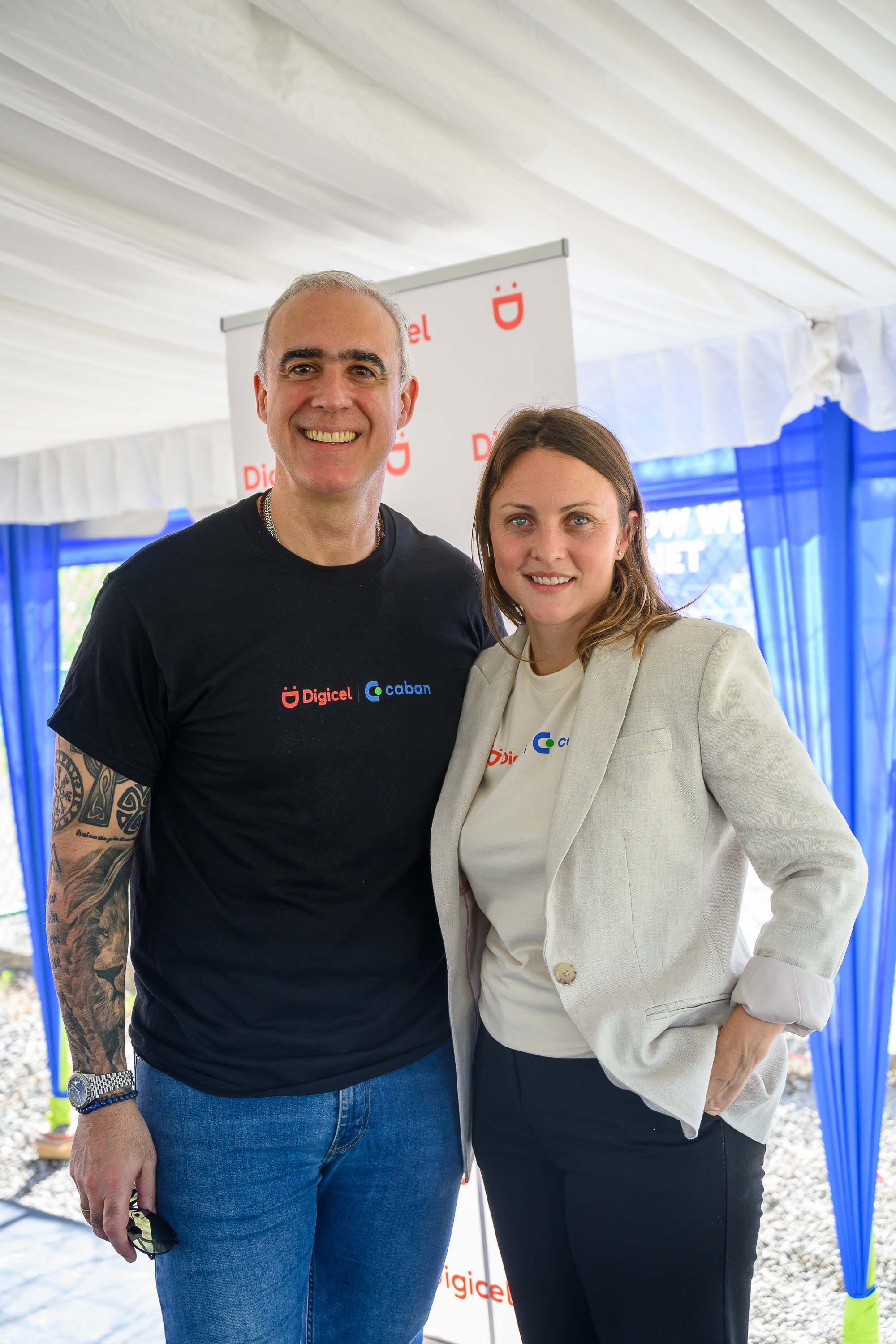
Barbados supplied another announced step. In November 2025, Digicel and Caban described a solar-powered mobile-site rollout there, with groundbreaking scheduled for January 2026. The announcement said 60 percent of Digicel’s mobile sites were ready to transition to solar. Its language pointed toward a regional program, while the work itself would still have to happen site by site.
The next scorecard is in Colombia
By September 2026, Rasch Castillo was describing a substantial Colombian operation: nearly 400 working sites and more than US$16 million invested. She said Colombia accounted for roughly a quarter of Caban’s operating assets and identified Bogotá as the center of its Latin American operations. The business had moved from entering a market to organizing more of its work around it.
Her goals were specific: approximately 500 Colombian locations within six months and 3,000 over the longer term. Those figures mark an ambition beyond the existing installations. Keeping the two categories separate makes the achievement clearer, and leaves the next assignment visible.
There is a pleasing change of scale between the beginning and this point in her career. A teenager counted matches. An engineer worked on batteries and vehicles. A founder now talks about hundreds of operating locations and the investment required for thousands more. The units have changed; the requirement to make something work repeatedly has become more demanding.
The phone call remains the useful place to end. We notice its power supply chiefly when something interrupts it. Rasch Castillo has built her working life around the equipment behind that ordinary expectation of connection. From the dinner table in Mexico City to a cell site in Jamaica, the question has become more concrete: how will this place keep running?
Follow the work
Interviews, public profiles and further reading
Caban’s website ↗Alexandra on LinkedIn ↗Watch: The Green Behind 5G, with Carrie Charles ↗Read: Her September 2026 Colombia interview ↗Read: Her Caribbean connectivity commentary with Marcelo Cataldo ↗Explore: The Digicel partnership and launch photographs ↗Listen: Distributed energy on The Smart Society Show ↗From the archive: Her Rice tennis years ↗Explore: California’s EPIC manufacturing project highlights ↗Read: Her approach to mission and customer partnerships ↗