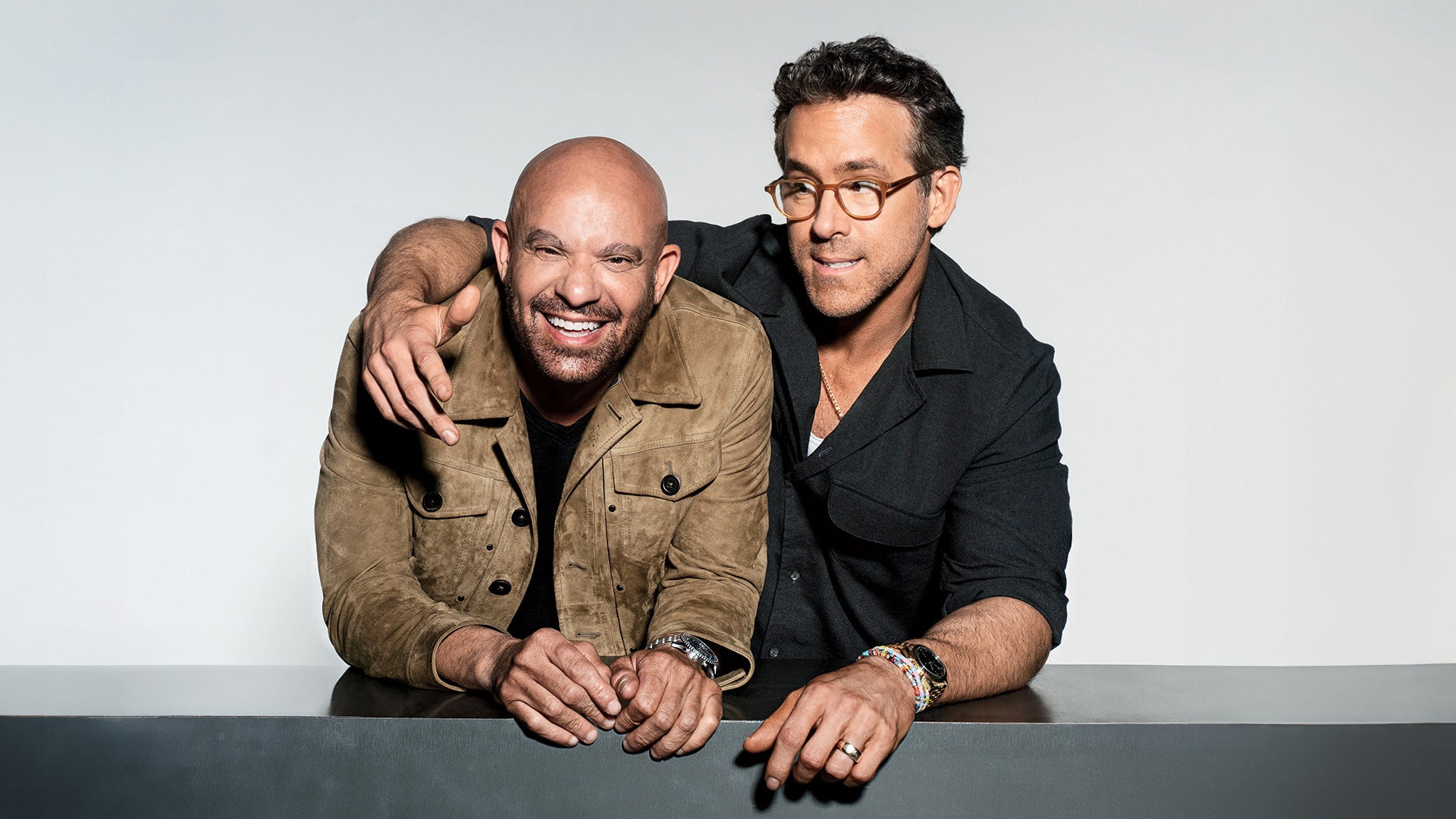
When Mark Douglas showed Ryan Reynolds his advertising software, Reynolds had a useful reaction: he thought he could operate it himself. For a demonstration involving a Hollywood actor, this was a refreshingly modest special effect. No explosion, no costume change. Someone had made a complicated piece of work look manageable.
Douglas had spent years building technology. Reynolds knew how to make people pay attention. The software demonstration put those abilities in the same room. In Douglas’s telling, a mutual connection introduced them; Reynolds called the next day to ask about becoming chief creative officer. The question was how to bring television advertising within reach of businesses that had learned to buy ads on search engines and social platforms.
Their partnership supplies an easy photograph. The harder story belongs to Douglas’s working life: an engineer moving through different businesses, carrying an interest in matching things that might otherwise miss each other. At eHarmony, those things were people. At MNTN, they are businesses and prospective customers. Television happens to be the place where the latest introduction occurs.
01A matchmaker with an engineering résumé
Douglas is a self-taught programmer. His early work included writing software for Wall Street banks, and his subsequent career took him through Oracle and several software businesses. He founded CenterView Software in 1994. The résumé contains the familiar vocabulary of enterprise technology: engineering, applications, development. It also contains repeated changes of setting. He kept taking technical experience into a different commercial problem.
From 2004 to 2008, he served as vice president of technology at eHarmony, where he worked on personality-matching technology. He then became vice president of engineering at the Rubicon Project, now Magnite, from 2008 to 2009. Romance and advertising make an odd pair on a résumé, although both involve a great deal of explaining why someone should give something a chance.
The connection is more substantial than the joke. A matching system has to select from possibilities. A dating platform and an advertising platform have different obligations and different outcomes, but both need a way to make an introduction useful. Douglas has explicitly connected the two in discussing his work. It is a practical way to understand his move into advertising without pretending the industries are interchangeable.
“First and foremost, I consider myself a coding engineer.”
Mark Douglas · Smart Money Circle, June 2026
That self-description still matters after the chief-executive title. The engineer’s question concerns the machinery underneath the experience. What information goes in? What should the system do with it? How much work should the customer have to perform? Those questions can sound unglamorous next to a television commercial. They become rather more interesting when you are the person trying to buy one.
02The company came first. Television came later.
Douglas founded the company now known as MNTN in 2009. Its initial work concerned performance display advertising across computers, phones and other devices. In 2018, the company began developing technology specifically for connected television. The nine-year gap is worth preserving. It gives the story a period of accumulated experience before the screen in the living room became the focus.
Streaming gave Douglas a different environment for the targeting and measurement work his company already understood. MNTN’s system lets an advertiser specify a budget, campaign duration and performance goals, then uses its algorithms to execute the campaign. The promise is that television can become a channel a business manages with the practical expectations it brings to other digital advertising.
- 1994CenterView
Software - 2004eHarmony
technology - 2009Company
founded - 2018The CTV
turn - 2025NYSE
debut
For a smaller advertiser, the obstacle is rarely a shortage of enthusiasm for being on television. It is the collection of jobs surrounding the idea. Someone must make the commercial, arrange its placement and decide whether the spending helped. A buying interface addresses only part of that work. Douglas’s product choices increasingly reach into the surrounding tasks, where a customer’s good intention can quietly run out of time.
The language he uses about advertising is correspondingly personal. He talks about connecting a founder’s enthusiasm for a product with someone who might appreciate it. There is a salesman’s optimism in that description, but also a recognizable engineering problem: reduce the distance between a person with something to offer and a person who has a reason to care.
03Hollywood joins the product meeting
MNTN acquired Maximum Effort Marketing in 2021, bringing Reynolds’s advertising work into the business. Douglas later described the negotiations as taking three days. Reynolds became chief creative officer. The arrangement gave a company selling the usefulness of television an unusually recognizable participant in its own pitch.
The work had two different demands. Software could help an advertiser find an audience and run a campaign. A commercial still had to say something. Douglas’s interest in simplifying production fitted Reynolds’s experience making short, timely advertisements. A small business approaching television could need help with both, regardless of how efficiently the placement was purchased.
Douglas once told a story about a director concealing a small digital camera inside a larger assembly because the client expected substantial equipment. The prop was effectively there to reassure the person paying. “You don’t need an 18-wheeler to show up to film,” he said. The anecdote is funny because an expensive-looking process can become part of what the customer believes they are buying.
The corporate relationship has since changed. On April 1, 2025, MNTN divested Maximum Effort Marketing to an affiliate of its original owner. The creative relationship continued under a services agreement, and Reynolds remains listed as MNTN’s chief creative officer. Ownership and collaboration are separate details here; both belong in the story. The photograph of the pair survives a more complicated organization chart.
04Getting the camera out of the way
Douglas’s interest in artificial intelligence follows the production question. In 2023, he argued that cheaper creative tools could increase demand for creative work, drawing a comparison with digital cameras and Photoshop. His expectation was that advertisers would commission more versions and refresh their commercials more often. That is his economic argument for the technology, rather than a settled prediction about every creative job.
There is a concrete product problem underneath it. If an advertiser can afford only a slow production cycle, changing a message becomes a project. Lowering the effort involved can make experimentation practical. A business can try another opening, another scene or another version. The value then depends on whether the resulting commercial deserves to be watched, a question no production schedule can answer by itself.
By May 2026, MNTN had released QuickFrame AI 3.0 with storyboarding, editing and the ability to reuse characters, locations and products across videos. Those details address an awkward gap between generating an attractive clip and assembling a coherent advertisement. A character who changes appearance between scenes can be a distraction even when the software is very pleased with itself.
An editorial map of MNTN’s workflow. Each step leaves another piece of work for the software to simplify.
His view still gives professional creators a role. In a 2026 interview, he described finding people doing interesting AI work on social platforms and commissioning videos from them. The tool changes how quickly something can be made. Someone still has to choose the idea, shape the result and recognize when the first attempt is not ready. Faster production makes those judgments arrive sooner.
05A public company, still under construction
MNTN began trading on the New York Stock Exchange in May 2025. Douglas arrived at that point with decades of technical work behind him. Around the listing, he said he still spent about 70 percent of his time on product and engineering. Becoming a public-company CEO had added an audience for the business; it had not exhausted his interest in the product.
The financial results give that continuing work a scale. In the second quarter of 2026, MNTN reported $82.5 million in revenue and $6.7 million in net income. Its count of active Performance TV customers over the preceding twelve months reached 4,225. Those are company results, distinct from any individual advertiser’s return. They show a business with more customers to serve and more expectations to meet.
Active Performance TV customers
The next connections extend beyond the television set. A September 2026 integration with Klaviyo lets brands bring their existing customer audiences into MNTN and use television ad exposure to trigger email or text follow-up. In product terms, the commercial becomes one event in a longer customer relationship. Douglas is again working on the space between systems that a business already uses.
There is a similar preference for relationships in his approach to leadership. He has discussed giving a company’s chief innovator room to work and handing over tasks that other people can handle better. At a remote company, that requires deliberate attention to how people spend time together. In a 2025 conversation, he described company gatherings and a shared working schedule, alongside his own enthusiasm for flying.
The pilot and the programmer both have reasons to like a well-arranged system. Douglas’s career suggests he enjoys finding the places where one can be improved. The actor can make the commercial memorable. The engineer can keep asking what made it difficult to produce, place or measure. Somewhere in that conversation is a smaller business hoping its next customer will look up from the sofa.