A spare bedroom is a perfectly sensible place to start a satellite company, provided you do not intend to keep the satellites there. In 1986, Mark Dankberg and two colleagues began Viasat in his house. Their equipment included Apple computers. Their immediate ambition was to stay in business for a year. Forty years later, Dankberg is still chairman and chief executive, and the question has become how much of the machinery connecting the planet his company should build, operate, or share.
The distance between those questions contains a useful story about engineering. Dankberg began by making equipment for other people’s networks. Eventually, he decided the network itself needed changing. That decision put him in charge of expensive objects that could fail a long way from the nearest repair shop. It also put his work in the hands of people who have never heard his name: a passenger opening a laptop, a ship’s crew, a household beyond the reach of a cable.
The education after the degree
Dankberg earned electrical engineering degrees at Rice University in 1976 and 1977. He worked at Rockwell International from 1977 to 1979, then joined Linkabit in San Diego. The formal education had given him the mathematics. Linkabit offered a place to see what happened when mathematical ideas met customers, hardware, and a business that had to pay its bills.
Irwin Jacobs and Andrew Viterbi were important influences there. Dankberg admired the combination of theoretical rigor and practical construction: communications theory could become a modem on a laboratory bench. Jacobs also supplied an example of an engineer who could build a company. When Jacobs and Viterbi left to establish Qualcomm, Dankberg considered that path. Instead, he chose to start something with Steve Hart and Mark Miller.
One early Viasat project brought the new company into competition with Qualcomm. Dankberg found himself presenting to a customer opposite Jacobs, the mentor whose skills he admired. It is an unusually tidy graduation ceremony: your former teacher arrives with a competing proposal.
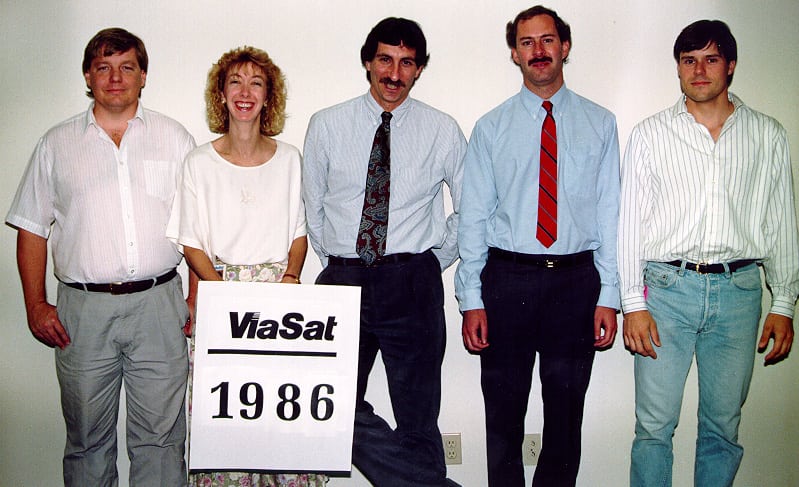
A company small enough to fit in the house
The three founders already knew how to work together. They had less experience persuading the world to buy from a company with no history. Defense work offered a route in, although the route involved modest contracts and patient accumulation of credibility. Small Business Innovation Research projects helped keep the young operation going.
Paul Baca, a longtime Viasat employee, recalled teams studying the government’s twice-yearly books of research problems, submitting proposals, and regularly winning several awards. Contracts of $75,000 to $100,000 could make a substantial difference. An enterprise that would eventually contemplate global networks was being assembled one answer to a government question at a time.
Early work included a signal-to-noise measurement device for the Army. This was an appropriate beginning for engineers: before promising to improve a signal, establish how well you can measure it. The company developed from research work into products, then networks and services. Viasat went public in 1996. The bedroom had become an origin story rather than a floor plan.
A room at home.
on Nasdaq.
reaches orbit.
joins Viasat.
By the time Dankberg testified before Congress in October 1999, he could describe a business with about 400 employees and annual sales above $70 million. He told lawmakers that Viasat equipment was on Air Force One. It is a useful correction to the usual startup shorthand. The spare room explains where the company began. The equipment aboard an aircraft explains what customers had come to trust it to do. His testimony also described competing and working with much larger companies, a reminder that a small supplier can have a consequential place inside somebody else’s system.
The customer needed a different sky
By the 2000s, Viasat was supplying the equipment that made satellite broadband work. WildBlue, one of its customers, brought internet access to households using Ka-band satellite technology. Demand exposed a problem. A better terminal could only do so much when the available capacity overhead was running out.
In 2008, Viasat announced plans for its own satellite. The company would take responsibility for a much larger portion of the system. Designing the ground equipment and the satellite together offered a way to improve the economics of delivering bandwidth. It also meant accepting the bill for the part that required a launch.
Investors did not all applaud. Recalling the decision in 2019, Dankberg described a share price that fell from roughly $30 to $15. Some large shareholders stayed; others did not. A technically coherent plan can still make an uncomfortable afternoon for the person explaining it. In 2009, Viasat bought WildBlue, bringing a customer base and the practical machinery of a service business into the company.
ViaSat-1 launched in 2011 with 140 gigabits per second of capacity. Its purpose was grounded in ordinary demand: people wanted to use more internet, and bandwidth had to become affordable enough to let them. The spacecraft was the visible gamble. The underlying wager was on what customers would do when the service improved.
The people doing the real work
For someone whose career is measured in satellite generations, Dankberg has a fairly earthly description of leadership. Speaking at UC San Diego in 2019, he said:
“The role of the leader is to create an environment where the people who do the real work are successful.”Mark Dankberg, 2019
The sentence leaves surprisingly little room for a heroic chief executive. It makes the organization’s design part of the engineering problem. People need conditions in which their work can succeed, just as a network needs the right equipment. His original ambition with Hart and Miller had included creating a company they themselves would want to work for.
His connections to education continued after graduation. Rice elected him to its board of trustees in 2013; it now lists him among its trustee emeriti. In 2017, he was elected to the National Academy of Engineering for contributions to broadband internet communications via satellite. There is a pleasing continuity here: the student who learned to connect theory with working hardware later received recognition for helping turn those connections into a public service.
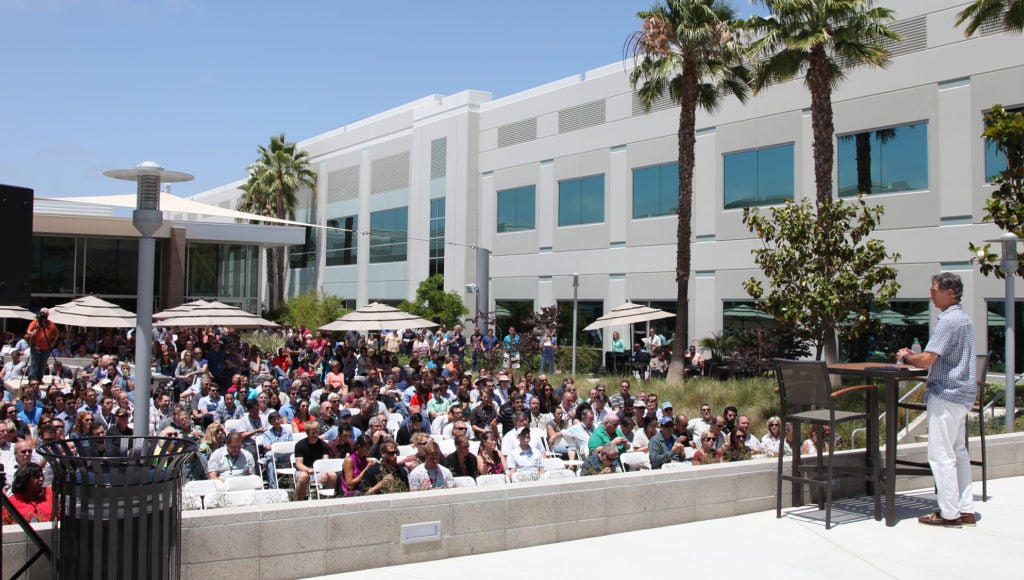
The repair shop is a long way away
Long tenure does not exempt a founder from unpleasant surprises. Dankberg became executive chairman in November 2020 while Rick Baldridge took over as CEO. He returned to the chief executive role in July 2022, with the Inmarsat acquisition still ahead. Viasat completed that purchase in May 2023, adding a business with established maritime, aviation, and government connections.
Dankberg’s message after the acquisition was measured. Combining the companies, he wrote, would require a cohesive team and carefully chosen markets. The transaction alone could not guarantee success. It was an acknowledgment that buying capabilities and making them work together are separate jobs.
Then came a problem that could not be settled in an integration meeting. The first ViaSat-3 satellite, launched in April 2023, suffered a reflector deployment issue. Viasat determined that it would recover less than 10 percent of the planned throughput. A number that small leaves very little room for cheerful interpretation.
The satellite did enter service in 2024 and has served airline customers, but useful remaining capacity does not erase the original shortfall. Both facts belong in the story. Building the network meant taking responsibility for its disappointments as well as its improvements. A strategy can be sensible and still contain machinery that fails.
A shared address in orbit
Dankberg’s recent arguments reach beyond the design of an individual spacecraft. He has written about scarce orbital and spectrum resources, national sovereignty, and how countries should share access to space. His position is that global connectivity needs cooperation and rules that preserve room for multiple participants. That is also a commercial position for the company he leads; the policy argument and the business interest travel together.
He also resists treating every orbit as a contestant in a race with one winner. In 2025, he argued that geostationary satellites remain economically useful for national and regional services, while low Earth orbit networks offer lower latency and inherently global reach. That distinction helps explain his attention to sovereignty. A country’s requirements may include control of communications infrastructure as well as the performance of a connection. The engineering decision and the political decision can occupy the same diagram.
Equatys brings that thinking into a proposed business. In September 2026, Viasat and Space42 announced a binding agreement to establish a shared satellite and ground infrastructure venture, with combined equity commitments of up to $1 billion upon formation. The model borrows from shared mobile towers: operators could use common infrastructure while retaining their own customers and spectrum rights.
The intended services include connecting smartphones and other devices directly to satellites. Formation and procurement still depend on closing conditions and regulatory approvals. The distinction matters. Dankberg is proposing how a future network should work, with partners, financing, and permissions still part of the task.
The change is striking. At the start, he and two colleagues needed a room they could work in together. Now he is arguing for infrastructure that other operators can share. The scale has expanded; the recurring question is how to arrange the work so that more people can participate.
In a September 2026 reflection on Viasat’s forty years, he returned to the importance of learning curves and business models, and to the influence of Clayton Christensen’s The Innovator’s Dilemma. The history included programs lost or delayed, financial crises, and customers whose needs kept changing. Forty years gives a founder plenty of material for certainty. Dankberg’s next project still requires an experiment.