Before Balan Nair joined Liberty Global, he thought it was an insurance company. The name did have a certain reassuring ring. His friend Tony Werner introduced him to the business, and Nair joined in 2007. For someone whose career would become so closely associated with Liberty, it was an agreeably unceremonious introduction.
Today, from Denver, Nair is president, chief executive and a director of Liberty Latin America. His responsibilities stretch across a region of islands, national borders and underwater cables. The company sells the everyday necessities of a connected life: mobile service, home internet, television and business connectivity. It is an enterprise whose products become particularly noticeable when they stop working.
The job brings together several earlier versions of Nair. There is the electrical engineer, interested in how systems work. There is the technology executive, concerned with how customers experience them. And there is the operator, responsible for the people, money and decisions that allow a technical promise to become an ordinary, dependable service.
A detour through Iowa
Nair grew up in Malaysia and came to the United States in 1985. A tuition increase upset his Texas university plans; Iowa State became his destination instead. He began in architecture, switched to electrical engineering and met his wife there. The route was less orderly than a corporate biography might suggest.
He earned both an electrical engineering degree and an MBA at Iowa State. Those two qualifications describe a recurring tension in his work: a network must function, and the business that owns it must function too. Engineering offers a way of understanding the first obligation. Business education supplies a vocabulary for the second. A telecommunications executive has little opportunity to ignore either.
His professional biography also includes a systems-development patent and a Colorado professional engineering license. These are useful details in a career that can otherwise disappear into a procession of executive titles. They place him close to the physical and technical work beneath the company name. Long before the quarterly presentation, somebody has to make the system behave.
- QwestTelephone networks
CIO & CTO - 2006 · AOLInternet services
CTO & EVP - 2007 · Liberty GlobalCable & broadband
Technology leadership - 2018 · Liberty Latin AmericaRegional operations
President & CEO
The customer has a remote control
Nair spent more than 12 years at Qwest Communications, ultimately serving as chief information officer and chief technology officer. In 2006, he moved to AOL as chief technology officer and executive vice president. Then came Liberty Global. The progression carried him through telephone networks, internet services and cable, businesses that were becoming harder to discuss as separate worlds.
By 2013, his public message about video was wonderfully impatient. At an industry conference in Orlando, he argued for quicker product development and a simpler experience. He also pressed for broadband speed improvements large enough for customers to notice. A modest technical increment could look respectable on a planning slide while making very little difference in a living room.
“People have to love it,” he said of building a product. That short sentence places an awkward obligation on an engineering organization. Working correctly is only the entrance requirement. A television service must also be easy to navigate. A faster connection must justify the attention, money and patience a customer is being asked to spend.
His career had brought him to a useful vantage point for making that argument. Someone who has worked in both telecom infrastructure and internet services can see the distance between what a network permits and what a product actually lets a person do. The customer, holding the remote control, has an efficient way of delivering a verdict.
“People have to love it.”
Balan Nair on building products, 2013
A bigger job, with the sea in between
In October 2017, Liberty Global announced that Nair would lead its Latin American and Caribbean operation when it became a separate public company. At the time, his existing technology remit included a workforce of 7,500 and an annual operating and capital budget above $5 billion in Europe. The appointment expanded his accountability beyond the technology organization to the whole enterprise.
He entered the role with established relationships inside the Liberty group. Mike Fries would serve as executive chairman of the new company. John Malone was another figure from whom Nair publicly acknowledged learning. His appointment statement emphasized carrying that experience into the new business. The corporate separation created a different job, while retaining a recognizable circle of colleagues.
Liberty Latin America began trading independently in January 2018. Its geography gives the word connection a very literal meaning. The company operates communications businesses in more than 20 countries, while its subsea and terrestrial fiber network connects more than 30 regional markets. A customer buying a local service belongs to a much larger physical system.
For Nair, that means running businesses that need local knowledge while sharing infrastructure and expertise across borders. A mobile offer, an enterprise contract and an underwater cable belong to different conversations. They still meet inside the same company. The chief executive has to understand how one decision travels through the others.
When the connection breaks
The new company’s beginning coincided with the aftermath of Hurricanes Irma and Maria. In Puerto Rico, the damage to Liberty’s broadband network was extensive. Restoring it required approximately $142 million in property and equipment additions. The network restoration was completed during the third quarter of 2018. Independence arrived with a reconstruction bill attached.
The work behind that bill was intensely practical. At the flooded Luquillo office, employees used buckets and a makeshift hose to remove water and protect telecom equipment. Outside, people gathered to use a free Wi-Fi hotspot. The scene gives a clearer account of the value of connectivity than a page of adjectives could manage: people needed a place where their phones could reach someone.
Nair later described a decision to retain employees after the hurricanes. By the first quarter of 2019, Liberty Puerto Rico was reporting $99 million in revenue and roughly 22,000 additional revenue-generating units. Those figures described a business recovering alongside the communities it served. They also make the employment decision part of the operating story, alongside the reconstruction and the returning connections.
There is a limit to what any chief executive can promise about weather. The more useful question concerns preparation, repairs and the choices made while revenue is disrupted. Nair’s early tenure offers a concrete example. A telecommunications company has equipment to replace and bills to pay, while its employees and customers are dealing with the same damaged surroundings.
Who gets credit for a decision?
Nair’s public reflections on leadership leave room for other people. In a discussion of career advice, he credited his wife with decisions that had proved important to his success. “Understand that many people have your back,” he said. It is a modest sentence for someone whose job routinely puts his own name at the front of the room.
That habit of distributing credit offers a useful way to read an executive career. A title records who carries responsibility. It reveals less about who gave good advice, made an introduction or helped someone see an opportunity. Nair’s acknowledgment makes those quieter contributions visible. Even a career spent connecting large systems depends on a few very personal connections.
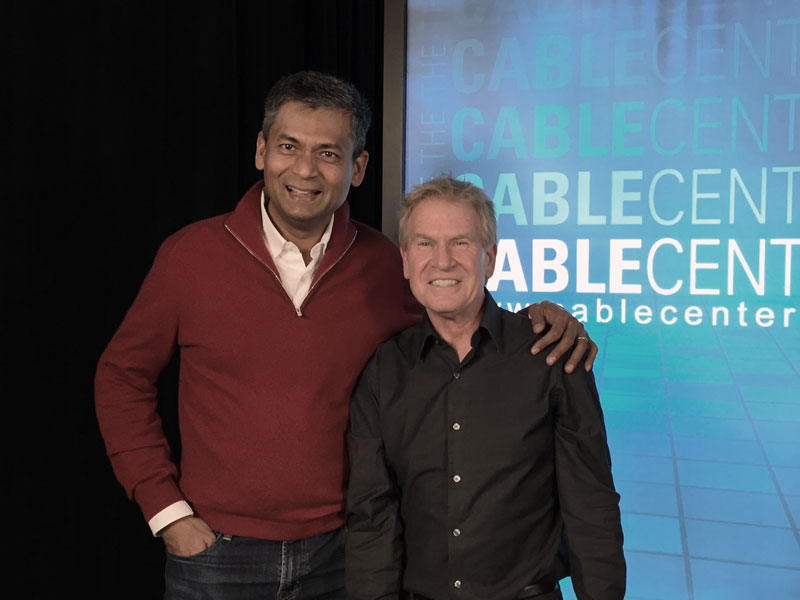
His industry recognition includes induction into the Cable Hall of Fame in 2018. The class also included the television series Breaking Bad, an unusually entertaining reminder of cable’s range. The industry needs both something worth watching and a way of getting it to the screen. Its roll of honorees can accommodate the people behind the network and the drama passing through it.
Nair and Breaking Bad both joined the Cable Hall of Fame’s class of 2018. Cable has always had room for a plot twist.
The next problem is already here
In March 2026, Nair described a business moving further into digital and enterprise services. Connectivity would remain central to the customer relationship, he argued, but operators needed additional capabilities and partnerships. He discussed working with Amazon Web Services on data centers and integrated business solutions. This was an account of strategic direction, with the work of delivery still ahead.
He also argued that telecommunications markets need sufficient financial strength to support long-term investment. His preference for fewer, stronger operators is a business position with consequences for regulation and competition. It belongs alongside his product ambitions: faster networks and broader services require capital, and the structure of a market affects where that capital goes.
In August, Liberty Latin America announced a ten-year engagement with Amdocs to manage its regional IT ecosystem. The stated aims include modernizing operations with AI, improving customer and employee experience, and reducing costs. Prodapt is involved in supporting continuity through the transition. The announcement describes an intended transformation rather than a finished achievement.
The latest reported numbers give that work a business setting. In the second quarter of 2026, the company recorded $1.103 billion in revenue and $181 million in operating income. It added about 45,000 postpaid mobile and broadband subscriptions on a net basis. Those additions describe two selected service categories; total mobile subscriptions fell during the quarter.
Leadership work continues alongside the technology agenda. On October 14, the company announced Guillermo Ponce as interim general manager of Cable & Wireless Panama, replacing Rocio Lorenzo, who was leaving to become Telenet’s CEO. Nair thanked Lorenzo and backed Ponce. After years of engineering, product launches and corporate change, the job still turns on deciding whom to trust with the next piece of work.
A connection looks simple from the customer’s end. You press a button, open a browser, call someone. Nair’s career has accumulated the responsibilities behind that simplicity: choosing products, funding repairs, managing partners and appointing people. The engineer’s problem survives inside the chief executive’s office. There is always another part of the system that needs to work.
Selected organic net additions, not total subscriber growth. Total mobile subscriptions declined by 49,300 in the quarter.
Keep the connection
- Official biography
- Balan Nair on LinkedIn
- Watch the 2018 oral history · Vimeo
- Watch: Caribbean services discussion · YouTube
- Product thinking, 2013
- Leadership and the people behind a career
- Nair’s March 2026 interview · Spanish
- Q2 2026 results
- The Amdocs agreement
- October 2026 leadership announcement
- Liberty Latin America on X · company account
- Liberty Latin America on Facebook · company account
- Liberty Latin America on YouTube · company channel