The phone call is an unusually unforgiving product. When it works, nobody applauds the network. When it fails, everybody discovers an interest in telecommunications. Ananth Veluppillai has made a career in the machinery behind that bargain, moving from network operations into the ownership and management of communications businesses. His current assignment brings those two worlds together: he runs BRC Group Holdings’ telecom practice and serves as Lingo’s chief executive.
There is a useful detail near the beginning of his career. Before the telecom leadership jobs, he worked at Gibbs & Cox, the naval architecture and marine engineering firm. Ships and telephone networks make unlikely companions in a corporate biography. Both, however, give engineers plenty of reasons to distrust the phrase “it should probably work.” The move from one industry to the other makes his later career easier to understand: technical systems came before financial structures.
By September 2026, the structures had become substantial. BRC had agreed to acquire Sangoma Technologies in a transaction with an enterprise value of approximately $204 million. Veluppillai was speaking as CEO of BRC Telecom, describing a platform built by bringing established communications companies together. The agreement offers a fresh view of a career spent moving between engineering, operations and the business of keeping familiar services useful.
The engineer before the executive
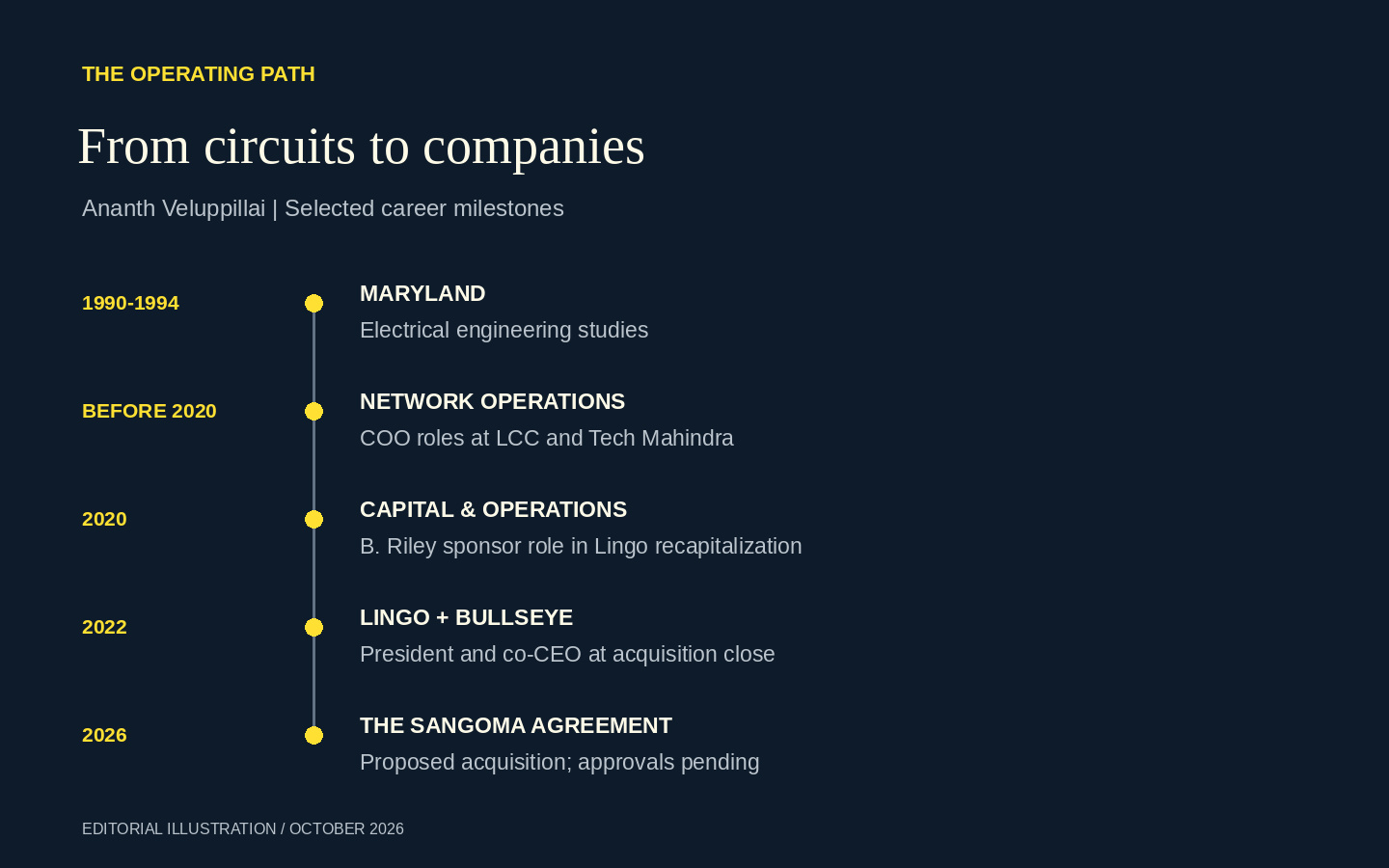
Veluppillai studied electrical engineering at the University of Maryland, College Park. His LinkedIn profile places his university years between 1990 and 1994 and lists EKN among his activities. His professional geography remains tied to the region: the profile identifies the Washington DC-Baltimore area as his base, even as his responsibilities have extended across companies and countries.
His subsequent positions included chief operating officer at LCC International and chief operating officer of global operations for Tech Mahindra’s Network Services unit. These were businesses concerned with wireless and wireline networks. His experience included responsibility for wireless network deployments in North America and Europe, alongside financial management, planning and execution.
That combination matters. A network deployment has a technical design, but it also has a timetable, a budget and a customer waiting for service. The executive responsible for operations sits where those demands meet. It is a practical apprenticeship for managing businesses whose product must continue working while their ownership, financing or technology changes.
The broader LCC business also passed through a change of ownership. Tech Mahindra’s Americas subsidiary acquired Lightbridge Communications Corporation in 2015. Its work ranged from consulting and system design to optimization, deployment, operations and maintenance. Those activities describe the long life of a network after the exciting announcement has finished. Someone still has to make the pieces cooperate.
When the balance sheet joined the network
By December 2020, Veluppillai was chief operating officer of B. Riley Principal Investments. Lingo was undergoing a recapitalization backed by that business. Approximately $64 million of existing debt was restructured and refinanced, with part converted into a 40 percent equity interest held by B. Riley. A further ownership tranche was contemplated, subject to approvals.
At that point, Vincent Oddo was taking the president and CEO role at Lingo. Veluppillai spoke from the financial sponsor’s side. His explanation paired Lingo’s network and subscribers with operating expertise and the potential to generate cash. It was a compact expression of the investment case: a communications business could be understood through its customers, its infrastructure and the way it was run.
The distinction between sponsor and operator would soon narrow. Veluppillai already had operating responsibilities elsewhere in the portfolio, including serving as president of magicJack and United Online. Those names carried existing customers and established services into the investment business. His work crossed the boundary between assessing an asset and taking responsibility for its everyday performance.
There is little romance in a debt restructuring. There is considerable consequence. Changing the financial footing of a company can alter what its managers are able to do next. In this chapter of Veluppillai’s career, the engineering vocabulary of capacity acquired a financial companion: the capacity to keep operating and pursue another transaction.
Two companies, a larger operating problem
In August 2022, Lingo completed its acquisition of BullsEye Telecom. Veluppillai was identified as Lingo’s president and co-CEO, alongside his B. Riley Principal Investments role. The combined business reported more than $200 million in annual revenue and 130,000 customers, with operations centers in Michigan and Georgia and customers in the United States, Canada and elsewhere.
BullsEye brought business from enterprises operating at multiple locations. Veluppillai’s explanation of the transaction emphasized additional revenue scale, customer density, network reach and products. Each item points to an operating question. How many customers can a network support? How widely can service be delivered? What else can the combined company sell to an existing customer?
For a business with several locations, communications purchases can become an administrative sport nobody intended to enter. Different connections, services and support arrangements accumulate. The appeal of a broader provider rests partly on simplifying that experience. Delivering the simplification requires coordination behind the scenes, where a combined company inherits the work as well as the revenue.
Lingo’s current offering spans cloud business phones, contact center services, broadband, security and traditional phone services. Its executive team distributes responsibility across finance, operations, revenue, compliance and technology. Veluppillai’s CEO role sits above those interdependent functions. An acquisition announcement may fit on a page; making the acquired business function takes rather more coordination.
The portfolio also has an exit door
Acquiring businesses was only one direction of travel. In August 2024, 46 Labs announced that it had purchased Impact Telecom from Lingo. The buyer described Impact as an addition to its international network and part of its effort to modernize legacy infrastructure. Veluppillai welcomed the role Impact would play in that modernization.
The sale adds a useful complication to an otherwise tidy consolidation story. A portfolio changes through disposals as well as additions. A network that has value inside one group may have a different role inside another. For Veluppillai, this transaction placed him on the selling side of the same industry’s continuing rearrangement.
It also keeps the story grounded in actual businesses. “Telecom” can sound like one enormous, interchangeable service. The transactions involve different customers, networks and capabilities. Running the collection requires decisions about how those parts fit, including when another owner is the appropriate next chapter for one of them.
The responsibility carried with the call
The operating story includes regulatory scrutiny. In August 2024, Lingo Telecom agreed to a $1 million civil penalty and a compliance plan to settle an FCC investigation involving caller ID authentication. The case concerned spoofed calls carrying an AI-generated imitation of President Joe Biden’s voice before the New Hampshire presidential primary.
The FCC identified political consultant Steve Kramer as directing the calls. Lingo’s role concerned their transmission and authentication. The settlement required additional customer and upstream-provider verification measures. Lingo responded that the settlement contained no findings of rule violations and maintained that its actions had complied with the applicable rules.
In April 2025, a multistate attorneys general task force addressed a second notice letter to Veluppillai as Lingo’s CEO, raising concerns about suspected illegal robocall traffic. Those were allegations about traffic carried by the company. The letter called for scrutiny of customers and the effectiveness of mitigation policies.
These episodes put another responsibility beside the portfolio’s financial ambitions. Carrying a call involves questions about who is entitled to use the number on the screen and whether a provider can trust the traffic it receives. For a chief executive, network reliability and network accountability belong in the same operating picture.
Sangoma, and the next set of connections
The September 28, 2026 Sangoma agreement would extend BRC’s communications business into additional capabilities, including customer experience and contact center technology. Sangoma offers cloud, on-premises and hybrid communications systems. Veluppillai’s stated aim was to bring a broader platform to customers, with particular attention to serving the mid-market.
The acquisition remained subject to shareholder, court and regulatory approvals, with closing expected no later than early 2027. An agreement is an important milestone; the operating combination still lies ahead. Sangoma’s chief executive, Charles Salameh, spoke of combining the teams’ operational strengths. Veluppillai expressed respect for the business Sangoma’s team had built.
“We have successfully brought five companies onto this platform.”
Ananth Veluppillai, September 2026
BRC’s existing communications group included UOL, magicJack, Marconi Wireless and Lingo, with BullsEye inside Lingo. That list gives the word “platform” a concrete meaning. It describes a collection of businesses with their own names and customers, brought within a shared portfolio. Sangoma would add another company to that arrangement if the deal closes.
A brief message, without the transaction language
There is a smaller public moment alongside the operating titles. On LinkedIn, Veluppillai shared Ishyan Veluppillai’s account of graduating from the University of Virginia and beginning a professional career. His accompanying message was brief: “Very proud of you Ish! Best wishes ahead!”
The tone is warmer than an acquisition release and considerably shorter. No claim about market reach was required. The moment offers a glimpse of him cheering someone else’s progress, without converting the occasion into a management lesson.
His own career now sits at another transition, with a proposed acquisition awaiting the steps that turn an agreement into an operating business. The distance from electrical engineering to portfolio leadership is considerable. The recurring concern is recognizable: what happens when separate parts have to work together, under real conditions, for people who expect the connection to hold.