The first thing to go missing was the record. A nationwide broadband and managed services provider had spent years acquiring businesses. Its network still needed to serve customers, but its knowledge of that network had become less dependable. IP address assignments had eroded across the acquisitions. The company needed an audit. Its own people were busy keeping everything running.
- Nettxio builds, migrates and supports business networks.
- Its Cue software connects project work with approvals and money.
- Cue Crane applies that approach to equipment procurement.
The records went missing first
Nettxio’s April 2024 account of the engagement describes engineers scanning the live network and checking equipment and customer services against configuration databases. They organized address ranges, planned replacements and coordinated migrations with the client’s commercial and technical teams. Simpler blocks received priority. Updated assignments went into an IP address management system.
There was a commercial reason for the housekeeping: surplus address blocks could potentially be sold. The interesting move was to treat confused records as an engineering problem with an asset-management consequence. Better documentation could help the operator understand both what its customers needed and what it might no longer need to keep.
That is a useful entrance to Nettxio. The company combines network services with software for managing work. Its territory includes the gap between the network on a diagram and the network someone must actually maintain. A replacement system needs migration planning. A completed task needs documentation. An improvement has to survive contact with the existing business.
- 01DiscoverScan the live network
- 02ReconcileCheck services and records
- 03MigrateSequence customer changes
- 04RecordKeep IPAM current
A crane belongs in this story
Then there is the crane. Nettxio’s Cue Crane division manages procurement for cranes, lifts and jobsite equipment. It sounds like a detour until you examine the work. A contractor needs a machine at a particular location, on a particular date, with the appropriate documentation and approvals. Getting a price resolves one part of a longer sequence.
Cue Crane connects sourcing with safety coordination, deployment and invoice closeout. Its services include tracking schedule changes, standby, cancellations and changes in scope. Those details matter because the job someone requested and the job someone ultimately pays for can develop differences along the way. A shared record gives the people involved somewhere to resolve them.
“Control the chaos.”
Nettxio’s software proposition
The company describes its software engineers working alongside project coordinators who handle bids, supplier communication and deployment requirements. That is the distinctive connection: people managing the process can describe its awkward parts to people building the software. The product has an operating team close enough to know what an approval actually holds up.
The wider Cue offering covers tasks, resources, purchasing, automated updates, invoicing and geolocated closeout. Nettxio therefore sits across technical services, managed operations and business software. Its commercial offer includes people doing work and software organizing it. For a buyer comparing options, that combination is more informative than the broad label “IT consulting.”
The alarm is only the beginning
Network operations presents another version of the same coordination problem. Nettxio offers round-the-clock monitoring, automated ticketing and alarm correlation. An incident can generate multiple signals. The operational task is to connect those signals to an actionable problem, then coordinate the response. Duplicate tickets and unnecessary dispatches are among the problems its offering targets.
Its supported systems extend from optical transport and IP networks to voice, power and environmental equipment. That range explains the customer fit: service providers and enterprises operating infrastructure that cannot be understood through a single application dashboard. The network includes old equipment, physical dependencies and several kinds of expertise.
Nettxio also lists support for legacy voice platforms, including Nortel DMS and Lucent 5ESS, alongside Metaswitch. Elsewhere, its infrastructure practice covers private wireless, data centers, RF engineering and site acquisition. These offerings meet buyers at different stages: preparing a site, replacing equipment, extending an existing system or maintaining technology that still has customers depending on it.

People who know which screw goes where
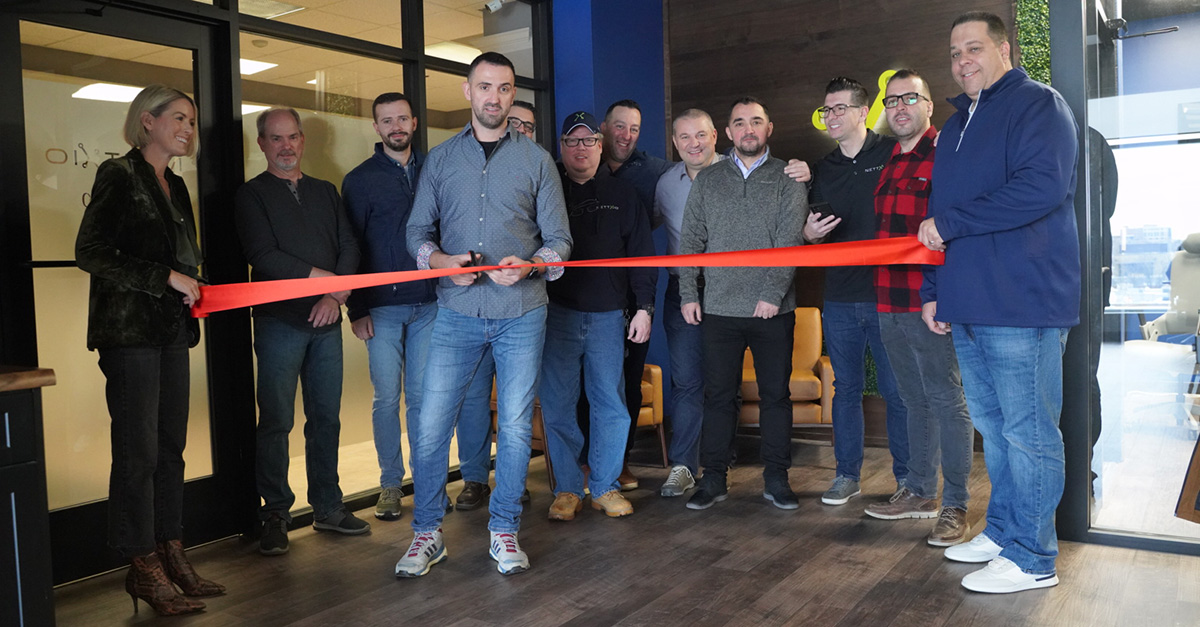
The company’s account of its Naperville office opening supplies an unusually concrete culture story. In 2023, Maria Chambers arrived for a marketing interview and found CEO Edward Krzyzanowski in an unfinished office, measuring tape in hand. Leaders helped assemble furniture and fit out the space. An alley served as a workshop. The company remembered the inconvenience with considerable amusement.
There is a more consequential example, too. That November, Nettxio reported employing two assistants who would work at Kosovo’s Përparimi Resource Center, supporting teachers and children. Its account traced the arrangement to a lunchtime conversation about a colleague’s concern. It is a specific employment decision behind the company’s stated emphasis on care and respect.
Nettxio’s operating footprint includes US locations and teams in London, Prishtina, Gjilan and Skopje. Its NOC offering explicitly combines European and US support. In 2026, Inc. ranked the company No. 26 on its Midwest Regionals list, reporting 203% two-year growth. That establishes business momentum; it does not tell a prospective customer which project to hand over.
That makes the buying decision unusually dependent on the assignment. A carrier needing specialist voice support is buying different expertise from a construction team coordinating lifts. A workflow tool alone cannot supply a field crew; a field crew alone cannot reconcile a procurement program. Nettxio brings those capabilities into the same conversation, although customers still need to define the outcome they expect.
Start with the handoff
The sensible starting point is a bounded problem. Compare live infrastructure with its records. Follow an equipment request through approval and payment. Ask whether incident reports converge on one response. Each exercise identifies work that crosses teams, where ownership and information can become separated.
For a migration, that outcome might be tested services and dependable records. For procurement, it might be an approved deployment followed by a traceable invoice. Defining completion this way gives both buyer and supplier a practical basis for judging the work.
The conditions matter. Reclaiming addresses requires genuinely surplus resources and careful migration. Procurement software needs current job details and people authorized to approve changes. A business with simple equipment needs may gain less from a managed coordination service. The transferable lesson is practical: make the handoffs visible before automating them. Nettxio’s offerings give buyers several ways to put that idea to work.