Consider a contract that belongs to a client, a project and an annual review. Put it in the client folder and the project team needs directions. Copy it into the project folder and someone must remember which version counts. The computer has stored the document perfectly. The people still have a filing problem.
- M-Files connects documents to clients, projects and approval rules.
- Crowe UK used it to improve collaboration during lockdown.
- The buying decision includes subscriptions, setup and deployment choices.
This is an illustrative puzzle, but it explains the appeal of M-Files UK. The British operation brings a Finnish-origin software group’s document management platform to businesses where files carry obligations: accountancy practices, financial advisers, engineering teams and manufacturers. Finding something is useful. Knowing whether it is approved, current and yours to share is often the harder job.
The folder has a memory problem
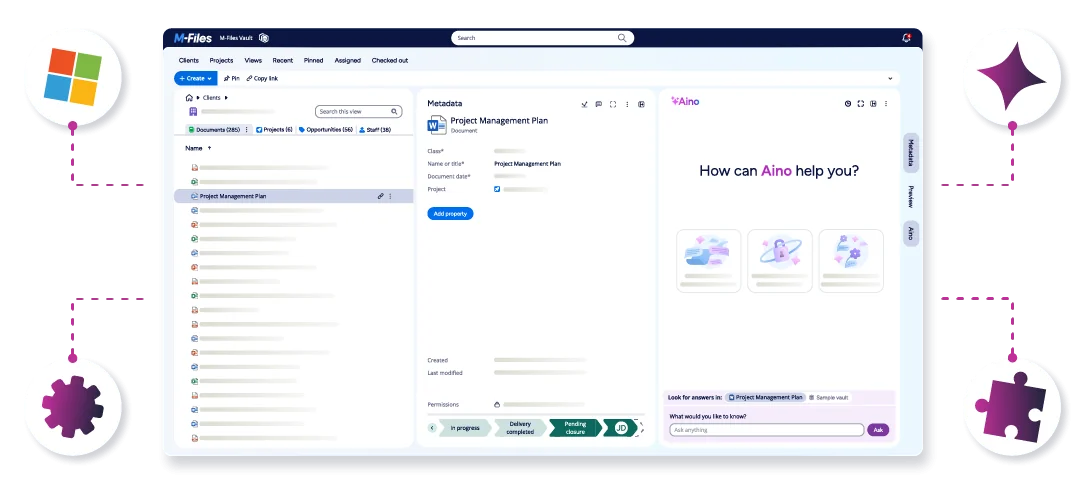
M-Files organises information through metadata: descriptions and relationships attached to a document. A contract can be connected to its customer, project and status without requiring people to maintain parallel copies. Different views can surface the same information for different tasks. The organising question becomes what the document represents.
Those relationships also give the software something to act on. A review can move to the appropriate person; access and retention rules can follow business context. Search, workflow and governance sit together. M-Files’ particular expertise is making that structure useful across documents and business systems, rather than treating every file as an isolated object.
A thousand people, no shared office
Crowe UK offers a useful test. Its network drives and SharePoint setup made sharing across offices cumbersome. Permissions required administration; colleagues could struggle to identify current versions. The first thing to give way was coordination.
The firm evaluated six products. Integrated workflow, usability and visibility across repositories helped persuade it to choose M-Files. In August 2020, the system reached more than 1,000 people under lockdown. Documents were tagged by client and job; approvals became part of the workflow.
“I wish all of our projects had been like this.”
Ian Norman, National Technology Director, Crowe UK
Preparation matters in this account: workshops included different business areas, internal champions helped colleagues, and training videos were available around the clock. The lesson a reader can copy is to design the process with its users. Software still needs people to agree what a document means.
Protolabs’ published experience points to a related problem in manufacturing. Its quality teams needed consistent documentation and approvals across sites. Automated notifications, assignments and reviews reduced manual handling. That use case puts the platform in perspective: the product is valuable when a file must move through an accountable process, with evidence of who did what.
The long route to an AI assistant
Antti Nivala began developing document management software in Tampere in 2002; the initial software shipped in 2005. The UK presence predates today’s enthusiasm for AI: a registered UK establishment opened in 2014. The newer M-Files UK Limited was incorporated in Reading in February 2026. These are different dates in the same business story.
The group expanded beyond document storage. Acquiring Hubshare in 2021 added client collaboration portals. Buying Ment in 2023 brought no-code document generation. That September, M-Files announced Aino, offering natural-language questions, summaries and translation. Its usefulness depends on the information and permissions behind the answer.
Money followed the wider ambition. A 2021 growth investment brought $80 million, led by Bregal Milestone. The group announced $100 million in annual recurring revenue in 2023. A majority recapitalisation closed in November 2024; Jay Bhatt became CEO the following month, while Nivala moved to innovation leadership and remained chairman. Those figures describe the global group.
Microsoft occupies an interesting position here. SharePoint can be an alternative in a buying exercise, yet Microsoft is also a partner. M-Files’ September 2025 announcement described deeper Microsoft 365 integration, including co-authoring, Copilot and Purview. Alongside Box, Laserfiche and OpenText, it competes for businesses that need controlled document processes. Its argument rests on connecting those processes to familiar working tools.
The price of putting things in order
M-Files makes money through business subscriptions, with services and add-ons around the platform. Its current public Essentials price is US$65 per seat per month; Enterprise requires a quote. Subscriptions are typically billed annually. This is a global dollar list price, rather than a sterling proposal for a British buyer.
20 seats × $65 × 12 months
Subscription arithmetic only. Services, scope and agreement terms affect the project total.The useful budget question is what the organisation needs to configure, connect and govern. Enterprise scope can depend on compliance, automation, AI use and content volume. A seat price cannot describe that work. Buyers should compare the complete proposed deployment against the hours and risks in the process they want to change.
Deployment also changes the offer. The company’s 2026 package announcement says self-hosted packages exclude Aino and Microsoft-native cloud capabilities. A team requiring self-hosting should evaluate that actual feature set before borrowing expectations from a cloud demonstration.
Start with one awkward handoff
A practical starting point is one process with a recognisable owner: an approval, a supplier document or a recurring client deliverable. Agree the document types, required metadata, access rules and next action. Then measure how often people chase a file or ask which version is right. This is an editorial recommendation, not a promised result.
The approach asks something of the customer. If nobody owns the vocabulary, permissions or process, the configuration has little dependable guidance. If a small team only needs basic sharing, the extra structure may be unnecessary. M-Files is more compelling when documents pass between roles and the handoff needs a record.

That also explains why a document management purchase deserves a demonstration built around the buyer’s own work. Bring a real approval chain and a difficult permission question. Ask the vendor to show the next action, the current version and the audit history. A tidy screen is only the beginning of the evaluation.
The company’s own culture language is disarmingly plain: “Make It Happen,” “Help Others” and “Love Customers.” In September 2026 it applied its product thinking to manufacturing, launching engineering change control and supplier transmittal management. The central idea persists: connect the drawing, approval or contract to the work around it. Give people enough context to make the next decision.