At Cooper Horowitz, a commercial real estate advisory firm with three generations in the business, a complicated loan portfolio could require more than eighteen hours of work on a single memorandum. Comparables had to be gathered. Photographs needed formatting. Tables needed building. Then someone had to check the whole thing. The property was already there. The document describing it was consuming another working day.
- Henry turns property information into branded deal materials.
- Henry Deal adds underwriting, research and firm-specific buyer lists.
- The savings depend on the assignment; human judgment remains part of delivery.
Henry’s published case study says Cooper Horowitz reduced that document-production task to under fifteen minutes. It is a customer example, not a stopwatch guarantee. Still, it identifies a peculiar expense in commercial real estate: skilled people performing work that must be done beautifully, but need not be done by them.
“We are not graphic designers”Ryan Horowitz · Cooper Horowitz
The building is waiting for its brochure
An offering memorandum is a property’s argument for being bought or financed. It combines financial information, photographs, location, market context and a persuasive account of the opportunity. The broker may know the argument perfectly well. Getting it into a presentable document is a separate occupation.
Henry’s original proposition was to shorten that occupation. A team supplies its information; the system assembles a deal deck in the firm’s own visual language. The dull details matter. A brand is fonts and colours, certainly, but also the arrangement of a rent roll and the way a particular shop likes to tell a property’s story. In this business, a generic slide can look like a stranger wearing your suit.
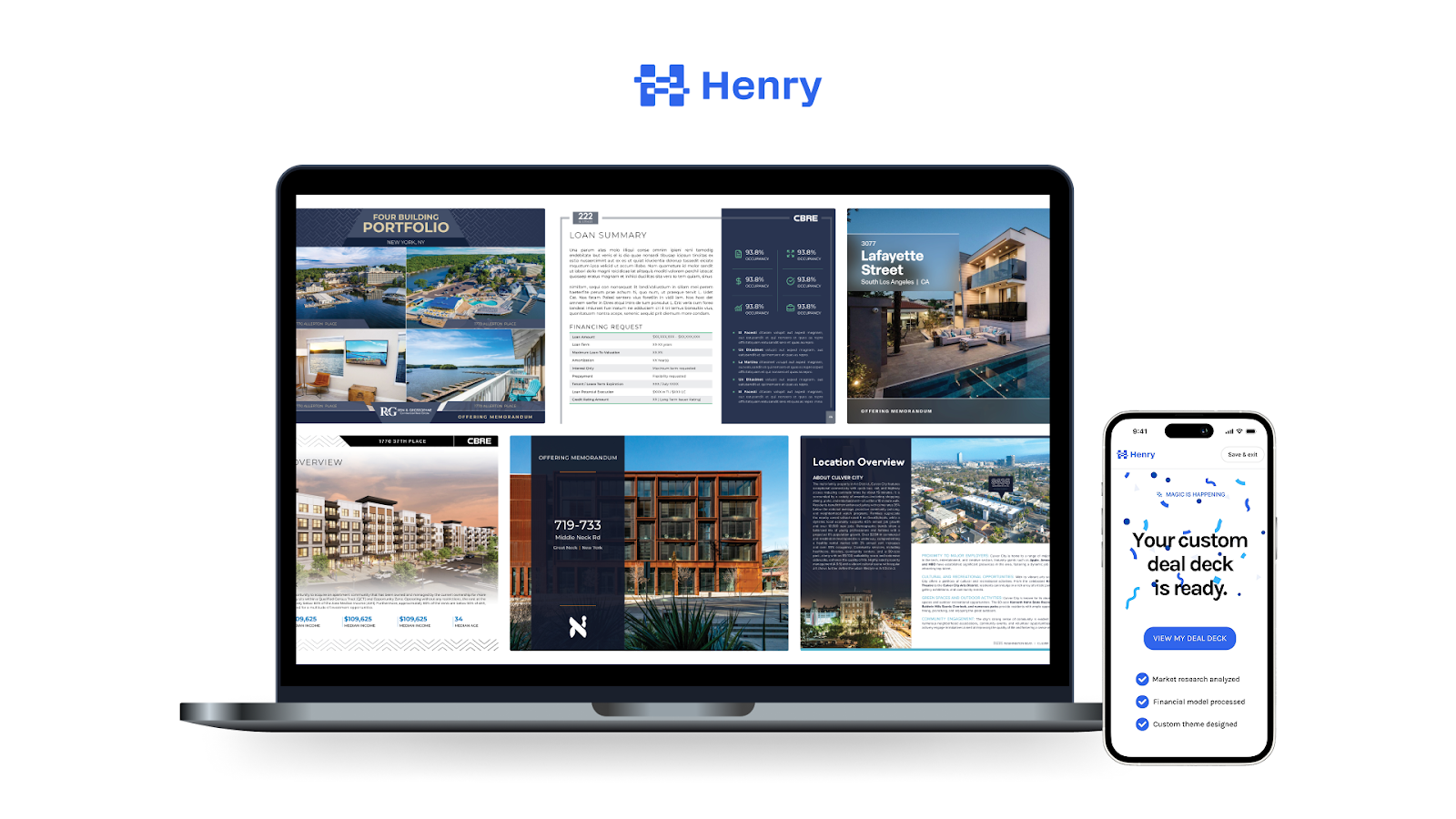
The company’s early launch described consolidating messy, unstructured transaction information into marketing materials and financial analysis. Its chosen customer was the commercial broker, whose business depends on relationships but whose calendar can disappear into preparing for them. That is an unusually legible software pitch: here is a piece of work you recognise, completed.
Two founders who knew the nuisance
CEO Sammy Greenwall came from the industry. Before Henry, he co-founded commercial real estate financing company Lev. CTO Adam Pratt brought a different apprenticeship: engineering at Zocdoc and an earlier company, Halligan, which made software for first responders and was acquired by Vector Solutions. Pratt had also been a volunteer firefighter. Buildings, evidently, kept finding him.
Henry joined Y Combinator’s Summer 2024 batch. Its founders were selling into an industry with reasons to distrust another tool. FirstMark partner Adam Nelson initially discouraged the venture. In his later investment essay, he explained the objection: brokers had repeatedly been sold software that demanded more of their time. An analyst who simply completed the assignment could be the more sensible purchase.
That distinction changed his mind. Henry was attracting brokers by delivering work, and FirstMark led its $16.5 million Series A, publicly announced in July 2026. The earlier seed round, announced in February 2025, was $4.3 million, co-led by Susa Ventures and 1Sharpe Ventures. A handsome presentation had become a venture-funded proposition.

A deck is an entrance, not a destination
There was an early temptation to abandon the idea. In a retrospective LinkedIn post, Greenwall described a broken minimum viable product and discussions about switching to a real estate meeting notetaker. He says a beta customer’s success with the deck persuaded them to continue. Treat the anecdote as a founder’s recollection, rather than proof that one presentation won a listing.
A newer pressure was less sentimental. Upstarts reported that improving general-purpose AI was weakening some demand for a deck-only offering. Henry responded with a rapid product sprint and Henry Deal. The business now reaches into the preparation behind the presentation: underwriting, comparable properties, research and identifying prospective buyers.
The wider product also changes what Henry needs to know. A property address alone cannot reproduce a firm’s experience. Past transactions, models and relationships supply the context. Henry’s promise is to make that scattered institutional knowledge usable on the next assignment, rather than leaving it marooned in old files.
+ property data
+ draft materials
+ client conversation
Two clocks, one invoice
Upstarts put Henry’s starting price at $2,000 per month in July 2026, scaling with usage. That makes it a business purchase whose justification belongs in the production budget. Compare the subscription with the work displaced, the review retained and the extra assignments the team can actually handle.
Keep two clocks on the desk. Henry’s July announcement reported a median turnaround below four hours alongside roughly thirty minutes of human review for work previously estimated at fifteen hours. Elapsed delivery and hands-on effort measure different things. Neither number promises that a property will sell sooner.
Median total turnaround: under four hours. Review time is one component of delivery, not its entirety.
Texsun’s experience supplies a useful counterweight. The Texas multifamily investor described receiving a substantial draft in four or five hours, then refining it. Managing partner Sean Fogelman estimated presentation lead times roughly halved. The remaining work concerned the business plan, assumptions and narrative. An investment thesis still requires someone willing to defend it.
By July 2026, Henry reported serving more than 150 firms. Named users include teams at Newmark and Berkadia. Its market spans large brokerages and smaller investment businesses, united by the recurring need to make property information presentable.
The spreadsheet keeps its chair
Henry offers a guided two-week onboarding period to ingest historical materials. Its support documentation says decks remain editable and undergo team curation. Underwriting lives in Excel, with an add-in to synchronize changes. These are practical concessions to professionals who already have ways of working.
The copyable lesson is to test automation on a real assignment. Bring the same inputs, record production and review separately, and ask the person receiving the result whether it is usable. A firm with occasional deck needs or little accessible historical data has a different calculation from a busy brokerage. Henry’s ambition depends on that calculation ending in its favour, one reviewed deal at a time.