On his fifth working day at FOUNDERS LEAGUE, Marc-Niclas Janz was already at an event in Bremen. Nearly 150 people were there. He remembered the occasion when he announced his departure two years later, by which point he had helped organise gatherings for more than 1,000. It is a pleasingly compact account of a job: arrive, find the room, discover that the room keeps getting bigger.
The numbers give his time there a visible shape. The less visible part involved finding sponsors, sharing responsibility and persuading people to keep their project tools updated. By 2024 he was sharing the chief executive role with Julian Rauch. He subsequently left, moved to Hamburg and returned to finance. His current employer, Sollors & Co., lists him as an analyst who joined in 2025. Between those two job titles sits an education in how much work it takes to bring other people together.
First, somebody has to say yes
In March 2023, Janz offered an unusually useful account of his partnerships work. He was paid to find sponsors. What happened when three prospective partners turned him down? He felt bad, worried about disappointing the team and felt the pressure of earning his place. Those thoughts, he observed, would not finance the next shows. The practical response was to return to the pitch.
His adjustment was specific: make the offers more individual. A prospective partner should feel that someone had thought about its needs. Rejection sometimes came with feedback that could improve the next approach. He was willing to absorb ten refusals in pursuit of a relationship between a startup and an established company.
There is a whole event business inside that admission. Before a founder can stand onstage and ask for attention, somebody has been asking companies to help pay for the stage. Janz's account makes room for the awkwardness of that work. The photograph comes later; the unanswered proposal has already done several laps of the inbox.
A plant pot gets its three minutes
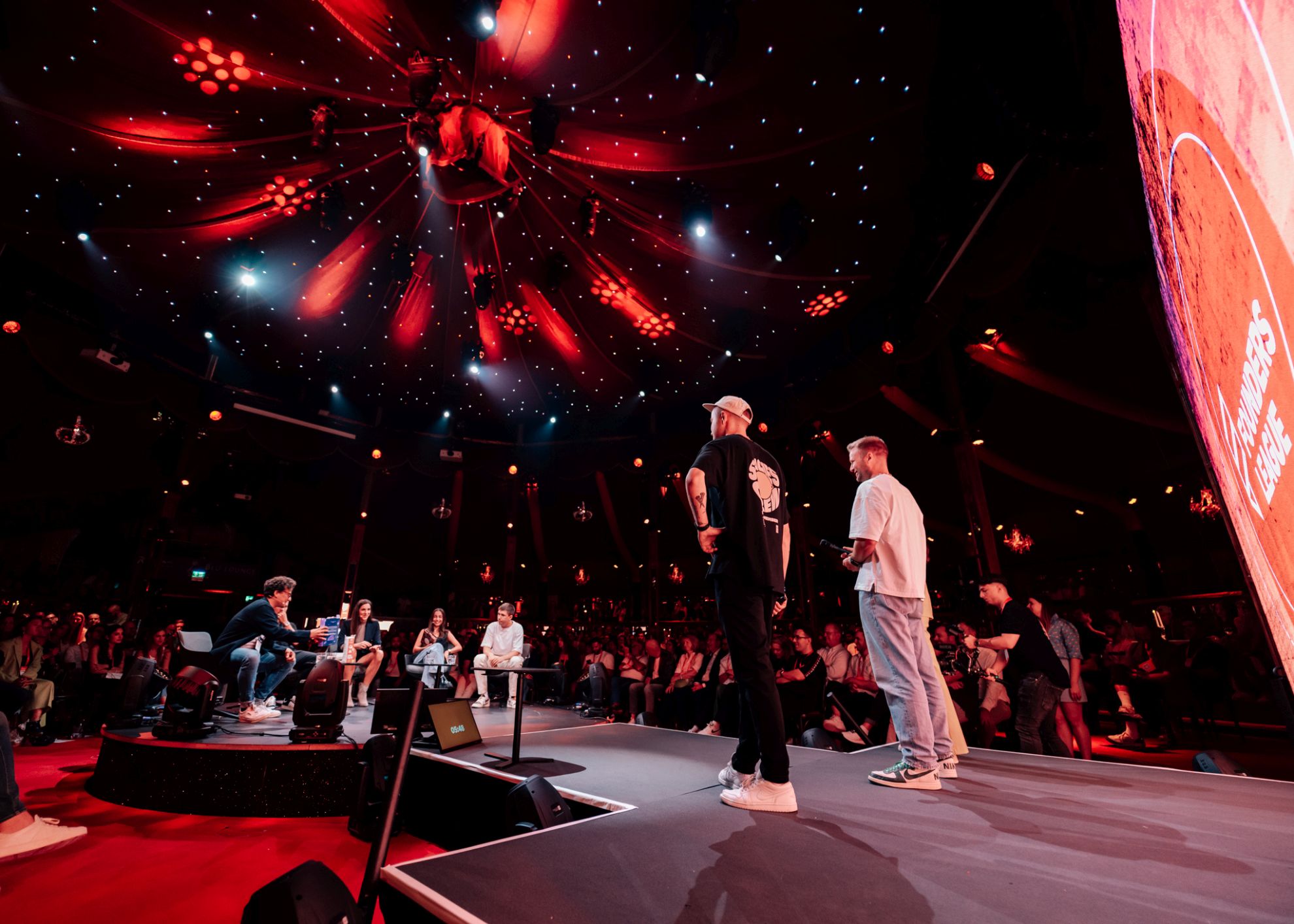
By April 2023, Janz was identified as Head of Partnership at the League's fourth show, held in Google's Digital Studios in Berlin. The company recorded more than 100 guests and tickets selling out in eight minutes. The businesses pitching included an electric motorcycle maker, a vertical-farming venture and Pottburri, whose plant pots offered an alternative to disposable plastic.
Antonia Cox won for Pottburri. The prize was €10,000, which she intended to put into marketing. Each startup had three minutes to make its case. For the organisers, that brevity meant accommodating very different businesses within a format the audience could follow. A motorcycle and a plant pot do not arrive with the same explanation.
Janz's verdict was short: “Wir werden immer besser!” We are getting better. The appeal of the line is its modest unit of ambition. An event had happened, the machinery had worked, and the next version could improve. For someone selling partnerships, a show that actually ran was also something concrete to discuss at the next meeting.
“Wir werden immer besser!”
Marc-Niclas Janz · Berlin show, April 2023
The guest list becomes part of the business
FOUNDERS LEAGUE had been established in 2022. By early 2024, its offer included live shows, smaller meet-ups and a new Academy. The latter began with an eight-week programme combining expert calls and online learning. Entertainment could introduce a business quickly; a learning programme gave founders longer to work through their questions.
The company also added 11 shareholders, including K5's Verena Schlüpmann and Sven Rittau, and Carlsquare's Michael Moritz. Its wider shareholder circle included footballer Julian Draxler, entrepreneur Franzi von Hardenberg and mathematics educator Daniel Jung. These people brought different professional worlds into the same undertaking.
Janz and Rauch were therefore organising more than an audience. They were building a company whose relationships were part of what it offered. A shareholder could also have experience to share, an introduction to make or a perspective on a founder's problem. That arrangement put a particular burden on the organisers: getting people into the circle was only the beginning of keeping it useful.
Who is supposed to do this?
In January 2024, Janz spoke candidly about the early difficulties of management. Delegating had been hard. So had personnel decisions and defining who should take responsibility for which tasks. He also described overwhelming shareholders with information. Clearer processes and communication helped the team deal with those problems.
This was a revealing admission from a company offering to help other founders. The organisers had their own unfinished homework. Sharing responsibility required decisions about roles, rather than simply telling everyone to work harder. Keeping investors informed required judgement about what they needed to know. More communication could itself become a problem.
The experience gives a practical meaning to his move into leadership. A growing audience is easy to put on a slide. A workable division of responsibility is harder to photograph. Yet an organisation needs both if it hopes to repeat the event. Someone must know which decision belongs to them before the next question arrives.
Three tools and one familiar irritation
By September 2024, Janz was writing about the tools supporting that work. Asana handled project management, Notion served as an internal wiki, and Google Docs supported collaboration. Structured tasks, he said, helped him lead and made meetings more productive. He wanted the work to be clear and transparent.
He also acknowledged the catch: colleagues were not all equally enthusiastic, and updates were inconsistent. A system can be perfectly organised while quietly waiting for someone to put something in it. His complaint will be familiar to anyone who has attended a meeting about the document that was supposed to prevent the meeting.
Janz described himself as usually the laughing type, while admitting how much ineffective work irritated him. He had yet to find the one solution that brought everything together, and asked others for suggestions. The combination is appealingly ordinary: a manager with preferences, frustrations and a question for his peers, still trying to make the working day run better.
The people at the door
The human arrangements were just as important. In May 2024, Janz recruited volunteers for the June conference at Palazzo Mannheim. The invitation offered a view behind the scenes, event-management experience and opportunities to meet founders and investors. There would also be a certificate, food and a crew shirt. The promise came with actual work attached.
After a Palazzo conference, he publicly thanked the team and the volunteers. He singled out the people welcoming guests, helping with entry, setting up, taking down and ensuring that speakers reached the right place at the right time. Recent team members had also had little time to learn the routines.
Henri Wendt's own account supplies a small example of how these connections could develop. He attended a Mainz show, took on support work and later joined FOUNDERS LEAGUE after finishing school. An audience member could become a colleague. The network had a staff entrance as well as a stage, and people could find their way through it by helping.
A smaller table has its uses
The League's gatherings did not all need a large room. Janz described plans for an October investor dinner at Berlin's Telegrafenamt, with 100 selected guests. A masterclass dinner in Mannheim had suggested an appetite for more focused meetings. His public invitation again included a request for help with reception and coordination.
That sits neatly beside another of his observations. Visiting Palazzo Mannheim as a guest for a Teaching Finance Grow Night, he looked forward to enjoying the evening and seeing how someone else used a venue he knew as an organiser. Even a night out could become a chance to compare notes. Apparently the event-management spectacles were difficult to leave at home.
Back toward the numbers
Finance had been there before the events. Janz studied finance at the University of Trier, including a semester in Seattle, after a three-year dual programme at DHBW that included time in Hong Kong and practical experience at a universal bank. His background also included portfolio-management experience at a private bank in Luxembourg and banking consultancy.
In July 2025, CAPCELLENCE welcomed him as an intern, noting his work advising financial-services businesses at Bankenimpuls Consulting and his former CEO role at FOUNDERS LEAGUE. Janz replied that he wanted to contribute his experience while deepening his first-hand understanding of private equity. Taking a learning role after leading a startup makes for an interesting career sequence. The title changed; the willingness to acquire another kind of experience was explicit.
Sollors & Co. now places him in its analyst team. The firm works in corporate finance, including M&A and debt advisory, as well as asset management. His career has moved from helping founders meet investors toward an advisory environment concerned with companies, transactions and financing.
In August 2024, Janz compared his life to an express train and wrote about wanting to gather experiences while young, balancing security with adventure. His subsequent change of direction gives that aspiration a concrete example. Bremen's room of 150 belongs to an earlier job now. Hamburg supplies the setting for the next one, with a different set of questions on the desk.