Kevin Berryman arrived at Nestlé’s headquarters in Vevey, Switzerland, with experience of the American business and an American way of presenting it. The second asset proved less portable than the first. In a more formal corporate culture, he had to adjust how he worked with colleagues. Being right about the business would only get him so far; he also needed to understand the room.
That episode is a useful place to begin a career otherwise easy to describe as a succession of finance titles. Berryman moved through consumer products, flavors and fragrances, and engineering services. The businesses changed. The recurring task was to make people with different expertise work toward a shared decision. A spreadsheet can travel internationally with very little trouble. Its author may need a little more preparation.
His childhood offered an early lesson. His family moved to Altadena, California, in the 1960s. His father taught mathematics; his mother worked as an administrator. Basketball and baseball brought him teammates from different backgrounds. Later came an economics degree at Occidental and an internship that became a job at Carnation. He completed his UCLA Anderson MBA in 1987 while working full time and raising a young family. Those were crowded years, long before crowded calendars became an executive accessory.
Before engineering, there was pet food
Nestlé gave Berryman a succession of opportunities to see a large business from different angles. Treasury, strategic planning, financial control and acquisitions all figured in his career. By late 2001, he was CFO of Nestlé Purina PetCare, helping integrate Ralston Purina into the group. The job placed him inside the aftermath of an acquisition, where an announced combination has to become an operating company.
He subsequently served as Nestlé’s senior vice president of group control from 2006 to 2008, followed by the Americas finance role at Nestlé Professional. These were jobs with different distances from the customer: one concerned a global group, another a regional business, another a newly combined pet-food operation. Together they gave him experience of both the corporate overview and the details that refuse to behave tidily underneath it.
In May 2009, International Flavors & Fragrances appointed him executive vice president and CFO. IFF’s products reached consumers through other companies’ goods, from packaged food to fragrances. He had moved into another international business whose output was familiar even when its name was not. His brief included finance, strategy, corporate development and information technology. Increasingly, the finance job was becoming a way to influence how the whole company worked.
The acquisition has an audience
Jacobs announced Berryman’s appointment in November 2014, with the CFO role effective January 5, 2015. He succeeded John Prosser, a finance leader with four decades at the company. Berryman arrived with a long international résumé and a remit spanning accounting, investor relations, acquisitions, supply management and real estate. Joining an established organization meant inheriting relationships as well as responsibilities.
The reshaping of Jacobs soon made acquisitions central to the story. In May 2017, Berryman joined Steve Demetriou, Bob Pragada and other representatives in discussions with CH2M’s leadership and advisers. The transaction record places him in the working meetings behind a deal that would expand Jacobs’ environmental and infrastructure capabilities. Such meetings rarely furnish a glamorous photograph. They do establish who was actually involved.
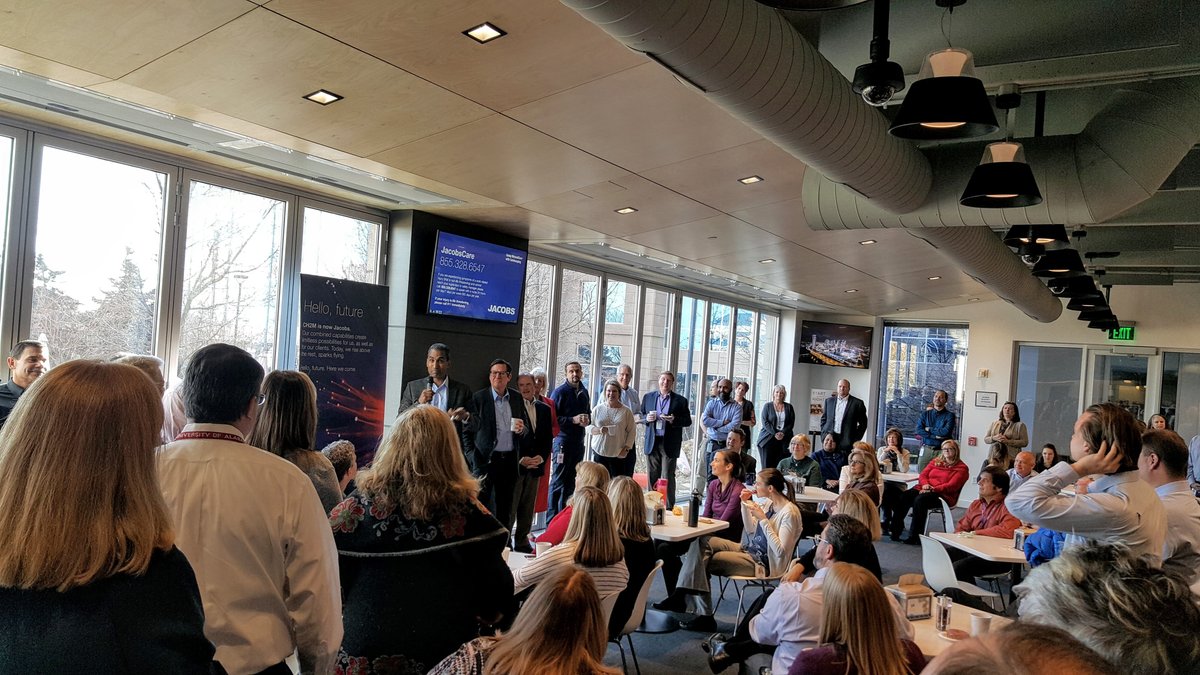
The acquisition closed in December 2017, and Berryman became CH2M’s treasurer. A photograph from the Colorado headquarters shows Pragada holding a microphone, Berryman beside him, and employees gathered around. Windows, exposed ductwork, coffee cups, people standing where they can find space: corporate transformation looks surprisingly like an office gathering when viewed from the floor.
The picture matters because an acquisition has more than one audience. Investors assess price and prospects. Employees face a new name, new colleagues and questions about their work. Berryman later described Jacobs’ culture as an essential part of its transformation. His financial responsibilities put him close to the transaction; the employee gathering shows the people who would live with the result.
A wider job description
In 2019, Jacobs added president to Berryman’s CFO title and expanded his leadership of digital and IT functions. That year also brought the acquisition of KeyW, adding intelligence and data capabilities. The company was changing the mix of work it wanted to pursue, with Berryman involved in the financial and acquisition strategy supporting that change.
He described the underlying choices in practical terms: decide which businesses deserve further investment and which businesses should leave the portfolio. Jacobs’ sale of its oil and gas business and acquisition of CH2M were examples he used. This is where finance becomes an argument about identity. A company’s future depends partly on which skills it chooses to own, and which opportunities it chooses to decline.
His career advice reflected that broad view. “I would suggest that everyone gain international experience,” he said. He also encouraged people to move laterally across functions. The attraction was a fuller understanding of the organization: knowing enough about colleagues’ responsibilities to have a useful conversation with them. A promotion changes a title. A sideways move can change the questions someone knows to ask.
“I would suggest that everyone gain international experience.”
Kevin Berryman, 2021
When a promise acquires an interest rate
At Jacobs, Berryman also served as executive sponsor for PlanBeyond, the company’s sustainability approach, and represented it as a founding member of the UN Global Compact’s CFO coalition supporting the Sustainable Development Goals. These roles extended the finance conversation into what a company measures, how it explains those measures, and where it directs investment.
In early 2023, he described a striking change in investor conversations: ESG had gone from a subject investors did not raise to one that appeared on every call. He emphasized comparable reporting and better information. Jacobs wanted to improve energy data collection and build a digital platform for ESG reporting. Fuel-consumption information also needed attention. Before a business can demonstrate progress, somebody has to collect numbers that deserve to be believed.
February 2023 supplied a concrete financial instrument: Jacobs issued $500 million of sustainability-linked senior unsecured notes due in 2033. The interest rates were tied to commitments concerning greenhouse gas emissions and gender diversity in leadership. The proceeds went toward repaying part of the revolving credit facility. The structure brought sustainability commitments into the financing terms of ordinary corporate borrowing.
That distinction gives the episode its interest. The money was being used for debt repayment, while the borrowing terms connected the company’s financing with its stated objectives. It joined two conversations that can otherwise take place in different rooms: what an organization promises and what it agrees to pay. For a CFO accustomed to acquisitions, reporting and capital allocation, this was familiar territory with additional measures attached.
Leadership gender diversity
The river needs more than engineers
In a 2022 discussion about the aftermath of COP26, Berryman appeared alongside finance executive Marisa Drew. He returned repeatedly to the difficulty of implementation. He spoke about employees, the different expectations of clients, and the need to make sustainability part of project delivery. Technical capability alone would leave much of the job unfinished.
He used work on London’s Thames as an example of the coordination required. Cleaning a river through changes to a city’s sewage infrastructure involved financiers, insurers and other stakeholders alongside the people delivering the engineering. He described years of interaction needed to establish a workable funding arrangement. The engineering problem and the financing problem belonged to the same project, however differently the participants described their work.
Berryman also stressed the usefulness of consistent performance measures in directing capital. In that account, better definitions and reporting make it easier to distinguish credible activity from an attractive claim. The point is practical: people deciding where to put money need a way to compare what they are being offered. Ambition gets a meeting. A usable scorecard helps with the next decision.
The return engagement
Berryman moved from CFO to special adviser to CEO Bob Pragada in August 2023, helping oversee the separation of Jacobs’ Critical Mission Solutions and Cyber & Intelligence businesses. Then came a return to the finance seat. Effective March 29, 2024, Jacobs appointed him interim CFO following Claudia Jaramillo’s departure, while it searched for a permanent successor.
Venk Nathamuni became CFO on June 3, 2024. Berryman supported the transition and continued the separation work as special adviser. His advisory service ended in December 2024. The sequence gives his final Jacobs period an unusual shape: a handover, a return, another handover, and the completion of an advisory chapter. A career exit can involve rather more entrances than the phrase suggests.
Board service carried his experience into other organizations. He joined Sealed Air’s board in July 2022 and ITT’s in October 2023. His Sealed Air directorship ended in April 2026 when its merger closed, alongside several other directors’ departures. ITT continues to list him on its board. These are distinct chapters, with their own start and finish dates, rather than an indefinitely accumulating collection of titles.
- Moves from CFO to special adviser
- Returns as interim CFO
- Venk Nathamuni becomes CFO
- Special-adviser service concludes
Back across campus
Education provides another destination for that experience. Occidental welcomed Berryman to its board of trustees in July 2025, bringing him back to the college where he studied economics. UCLA Anderson now lists him as an emeritus member of its Center for Global Management board. The institutions that helped prepare him for an international career became places where he could contribute what it taught him.
His 2023 gift to Anderson supported closer collaboration across disciplines, including business and engineering. He wanted future leaders to understand how technology, commercial decisions and people affect one another. “The world no longer works in verticals,” he said. It is a short sentence with a substantial educational demand behind it.
Read across the career, that demand feels consistent. A pet-food integration required financial and operating teams to work together. An engineering acquisition brought employees into a new organization. Sustainability-linked borrowing connected company objectives to financing. Supporting collaboration between business students and engineers carries the same question into a classroom: how well can you understand the person whose expertise is different from yours? Berryman has spent much of his working life finding reasons to cross that room.