Kevin Lobo was answering questions from interns when someone asked what he wished he had known at twenty. His answer reached back to a choice between two job offers. The work looked similar. The possibilities beyond it did not. He had asked each employer about advancement. One described a long wait before management; the other held out the prospect of moving quickly, perhaps eventually running a division. Lobo chose the second.
In that 2014 conversation, he had already become chief executive of Stryker, and the interns were joining the conversation from different parts of the world. A conventional career talk might have concentrated on securing the first job. His story concerned the one after it. The offer on the table mattered, but so did the employer’s imagination about what a capable person might do later.
There is a pleasing inconvenience in this advice. It asks an applicant to interview the future employer about its future. Lobo’s career gives the question some substance. The accountant who moved through consumer businesses and chemicals eventually ran a global company. Along the way, he had to become comfortable with unfamiliar industries, unfamiliar surroundings, and the occasional discovery that his own habits needed editing.
A career that refused to stay in one column
Lobo was born in Mumbai and grew up in Montreal after his Goan parents moved to Canada. The geography of his family resists the tidy version of a corporate biography. He met his wife, Shazie, in college in Montreal. English and French were part of his life; he also spoke some Konkani and Hindi. Years later, on a business visit to India, his itinerary included seeing aunts in Pune. The international executive still had relatives to visit.
His formal qualifications were commercial: a Bachelor of Commerce from McGill University, an MBA from the University of Toronto, and a chartered accountant’s training. Numbers supplied an entry into business. They did not confine the rest of the journey.
Early roles included KPMG and Unilever Canada. He joined Kraft Canada in 1992, then Rhône-Poulenc in 1995. The next stretch included finance responsibilities in North America, a corporate controller assignment in Paris, and a general management role in specialty phosphates based in London. By the time he joined Johnson & Johnson in 2003, he had already worked across several corporate settings.
The sequence matters because a title can conceal the breadth of the work underneath it. Finance, a head office assignment, and responsibility for an operating business ask different questions of the same person. A controller must understand how a company records performance. A general manager has to help produce it. Lobo’s résumé records the movement between those responsibilities without pretending it happened in a single grand leap.
Paris, without the subtitles
The Paris assignment came with a surprise. Lobo has recalled arriving to discover that his staff worked in French. He could speak the language, but the professional version was a different proposition. Conversation over dinner had not prepared him to write office memos. A global job, it turned out, could have a thoroughly local working language.
He challenged his boss about the discovery. The answer was brisk: Lobo spoke French, didn’t he? The distinction between speaking a language and conducting a demanding job in it was apparently his problem to solve. He has described the assignment as exceptionally hard work.
It became a point of confidence. He had succeeded at headquarters, in another culture and another working language. A move into running a phosphate chemicals business followed. In his later account, that period helped put him on the general management path. The experience is concrete enough to survive the usual abstractions about leaving one’s comfort zone. There were memos to write. They had to be in French.
At Johnson & Johnson, further responsibility came quickly. He became president of its Canadian medical products business in 2005 and president of Ethicon Endo-Surgery, then a $4 billion business, in 2006. These were increasingly large operating assignments for someone whose early professional identity had been in finance.
Even before Stryker, his thinking about organizations included the value of breadth. In a 2006 interview, he described a decentralized company whose separate businesses had their own objectives, supported by shared services. He also emphasized developing future leaders and giving employees opportunities to move between sectors. Those concerns were present years before the CEO appointment that would make them his everyday responsibility on a larger scale.
A purchase with a waiting period
Lobo joined Stryker in April 2011. On October 1, 2012, the board named him president and chief executive, following a search that considered both internal and external candidates. He had most recently led the company’s Orthopaedics group. The board also appointed him a director. In July 2014, he would take on the chair’s role.
Within his first year as CEO came a decision with a conspicuous price tag. On September 25, 2013, Stryker announced an agreement to buy Mako for approximately $1.65 billion, or $30 a share. The company completed the acquisition that December.
Announced purchase price for Mako
- Year 1Lower adjusted earnings per share
- Year 2Neutral
- ThereafterExpected to add to earnings
The announcement supplied an unusually useful piece of narrative machinery: a timetable. Excluding specified charges, the deal was expected to reduce adjusted earnings per share by about ten to twelve cents in the first full year, be neutral in the second, and add to earnings afterward. The financial cost would arrive before the expected benefit. Anyone reading closely could see that patience was included in the purchase.
In 2026, Lobo returned to the decision in a conversation with Jimmy Allen. He discussed the appeal of an opportunity with substantial upside, the uncomfortable early period, and the work of learning how to acquire and integrate businesses repeatedly. The conversation also addressed the cost of complexity as an organization grows.
A purchase can be announced in a morning. Developing the judgment to make the next one, and the organization to absorb it, takes longer. That is the less photogenic part of an acquisition career. By the time of the succession announcement in October 2026, Stryker’s account of Lobo’s tenure included more than sixty completed acquisitions.
The pencil gets a vote
For a person inclined to get things moving, the restraint required inside a large organization has been an education of its own. Lobo has described learning that a suggestion from a senior leader could become a project before the speaker had decided it deserved to be one. Thinking aloud had acquired an implementation department.
His remedy included writing an idea down before deciding whether to say it. The pencil supplied a pause between having a thought and giving colleagues something else to do. He also asked teammates to help check his tendency to initiate too much. It is a modest habit with a practical recognition behind it: other people experience the boss’s brainstorming differently from the boss.
“You better slow me down sometimes.”
Kevin Lobo
That willingness to be checked sits alongside a firm view about collaboration. In a 2024 conversation with Janice Ellig, he described Stryker as a place where colleagues value one another and where results belong to teams. “People with high egos just don’t do well at Stryker,” he said.
His argument also challenged the usefulness of position alone. A title may settle who occupies the office, but it cannot supply all the cooperation required to run the business. In his account, people succeed by drawing on one another’s abilities and contributing to collective results. It leaves little room for the executive who regards every meeting as an opportunity to demonstrate that the executive is present.
A medal with three countries behind it
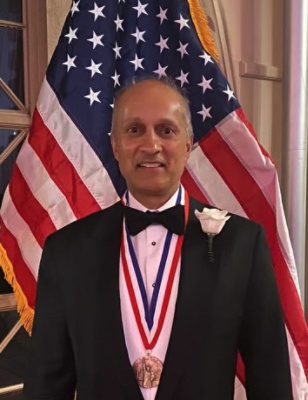
In 2023, Lobo received the Ellis Island Medal of Honor. The recognition brought a different set of coordinates into view: India, Canada, and the United States. He is a dual citizen of Canada and the U.S. His parents and in-laws, he said at the time, were first-generation immigrants to North America and were especially proud.
He connected living in different countries with an openness to different ideas and ways of working. That observation fits the actual itinerary. Montreal, Paris, London, and the American corporate assignments gave him repeated experience of being competent in one respect while needing to learn in another. The medal offered an occasion to place that movement alongside the more familiar sequence of promotions.
The photograph is a useful interruption to the boardroom version of his life. There is a medal, formal dress, and a family’s pride in a journey across borders. A professional biography can make success look like an uninterrupted matter of personal intention. Lobo’s account leaves room for migration, opportunity, and the people who remember the beginning.
The next question has a date
On October 6, 2026, Stryker announced that Spencer Stiles would become chief executive on January 1, 2027. Lobo would move to executive chair. As of this profile’s publication, he remains chair and CEO. The handover is an announced future transition.
Lobo said he intended to help make the transition smooth and continue supporting the company from the board. Stiles, the president and chief operating officer, would take responsibility for the operating role. The distinction gives the familiar language of developing leaders a specific consequence: another person will occupy the CEO’s seat.
Read backward, the succession gives the interns’ conversation a different resonance. The younger Lobo had asked prospective employers what responsibility might follow the job on offer. After fourteen years as chief executive, his next assignment involves passing responsibility onward. There is still work to do, but the distribution of it will change.
His career has room for both the large transaction and the small pause before speaking, for taking an unfamiliar assignment and for letting colleagues exercise their own judgment. The next date on the calendar brings another adjustment. Lobo has spent much of his working life asking what comes next. This time, part of the answer is Spencer Stiles.
Continue the conversation
- Kevin Lobo on LinkedIn
- Official Stryker biography
- Watch: conversation with Jon Clifton
- Listen: conversation with Janice Ellig
- Listen: Founder’s Mentality with Jimmy Allen
- The 2027 leadership transition
- Ellis Island Medal of Honor
- The interns’ career conversation
- Paris and the move into general management
- The original Mako agreement
- A 2006 conversation at Rotman
- Mumbai, Montreal and a return to India