At Managed by Q, a new headquarters job could begin beside a toilet. Recruits joined a deep clean, taking instructions from the people who cleaned offices for a living. The CEO had done his share, too. “Everybody cleans” became the company’s motto after early evening shifts left its founders scrubbing and supervising. The ritual taught designers why a bathroom takes longer than a spreadsheet suggests.
- Cleaning earned Q access to the office; repairs and supplies widened the relationship.
- Direct employment and training were part of its service-quality argument.
- A vendor marketplace and employee helpdesk broadened the original model.
- WeWork bought Q in 2019. Eden took over in March 2020.
01The buyer who could say yes
Dan Teran and Saman Rahmanian did not begin with the office. Both had encountered disappointing residential building maintenance. Rahmanian designed an iPad concept; they explored selling to condominium and co-op boards. In Teran’s account, those boards proved poor customers. Office managers were more promising: they had the irritation, the responsibility, and the authority to spend money fixing it. The first change was the buyer.
Launched in New York in 2014, Q supplied an iPad through which a workplace could arrange cleaning, request repairs, and order supplies. The early target was a commercial tenant with roughly 50 to 150 employees. Imagine the purchasing burden: one firm for floors, another for plumbing, another for paper towels. Q offered a common interface for work that otherwise arrived as a collection of phone numbers.
Labor was the purchase.
The iPad made it easier to arrange.
Cleaning carried a reported price of $25 an hour in 2015. Repairs and supplies added separate spending. That repeat cleaning visit mattered commercially: it gave Q a regular presence in the building. A cleaner could notice a leak; the business had someone to call. Selling the next service became easier because the first one was useful every week.
02Good jobs needed a good schedule
Q initially relied on partner janitorial companies. That arrangement simplified staffing but weakened control over training and the customer experience. Teran described the change in a Lean Startup interview: within weeks, Q recognized the need to build its own workforce. It hired cleaning operators as employees, with training, more predictable employment, and opportunities to advance. The intended return was better service from people with reasons to stay.

There was an awkward catch. Saying yes to whatever a customer wanted could stretch those workers across jobs they were ill-equipped to perform. In its own account of the eventual improvements, Q emphasized refusing unsuitable work, making demand predictable, and training frontline supervisors. The romantic idea of instant service had to accommodate the unromantic facts of a schedule.
Q said 70% of its services supervisors had started as cleaners.
In October 2017, Q Services reported operating profitability. This was a milestone for the services unit. The calculation included service-worker pay, benefits, training, and insurance, while excluding some corporate costs and equity grants. A business-unit profit could support the employment argument without settling the economics of the entire company. Those are different questions, however convenient it would be to answer both with one number.
The company motto“Everybody cleans.”
Managed by Q
03An inbox with a purchasing department
Q expanded into a self-service marketplace in 2017. Office teams could hire commercial providers for cleaning, IT, security, and repairs. Later partner profiles surfaced credentials and verified reviews. Its appeal was reduced coordination: compare providers, arrange work, and handle payment in one place. Against a local vendor, Q offered breadth; against a spreadsheet, it offered a way to get the job done.
Then it bought Hivy, a workplace task-management startup. Employee requests could enter through Slack, email, or a dashboard, be assigned internally, and lead to an outside service. BARK’s Emily Muhl described the earlier arrangement: “Prior to using Task Management, we had been tracking things in Google sheets, email, and notebooks, so records were getting lost.” The office had plenty of messages. It needed a memory.
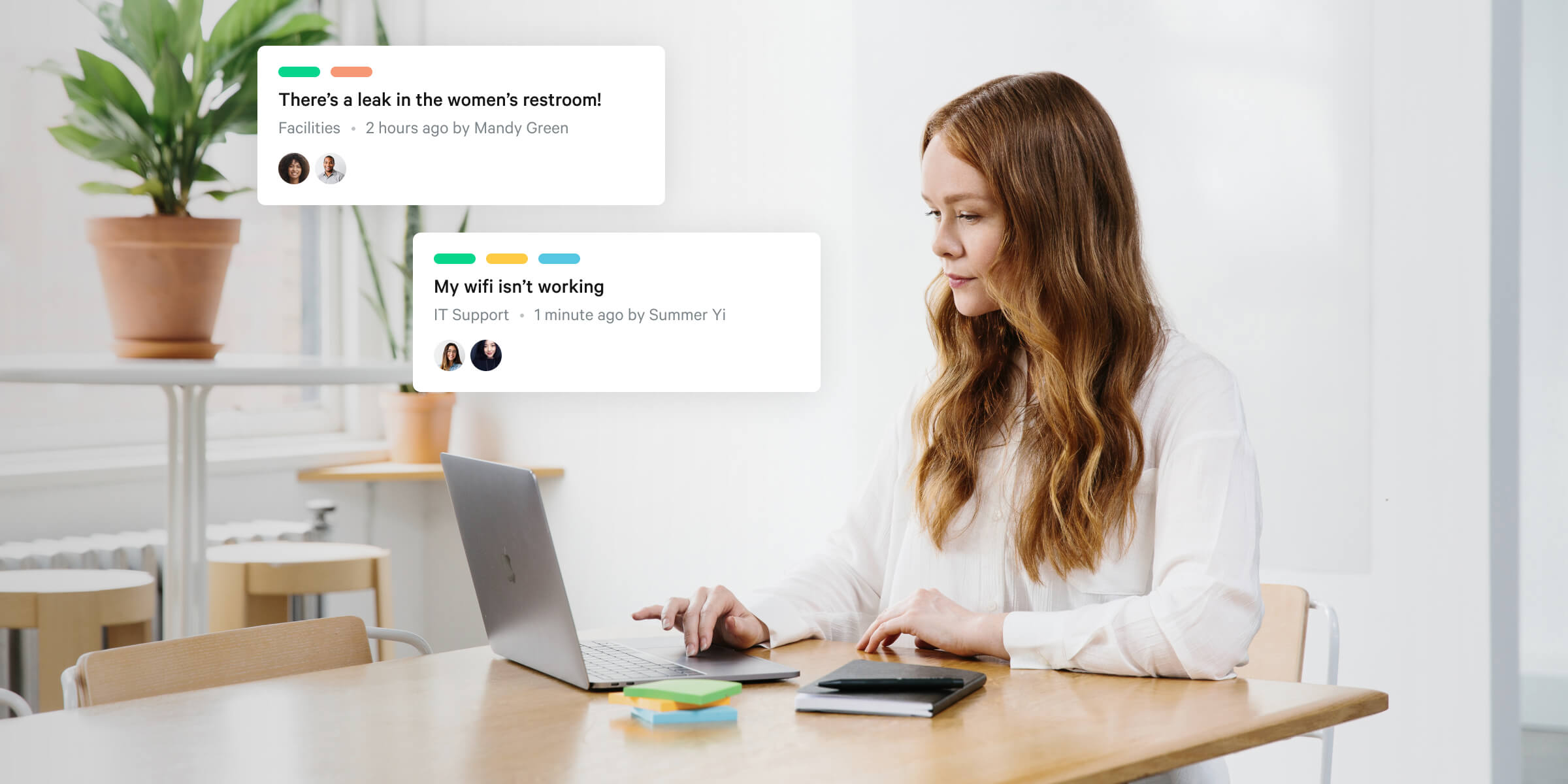
The revenue mix followed the widening offer: paid services, supplies, vendor transaction fees, and software subscriptions. A legacy software listing shows Standard at $149 monthly when billed annually, or $189 on monthly billing. Those figures describe the old listing; they are not a present-day Q offer. Hiring a cleaner also remained a separate economic proposition from subscribing to task software.
04Two owners in eleven months
The NVS acquisition added pre-lease planning and office project management. Publicly described work included assembling more than 200 furniture pieces for Justworks. Q was reaching further upstream, toward the decisions that shaped a workplace before the first desk was occupied. Its expertise now included building projects.

WeWork acquired Q in April 2019, promising to combine its global space network with Q’s workplace services. After WeWork’s failed IPO, that expansion gave way to divestments. Eden acquired Q on March 3, 2020, bringing over customers, vendors, and technology. Contemporary reporting also documented substantial layoffs ahead of the sale. A change of owner carried consequences well beyond the software.
Acquisition consideration versus total cash sale consideration. Different transaction measures, not a valuation series.
The filed numbers sharpen the distinction: $189.7 million in acquisition consideration, followed by $28 million in total cash sale consideration. These are transaction figures, not a valuation series. The ownership reversal still reveals how quickly an attractive extension can become an asset a parent wants to sell.
05The office still needs somebody
Today, Eden markets desk booking, room scheduling, visitor management, deliveries, and internal ticketing. Those are Eden products. In a 2026 retrospective, Teran said AI could make routing workplace requests easier, but he would not start Q again. His priorities had changed, and he was uncertain about the office market’s growth. Better tools could simplify the work without making the market more appealing.
What can a reader copy? Find the buyer who can act. Earn repeat access with a recurring service. Let the people doing the work teach its designers. Make promises narrow enough to keep. The approach needs repeat demand, capable local providers, and customers willing to pay for dependable service. Scattered jobs and unpredictable requests make that harder. Paper towels still need replacing. Somebody must arrive.