The peculiar bargain of renting is that you pay a landlord for the privilege of not knowing a plumber. A tap breaks; you call somebody. A furnace coughs; you call the same somebody. Then you buy a house and discover that the somebody is now you. Jorey Ramer, who had rented through his adult life, felt that promotion keenly when he became a homeowner in San Francisco. After selling his earlier company, Jumptap, he could afford a house. What he missed was the predictable monthly fee and the person who made the house work.
The short version
- Super sells plans covering specified appliance and home-system breakdowns.
- It coordinates local technicians through a digital claims and scheduling system.
- Maintenance jobs, from HVAC tune-ups to gutter cleaning, sit alongside the warranty.
- Acquisitions took its reported footprint from eight states to 35 in 2023.
He and Ryan Donnelly founded Super in 2015. The name is deliberately literal: the super in an apartment building is the person who knows whom to call and what to do when the oven quits. Super’s proposition is to put that role into a homeowner’s phone, then back it with a contract and a network of service businesses. A company can make an app in months. Building the trust behind the button takes rather longer.
The first thing to break was certainty
Super’s origin story is about a change in responsibility, not a famous burst pipe. Ramer has said he liked the predictability of renting: one fee, one call, little detective work. Ownership replaced that with a sequence of small mysteries. Is the noise in the dishwasher covered? Which repair firm answers? Is its quote fair? Will it return if the fix does not hold? The price of a repair is only one line on that bill. The rest is time, research and an uneasy reliance on strangers.
“I liked being a renter. You pay a fee, and you know what to expect.”Jorey Ramer, speaking in 2021
The founders’ answer was a home warranty subscription. A member pays for a plan, submits a service request when a covered system or appliance fails, and pays a standard copay for the visit. Super arranges a technician and pays for repair or replacement within the contract’s limits. Plumbing, heating, electrical systems and appliances are among the categories on its published plan table. The exact list and payout ceilings change with the plan. That distinction deserves a place beside the glossy promise, because a warranty is a contract before it is a feeling.
A predictable price, with asterisks
The public numbers are concrete enough to inspect. A Super offer for Long & Foster clients lists three annual prices: Simple at $525, Signature at $849 and Lux at $1,449. It also lists monthly payment options. These are partner-offer figures, rather than a universal quote; the price for a particular house depends on address and selected coverage. A standard service copay comes on top. Super says there is one copay per covered claim, even when a repair needs more than one visit.
Published Long & Foster offer. Coverage, service fees, availability and prices can vary by home and market.
The real comparison is not simply plan price against the cost of a new refrigerator. It is plan price plus copays against the repairs a household may actually need, the caps in the contract, and the value of letting someone else manage the job. Super’s own table gives the same $30,000 aggregate limit across the three named plans, while individual items have different limits. A dishwasher carries a $3,000 listed limit on Simple and Signature, for example, and $10,000 on Lux. Reading those rows is less glamorous than buying peace of mind, but considerably more useful.
The app is the easy part to see
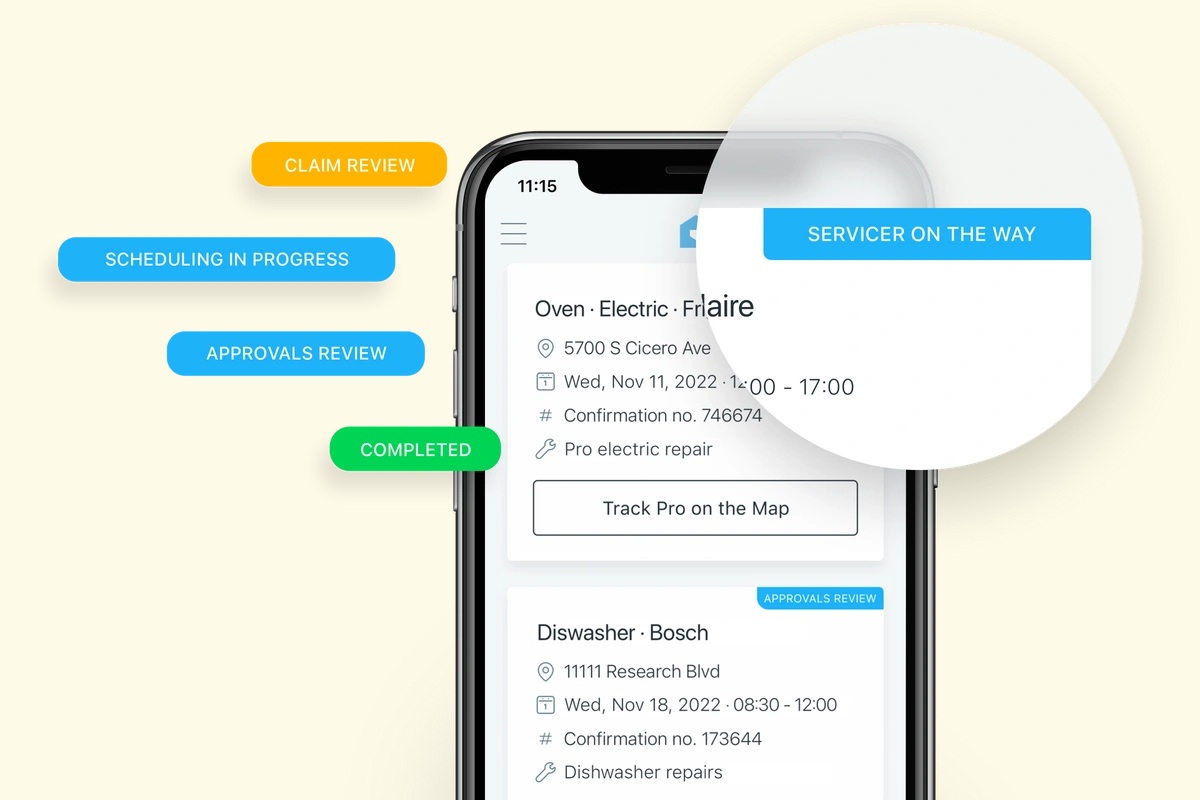
Super’s app lets a homeowner request service, track a claim and keep a history of work on the house. Its product imagery shows stages such as claim review, scheduling, approval and a technician on the way. Those small updates matter. Anyone who has waited at home for an unnamed contractor knows the difference between “we will be there” and an actual appointment window.
Behind those screens is a less photogenic business. Super recruits independent local technicians rather than employing every plumber and appliance specialist it might need. The contractor side has its own Super Pro app for jobs, estimates and communication. Super says it checks licensing, insurance, background and performance, then handles the scheduling, customer service and payments. Its contractor page is unusually candid about the arrangement: subscriptions fund covered work; for coordinated jobs outside coverage, Super takes a small share of revenue for bringing in the customer and managing the transaction.
That is where Super differs from both a plain warranty and a lead-generation directory. A directory leaves the homeowner to choose and manage the tradesperson. A conventional warranty chiefly promises to help pay when something breaks. Super wants to own more of the sequence - from the first request to the person at the door. The benefit is a single point of contact. The difficulty is that service quality is local and stubbornly human. Software can move a claim to “assigned”; it cannot make an unskilled repair last.
Why sell a gutter cleaning beside an HVAC claim?
Super’s Maintenance Marketplace stretches the relationship beyond breakdowns. Its published menu includes lock rekeying, pest control, HVAC tune-ups, dryer-vent cleaning, window washing and gutter cleaning. These are on-demand services, with prices and availability that vary by location. The logic is simple: homeowners think about the house between emergencies, and preventive work can mean fewer emergencies. A warranty provider that only hears from customers when something fails meets them at the worst possible moment.
The real estate channel gives Super another way in. Long & Foster recommends its plans to clients. Super’s “In the Clear” program reviews a buyer’s home-inspection report to clarify coverage for working systems and appliances. Its Super Certified Home package, advertised at $275, combines a pre-listing mechanical inspection with warranty coverage on qualifying items until close of escrow, for up to six months. Those offerings put Super at the moment when people are already scrutinizing a home’s risks, rather than waiting for an ad to find them after move-in.
A local business buys a bigger map
The company’s growth also reveals the limits of purely digital expansion. In 2021, after a $50 million Series C led by Wells Fargo Strategic Capital, Super described a business active in several large metro areas, including Austin, Chicago, Dallas, Houston, Phoenix, San Antonio and Washington, D.C. It reported that revenue had grown sevenfold since its 2019 financing, although it did not disclose the revenue figure. The money was meant to fund more markets, people, services and technology.
Then came acquisitions. Super bought Platinum Home Warranty in 2022 and, in 2023, assets of Nations Home Warranty, American Home Guardian and TotalHome Warranty. It said that second wave took its footprint from eight states to 35. Buying an existing book of warranty business is a practical shortcut to distribution. It also brings the less romantic work of combining contracts, contractor relationships and customer expectations. A national map is useful only if the local repair still happens.
The company said it was named USA Today’s Best Overall Home Warranty Company of 2026. That accolade is a signal of visibility, not a substitute for reading a particular policy. Super’s model works best when a homeowner values both budget smoothing and coordination, lives in a market with strong technician coverage, and understands the exclusions and limits before a failure. The broader lesson for any service business is wonderfully unglamorous: find the annoying job customers inherit by default, price the job clearly, and take responsibility for the handoff all the way to the doorstep.
Ramer’s old landlord had one advantage Super cannot put in a slide deck: proximity. The super was already in the building. Super’s wager is that a good network, careful operations and a clear interface can recreate enough of that feeling across many buildings and many cities. It is a difficult trick. That is why it is a company.