A house does not care how many formats the internet requires. It sits there while somebody photographs the kitchen, measures the bedrooms, assembles a virtual tour and wonders whether there is enough material for a video. Giraffe360’s proposition is to make that visit work harder. Carry in a robotic camera, capture the property, then let the resulting data supply a small publishing operation.
The London-based company, founded in Latvia by brothers Mikus and Madars Opelts in 2016, sells a subscription connecting its own hardware to cloud processing and marketing software. The output can include photographs, floor plans, virtual tours, videos, a property website, staged images and social content. Its commercial argument begins with a familiar irritation: the appointment may be over, but the listing still needs hours of work.
That gives Giraffe360 a more interesting identity than “360 camera company.” It competes for the work between getting the keys and publishing the advertisement. A camera is something an agent can hold. A shorter production process is something a brokerage can buy repeatedly.
The tripod has a job description
The PRO camera makes this proposition unusually physical. Its motorized tripod supports capture at two heights, and its scan view lets the operator check coverage while moving through a property. LiDAR supplies spatial measurements; imaging supplies the visual material. The company lists a 20.3-megapixel HDR imaging system and a one-inch Sony sensor. The important feature for the customer is how these inputs work together.
Consider the difference between a pretty photograph and a usable property record. The photograph can show a bright sitting room while leaving its relationship to the kitchen a mystery. A floor plan explains that relationship. A tour lets a remote buyer inspect it. Combining those formats makes the same home easier to understand without making the agent arrange three separate capture processes.
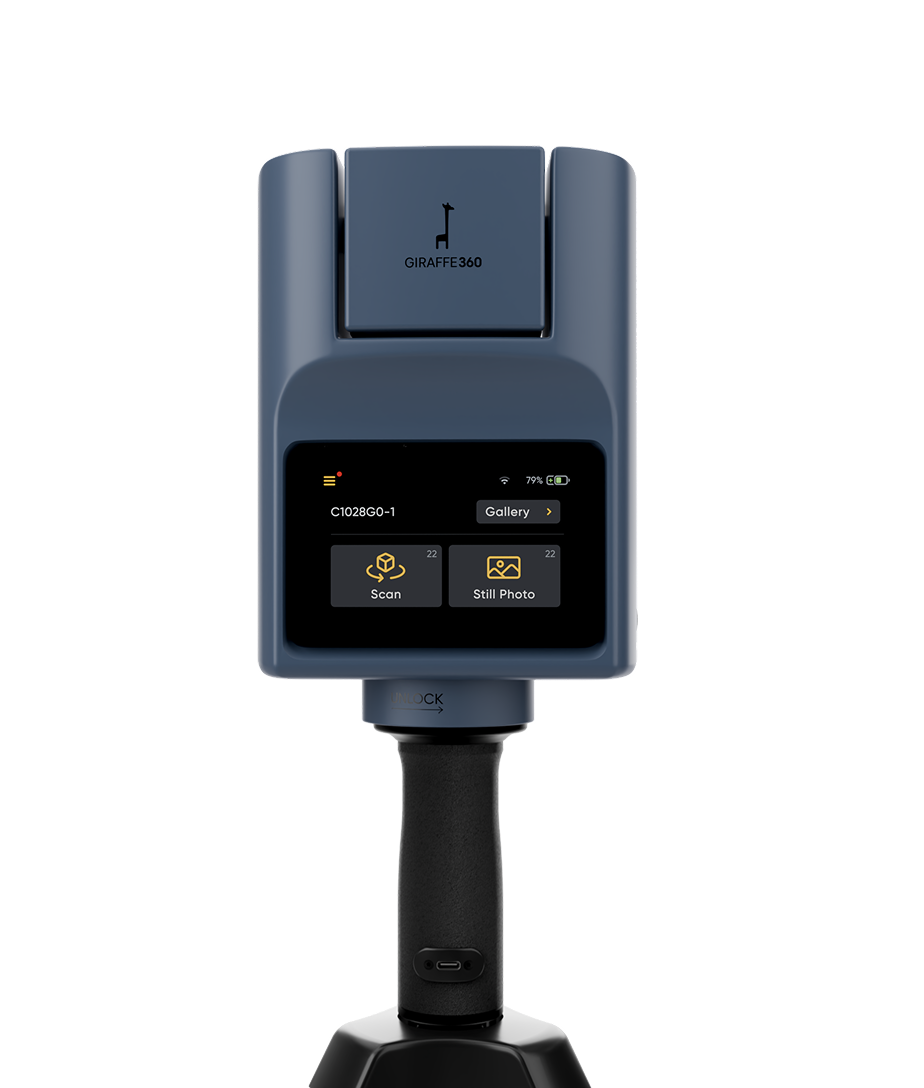
There is still somebody carrying the equipment, choosing positions and checking rooms. “One visit” should not be mistaken for one stationary snapshot. The motorized tripod and live scan view address mundane sources of rework: moving the camera, collecting enough information and noticing gaps before leaving. Those details matter when the owner has handed back the keys and the next appointment is across town.
The work continues after the camera stops
Content Studio is the other half of the purchase. It brings creation, editing and export into a common workspace. The company says the system renders more than 1,000 new properties daily and automates 95 percent of media-asset production. Those are company-reported operating claims, rather than a promise about how long any individual customer will spend on a listing.
The practical attraction is consistency. A photographer can produce the stills an agent needs now, then use the captured property data for additional material. Room labels and dimensions can be adjusted in the floor-plan tools. Tours can include access controls and lead capture. The marketing package stretches beyond the property portal to a single-listing website and content for other channels.
Giraffe360’s video offering adds a pleasingly odd trick: a virtual drone-style flight without a drone being flown through the living room. The software generates movement through the captured digital property. It also produces shorter vertical cuts for social channels. This creates another deliverable from the visit, although the result belongs to a different production method from footage composed and filmed by a camera operator.
For the buyer, the benefit is less abstract than “immersive content.” A useful tour can answer whether the dining area opens onto the kitchen. A plan can reveal a corridor that flattering photographs barely acknowledge. The formats earn their keep when they answer different questions about the same home.
$360 is a price. Utilization is the business.
The current US PRO offer starts at $360 a month for a single operator, including the camera, Content Studio, AI tools and Listing Spotlight beta. Its “unlimited” wording comes with a fair-use allowance of up to 60 projects per camera per month. Enterprise packages involving multiple cameras go through sales. Currency, region and the actual agreement matter.
A little division tells a more useful story than a sweeping savings claim. At two projects a month, the $360 base subscription allocates $180 to each project. At ten, it allocates $36. At twenty, $18. These are illustrative subscription costs, excluding labor, travel, taxes and extras. They are neither a photographer’s total production cost nor a prediction of profit.
Base subscription cost per project
The subscription therefore rewards a regular calendar. An operator with recurring listing work can spread the fixed charge across more assignments. Somebody handling an occasional property has a different calculation. They must value the convenience or additional formats enough to justify paying during quiet periods. The cheapest-looking monthly offer can become expensive equipment if it spends its working life in a cupboard.
The PRO service agreement also defines possible charges for items such as additional AI enhancement requests and integrations. It distinguishes camera access from outright ownership and addresses dashboard access after subscriptions end. These details belong in the purchasing calculation alongside the monthly headline, especially for an agency expecting to keep old tours available.
The photographer becomes a customer
Giraffe360 markets to agents and brokerages, but professional property photographers are increasingly explicit in its pitch. The company announced its official Photographer Network in April 2025. The PRO launch presentation later that year put the camera, Content Studio and broader listing marketing together. For a photographer, the appeal is the opportunity to sell a richer package from an appointment already on the calendar.
That positioning changes the question a potential customer asks. An agent may want to bring production in-house. A photographer may want to attach a floor plan, tour or video to an existing commission. The same system can serve either ambition, provided the customer has demand for the resulting work. Extra deliverables have little commercial value if nobody wants to purchase or publish them.

The company’s published customer stories extend into architecture. Adam Slade of C+A Architectural Design describes replacing a process that took two days with a two-hour capture yielding more material. It is one customer’s account, not a benchmark for every building. His more revealing observation concerns completeness: “We no longer miss things when capturing each property.”
“We no longer miss things when capturing each property.”Adam Slade, C+A Architectural Design
Company-published customer testimonial
The advantage he describes is avoiding missing information. That is a useful buying criterion: test whether a system reduces return trips and revisions in your own workflow. A striking demo can establish that a feature exists. A representative job establishes whether it earns its place.
A camera business with software investors
Building proprietary hardware and the processing behind it has required outside capital. Giraffe360 raised $4.5 million in 2020, followed by a $16 million Series A led by Founders Fund in November 2022. An additional $6 million in venture debt accompanied the latter financing. The GO camera belonged to that earlier expansion; the PRO generation has since broadened the proposition.
On March 26, 2026, the company announced a $10 million Series B led by Cipio Partners. Returning investors included Founders Fund, Hoxton Ventures, LAUNCHub Ventures and Change Ventures. The funding is intended for platform development, product expansion and growth across markets. Capital raised explains the resources available to pursue that plan; it does not establish customer profitability.
Cipio’s announcement described more than 200 employees and customers in over 40 countries. Giraffe360’s own company page lists offices spanning Latvia, Britain and Miami. The combination reflects the product’s demands: robotics, imaging, software and customer-facing operations all have to cooperate. A subscription containing physical equipment needs more kinds of competence than an app download.
The visible strategic change is expansion from core capture outputs into a fuller marketing service, accompanied by a more direct courtship of photographers. The releases give customers more ways to use material they have already captured. That also gives Giraffe360 more reasons to remain part of their daily work.
Matterport is in the next room
Matterport is a substantial alternative, and its overlap deserves an honest description. It also offers tours, photos, floor plans and property information. Its plans vary by active spaces, supported cameras and additional services. Giraffe360 cannot claim that generating several formats from property capture is uniquely its invention.
Its pitch is the particular bundle: proprietary capture hardware supplied with an automated production and marketing service. Matterport offers another device and software ecosystem, while hiring separate specialists offers a different balance of convenience and creative control. Comparing them requires a finished assignment: the same property, the required outputs, acceptable quality and the full cost of delivery.
Distribution deserves a place in that test. Giraffe360 lists portal compatibility and integrations, and idealista lists Giraffe360 among supported multimedia providers. An agent needs content in the places buyers use. A polished file stranded in a dashboard still leaves a job unfinished.
The room still needs a human eye
Automation creates its own editorial decisions. Giraffe360’s image tools can replace skies, remove objects and furnish rooms virtually. A user can alter the mood of an image quickly. The person approving it must still distinguish a helpful presentation from a misleading impression. A beautifully furnished rendering cannot settle whether that furniture exists in the property.
The first place to test is the handoff from capture to publishable material. Check room coverage, examine the edits and ask whether each deliverable suits the client. Do that before committing a whole office to the workflow. Low assignment volume and highly bespoke photography requirements also weaken the appeal of a standardized subscription.
The copyable idea is straightforward: collect information once in a form that supports several useful outputs, then remove repetitive handling between them. For an agency, that means testing the entire path from appointment to live listing. For Giraffe360, success depends on making the seventh deliverable feel less like another job. The house, meanwhile, can stay exactly where it is.
See it work
Giraffe360 website ↗ · Explore Content Studio ↗ · Company news ↗
Watch the PRO launch presentation ↗ · Launch discussion with Mikus Opelts and Samy Jeffries ↗