Ninety-nine banks said no. Maik Taro Wehmeyer remembers pitching Taktile’s first product to a hundred of them and finding almost no appetite for it. A statistician can appreciate a sample that decisive. A founder has to keep the company alive.
The product was software for machine-learning engineers, built by people who knew that work well. Then the large cloud platforms supplied competing tools. The founders’ expertise remained useful; the proposition became harder to sell. Familiarity with a problem had not secured a market for their particular answer.
Wehmeyer and his co-founder, Maximilian Eber, began paying closer attention to another conversation. Credit and compliance teams wanted to put rules around the models. Some of those people could not code. They still carried responsibility for the decisions. Their requests gradually pulled Taktile toward a different business.
By June 2026, that business had announced a $110 million Series C led by Growth Equity at Goldman Sachs Alternatives. It is tempting to read the funding announcement backward, as if the early refusals were merely decorative obstacles. They were information. Wehmeyer’s story turns on his willingness to change what he was building after receiving it.
A stock-market education, shouted from the terrace
His first encounter with finance came with an unusually effective notification system: his grandfather. Growing up in Dortmund, Wehmeyer played outside with the neighborhood children while his grandfather occasionally shouted news of rising stocks from the terrace. He had bought shares for the children. “Microsoft is up 5 percent,” he would announce. The children cheered without understanding much about the market.
Wehmeyer does not present this as the opening chapter of a childhood investment strategy. The interest receded. Mathematics drew him toward engineering; statistics and machine learning eventually brought him back to financial services. His account leaves room for the detour, which makes it more convincing than the usual founder biography in which every childhood purchase somehow anticipates the business plan.
He studied industrial engineering as an undergraduate and concentrated on mathematical optimization and statistics in graduate school. Harvard became a meeting point: there he got to know Eber, who would become his partner at Taktile. Their connection preceded the company, and the technical work preceded the sales pitch.
“I've always been some sort of a builder,” Wehmeyer has said. He liked bringing people together to accomplish things. He had interned in consulting, including at McKinsey and Boston Consulting Group, but chose work where he could build technology. A tidy career ladder held less appeal than getting something to run.
The model worked. The organization still had to use it.
At QuantCo, Wehmeyer worked on applying machine learning to business problems. Banks supplied a particularly interesting setting: structured data, consequential predictions, and operations large enough for improvements to matter. There was room to test whether the mathematics survived contact with the institution.
The founders also encountered the work surrounding the model. Deploying an application required infrastructure. People outside the engineering team needed to understand it. A prediction became useful only when a business could operate it, explain it, and incorporate it into the way it made decisions.
Those concerns were present in Taktile’s early public proposition. Its 2021 seed announcement described a platform for deploying machine-learning applications with model reports and explainability features. The company raised $4.7 million in a round led by Index Ventures. The aim was to make machine learning accessible to the business people and compliance departments who would have to trust it.
That ambition helps explain why the later change of direction had some continuity. The engineering problem and the organizational problem had been sitting beside each other all along. As customers asked for more control over rules and data, the organizational problem became harder to ignore.
Consider the difference between estimating whether a borrower might default and deciding what a lender should do with that estimate. The latter includes a policy, a tolerance for risk, and a commercial judgment. Someone owns those choices. Software that conceals them also conceals part of the business.
“the trust comes first and the sell comes afterwards.”
Maik Taro Wehmeyer, on selling to banks
Two in the morning, waiting for a loan
Taktile was founded in 2020 and joined Y Combinator’s Summer 2020 batch. Building across borders meant that the workday could stretch well beyond the hours suggested by an office address. Wehmeyer remembers the first customer, Branch, going live at 2 a.m. Berlin time. The founders waited at their computers for the first loans to reach the production API.
It is a small scene with a large amount of work behind it. An API receiving a real loan is an unglamorous milestone, which is precisely its appeal. Someone has agreed to rely on the software. The demonstration has acquired consequences.
Wehmeyer remembered the excitement, and also the limits of keeping those hours. Serving American customers from Berlin was difficult to sustain. Taktile subsequently built a New York office. He has described Berlin, London, and New York in terms of their different strengths: engineering talent, financial networks, and lending expertise.
The geography tells you something about the job he chose. A model can be developed at a desk; a company has to find the people who will buy it, operate it, and keep trusting it when circumstances change. The late-night launch sits between those two activities. It is the point at which an engineer’s output becomes a customer’s working system.
Who gets to change the rules?
Taktile’s present platform combines AI agents, rules, data, and human oversight for financial institutions. Its applications include onboarding, credit underwriting, fraud, and anti-money-laundering work. Underneath that range of uses is a practical question: can the people responsible for the decision work effectively with the people responsible for the technology?
The question is easy to underestimate. A bank can have capable engineers and capable risk analysts while still making it cumbersome for either group to alter a working process. An interface that lets them collaborate changes who can participate, and how quickly an idea can be tested.
Wehmeyer has called the approach interactive decision design. The phrase carries less drama than artificial intelligence, but it locates the human work accurately. Someone has to decide which data matters, which rules apply, and what should happen when an application does not fit the expected pattern.
A useful way to understand his preoccupation is to treat the lending policy as part of the lender’s craft. The institution should be able to own and revise it. Buying infrastructure need not mean outsourcing the judgment that makes one lender different from another. That is a fairly modest sentence with fairly extensive implications for how software should be designed.
Capital, with a job attached
In November 2022, Taktile announced its $20 million Series A, co-led by Index Ventures and Tiger Global. Wehmeyer described plans to improve the decision-design interface, expand data integrations, and grow the company’s American presence. The intended uses of the money followed the product’s changing center of gravity.
That same month, he wrote about fintech’s turn from growth toward profitability after appearing at Founders Forum. Acquiring users was no longer a sufficient account of success. Lenders needed to assess risk precisely and bring in customers who made commercial sense. His argument connected the software to the economics of the customer’s business.
The point sounds obvious until the numbers are somebody else’s responsibility. A lender can make more loans and build a worse portfolio at the same time. A faster workflow is useful when it helps the institution exercise better judgment; speed alone supplies no guarantee.
Announced round sizes in US dollars. Bars share one scale. Company financing, not personal wealth.
The February 2025 Series B was led by Balderton Capital. Taktile reported that its customer base had quadrupled in 2024 and annual recurring revenue had grown by more than 3.5 times. Those are company-reported results, attached to a specific year, rather than predictions about what every customer will experience.
By the June 2026 Series C, the ambition had widened to helping financial institutions operate AI-driven decisions at scale. The announced plans included further product development and expansion across the United States, EMEA, and Latin America. More capital makes the next stage possible. It also enlarges the set of promises the founders have to keep.
AI has to earn its chair
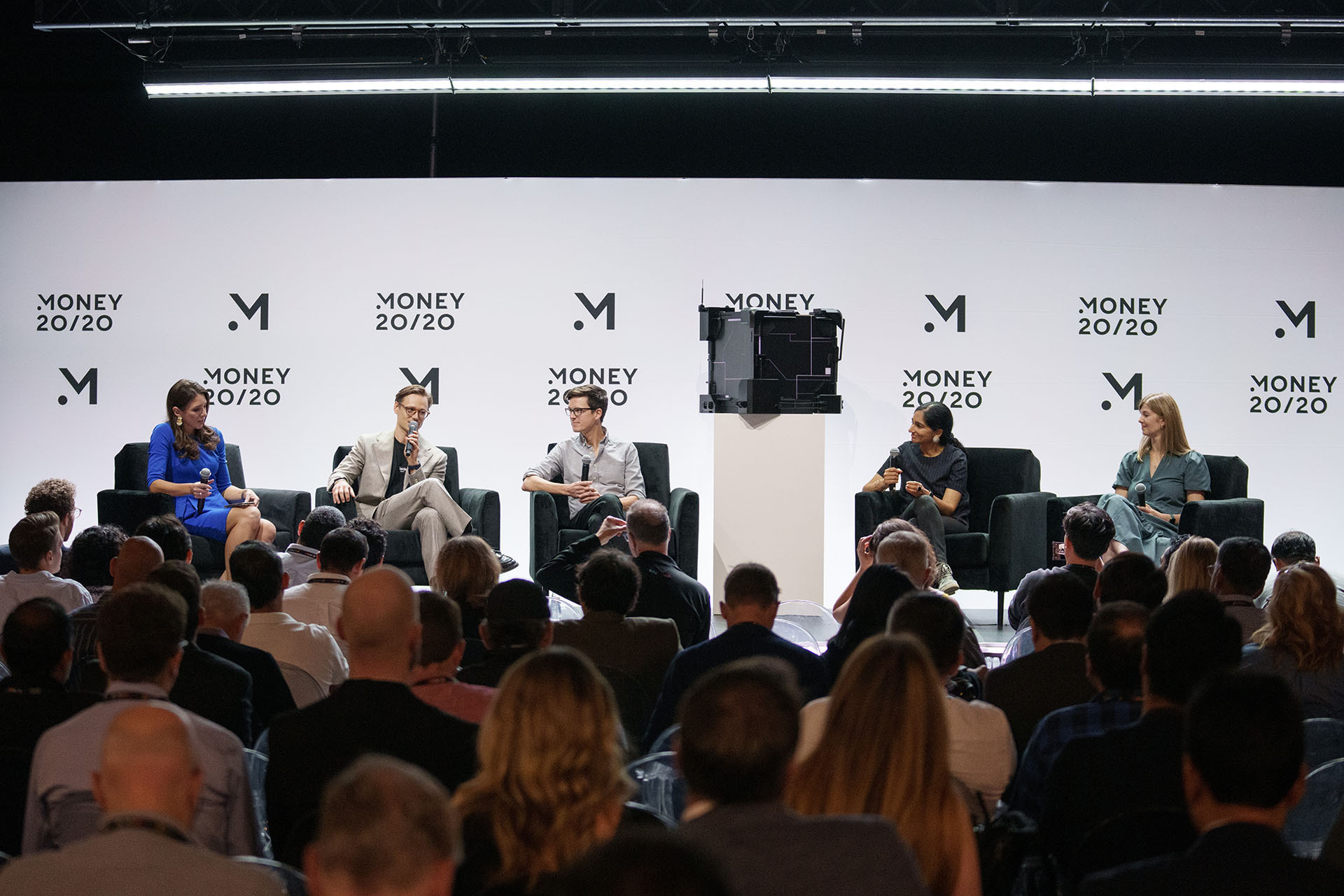
Wehmeyer’s enthusiasm for machine learning has included fairly pointed qualifications. At Money20/20 Vegas in 2023, he discussed AI in underwriting alongside Sarah Hinkfuss, Matt Mollison, and Seema Amble. His subsequent account separated the appeal of large language models from their suitability for making credit decisions.
He saw uses in interpreting and categorizing transactions, creating signals, and helping with the work around existing risk models. He also questioned the prospect of replacing those models with ChatGPT at that stage. That distinction matters in a field where a persuasive answer and a dependable decision can be expensive things to confuse.
One detail from his account gives the technological change a human scale. Taktile had previously hired 15 working students to label a lender’s banking transactions. He described comparing that work with ChatGPT and finding almost similar accuracy. A task that had required a small temporary workforce was becoming a candidate for automation.
The example invites a more useful question than whether a whole profession is about to disappear. Which task has improved? How well does it perform? Who checks the result? Those questions suit the technical founder whose customers have to put a system into everyday operation.
His company’s proposition now embraces agents while continuing to put human oversight into the platform. That combination makes sense of the career behind it. Wehmeyer has spent years working in the distance between what technology can demonstrate and what an institution can responsibly use.
The bridge back to Brooklyn
For all the talk of automation, his own work remains conspicuously social. After Davos in 2026, he described more than 30 conversations with senior executives over five days. Selling a system for consequential decisions still involves finding the room, meeting the people, and answering their questions.
There is a quieter route through his New York life, too. In a public post marking three years in the city, he described crossing the Brooklyn Bridge toward Manhattan for work and the relief of the return journey, especially by bicycle in summer. He argued for making boundaries visible to the team. A founder is also a person with a life outside the company.
That bridge is a fitting place to leave him. The story contains mathematics, institutional caution, rejected pitches, and very large financing rounds. It also contains somebody riding home. The customer conversations changed the product because he was willing to hear them. Keeping that willingness as the company grows may be the more demanding part of the job.
The ninety-nine closed doors supplied a clear message. Wehmeyer eventually found a better question to take through the hundredth: what do the people inside need to be able to do?
Read, watch, follow
- Taktile - company website ↗
- Maik Taro Wehmeyer on LinkedIn ↗
- Maik Taro Wehmeyer on X ↗
- Fintech Leaders - the September 2026 conversation ↗
- Watch: Fintech Leaders with Miguel Armaza ↗
- Listen: Enhancing decision accuracy ↗
- Watch: Behind Company Lines, 2023 ↗
- Read: Taktile’s 2021 seed announcement ↗
- Read: the Series A announcement ↗
- Read: the Series B announcement ↗
- Read: the $110M Series C announcement ↗
- Read: the Money20/20 underwriting discussion ↗
- Read: Wehmeyer on fintech profitability ↗
- Read: his Brooklyn Bridge reflection ↗
- Read: his Davos reflections ↗
- Taktile at Y Combinator ↗