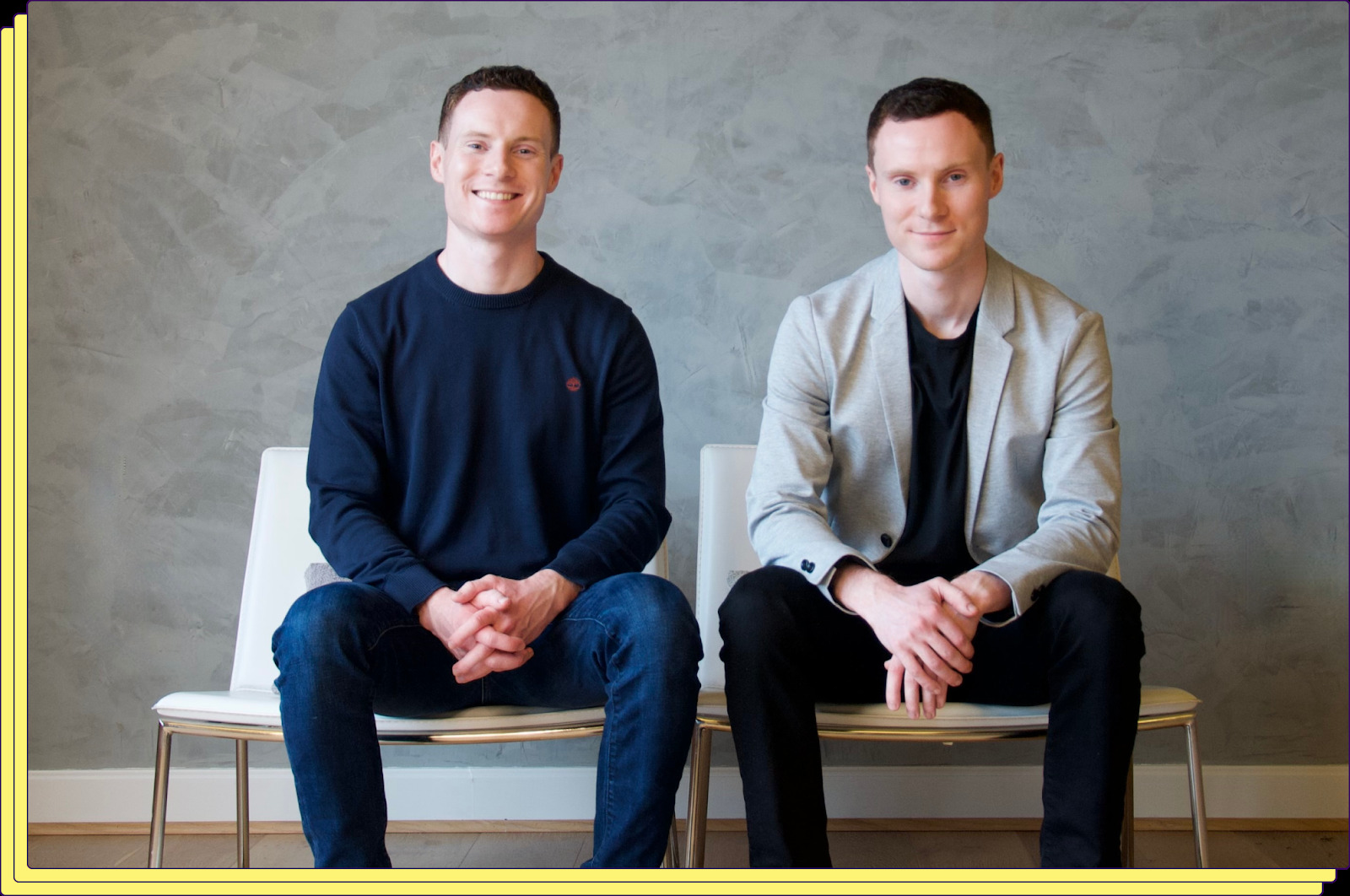
Long before Ronan Burke made a company out of suspicious documents, he studied a map of ambition. His father kept a poster of Silicon Valley at home in southwest Ireland, its company names scattered across the Bay Area. Ronan and his twin brother, Conor, were around ten. Their father worked in electronic engineering and computer manufacturing, so computers had arrived in the Burke household while they were still unusual furniture in many others. The boys wanted to know what those distant companies were building and who was building it.
The poster supplied geography to their curiosity. Ireland supplied the education. The country was changing around them, and technology companies from California were making it an operational base. The twins became part of what Ronan has called the second generation to benefit from that shift. Both went on to study electronic engineering at University College Dublin. It was a sensible choice for two people interested in how things worked, though their eventual business would be concerned with a more slippery question: how do you know when the thing in front of you is lying?
The backstage of a bank account
After graduating in 2017, the brothers did something refreshingly impractical. They agreed not to apply for graduate programs. Bali was discussed. The location mattered less than making time to build software. Alongside university classmate Oisin Moran and James Eggers, they tried ideas and prototypes without demanding that each one arrive dressed as a venture-scale business.
Meanwhile, ordinary encounters with finance were bothering them. A checking account, credit card, loan or crypto account could take days to approve, sometimes weeks. The application screens looked modern. Somewhere behind them, though, sat queues of people checking documents and balancing growth, compliance and fraud. Conor had seen the machinery during an internship on a Bank of Ireland project digitizing onboarding, account openings and mortgages. The front door had received a redesign. The back room was still full of paper cuts.
Early software users clustered in the Bay Area, so the founders flew to San Francisco about three months after university. Then a wonderfully mundane thing happened: customers asked for contracts. Contracts required a legal entity. An early angel cheque allowed the group to stay longer. Ambition had moved from the poster into a sequence of administrative necessities.
A pivot with paperwork attached
In May 2018, the team applied to Y Combinator and entered its summer batch. Their first idea was not growing. Weekly conversations with partners and peers made that fact difficult to decorate. At one dinner, fintech founders and employees confirmed that the awkward bank workflow Conor had encountered was widespread. The old observation returned with commercial weight. Inscribe pivoted toward automating document review and detecting fraud.
The early premise was clear: a financial institution asking for proof of income, address or expenses should not need a person to squint at every page. Software could parse documents, compare their details and flag manipulation. Yet speed alone carried its own danger. Automating a bad decision merely lets it travel faster. Burke’s formulation was that document automation needed fraud detection beside it, with credit analysis and risk context available to the people making the call.
The company raised $3 million in 2018 and opened a Dublin engineering office. A $10.5 million Series A followed in 2021. In January 2023, a $25 million Series B led by Threshold Ventures took reported funding to $38 million. Clients named publicly over the years have included Ramp, Bluevine, TripActions, Mercari and Rapid Finance. The four founders were recognized on Forbes’ 2020 30 Under 30 Europe list.
Funding milestones make a neat timeline. Fraud does not cooperate with neatness. It changes in response to the defenses placed before it, and generative AI lowered the cost of changing tactics. Editable bank-statement templates could already be purchased cheaply. Image and language models added speed, variation and polish. The fake document stopped being a specialist craft and became something closer to an office task with criminal intent.
When tidy becomes suspicious
Real financial life is untidy. A bank statement contains a petrol-station name, an inconvenient decimal and a merchant label no human would have invented for clarity. Early AI-made statements sometimes looked like immaculate spreadsheets: perfect alignment, round-dollar transactions, purchases helpfully labeled “groceries.” The tidiness gave them away. By 2026, many of those easy tells had vanished.
The harder case begins with a real document. Change the balance or inflate the income while preserving the original structure, and the page carries the visual authority of an authentic source. An experienced reviewer may see nothing wrong. One case discussed on Burke’s podcast involved a bank statement stripped of its digital watermarks. What remained was a three-digit substring repeated across transaction descriptions. It took pattern comparison, not a heroic pair of eyes, to notice.
How a document becomes an investigation
The sequence adapts to what each check finds. The point is a trail of evidence, not a mysterious score.
This is where Burke’s language has shifted from fraud detection to “fraud reasoning.” A traditional detector runs a known set of rules or classifiers and returns a score. A reasoning system plans its checks, changes direction when evidence warrants it, correlates signals across documents and explains why it reached a conclusion. Inscribe says its AI agents can cross-reference metadata, validate employers and surface anomalies while reducing a review that might take 30 minutes to under 90 seconds.
The explanation matters. Financial risk teams work inside regulated decisions. An alert without a reason creates another item in the queue. Burke’s argument is that useful automation must produce something an analyst can inspect, challenge and carry into an audit. The machine can search at machine speed. Accountability still needs readable sentences.
The founder as fraud correspondent
Burke has gradually become a translator between the people making AI systems and the people watching fraud mutate in the wild. He writes about deepfake documents, responsible automation and the future of risk work. He also hosts Good Question, an Inscribe podcast whose episodes are framed with the candor of a curious search box: are we in an AI bubble, can ChatGPT be a guest, will every bank become a fintech?
The conversations keep the technology attached to the work. Guests include risk operators, fraud investigators and leaders from financial infrastructure companies. In a 2026 discussion with Alloy co-founder Laura Spiekerman, the subject was not simply whether AI could detect more fraud. It was also how much good business a defensive system might block. A perfect wall is commercially useless if legitimate customers cannot get through the gate.
That balance has been present in Burke’s public mission for years: help more good customers access financial services, keep fraudsters out and remove tedious work from onboarding and underwriting. It is less cinematic than chasing a thief. It is also closer to the actual product challenge. Every additional check adds friction. Every removed check creates an opening. The system must decide where uncertainty deserves attention.
“Start with data, not machine learning. If you don’t have a good dataset, you’re wasting your time.”
That rule also describes his founder story. The Burkes did not begin with a grand theory of synthetic identity. They began with data in its broadest sense: a slow application, an internship, a cluster of users, a contract request, a failed first idea and a room of fintech people admitting the same problem. Each piece narrowed the next move.
Still following the evidence
The contest now has an awkward symmetry. AI helps fraudsters make paperwork; AI helps investigators test it. Open-source advances benefit both sides. Purpose-built criminal tools reduce the knowledge required to attempt fraud. Defenders respond by sharing patterns, comparing larger networks of genuine documents and making their systems adaptive. Burke describes an arms race, but his practical response remains methodical: more context, layered checks, clear explanations and human judgment where the case becomes consequential.
There is a quiet continuity between the child studying that Silicon Valley poster and the CEO studying artificial transactions. Both activities begin with the same impulse: look closely at a system, then ask who made it and how. The difference is that today some makers prefer not to leave a name. They leave a repeated number, an implausibly clean table or metadata that disagrees with the story on the page.
Burke once offered a simple life lesson in a podcast lightning round: if you care about something, double down on it. Inscribe’s history makes the phrase sound less like motivational wallpaper and more like an instruction to keep examining the evidence. Nearly a decade after the pivot, the documents have become harder to trust, the machines more capable and the question more exacting. The fine print keeps changing. Burke is still reading.