The future, in Alla Gil’s telling, is badly behaved. It ignores the neat bell curve, slips outside the historical sample and arrives wearing combinations that no committee thought to invite. A bank can spend months polishing its favored forecast only to discover that reality has chosen a side door. Gil has built a career around making that embarrassment useful.
Her company, Straterix, gives financial institutions a way to explore broad ranges of economic scenarios and see what they do to capital, liquidity, earnings and portfolios. The premise is both mathematical and disarmingly human: nobody receives tomorrow’s answer key. Preparation improves when an organization stops pretending otherwise.
This is less a rejection of models than a demand that they behave with better manners. A model should reveal its limits. It should widen a decision-maker’s field of view, identify the variables that matter under stress and show where apparently separate troubles begin to move together. It should not stride into the boardroom dressed as fate.
Mathematics as a passport
Gil’s route to that philosophy began in the Soviet Union. A founder interview records an early obstruction: she was blocked from graduate school despite being gifted in mathematics. The closed door did not end the subject. Her public profile lists Voronezh State University, and mathematics became the through-line into quantitative finance.
Before founding Straterix, she worked on credit-derivatives models at CIBC and interest-rate-derivatives models at Goldman Sachs. At Citigroup, she led a strategic risk analytics and modeling group, advising senior clients on currency and interest-rate exposure, asset and liability management, credit portfolios and optimization. Her later strategic-advisory work stretched across Goldman Sachs, Citigroup and Nomura. The job was no longer merely to price an instrument. It was to help an institution decide what kind of risk it could afford to own.
There is a quiet tension in that progression. Finance hires mathematicians to reduce uncertainty, but senior strategy makes them confront how stubbornly irreducible it remains. Historical relationships are useful until a crisis changes behavior. Depositors move faster. Correlations harden. A liquidity problem travels. The tidy assumptions that made yesterday’s model tractable become today’s blind spot.
The base case meets its extended family
Straterix, co-founded with technologist Joseph Dafni, emerged from stealth in 2017. Its work begins where the conventional planning deck often ends. Instead of asking a balance sheet to survive one base case and a small set of adverse narratives, the platform generates and expands many forward-looking paths. It can then search backward from a bad outcome: what combination of shocks would produce this failure, and which warning signals appear first?
How a risk rehearsal moves
Gil has compared exhaustive scenario analysis to flight simulation. Airlines do not train a pilot by predicting which precise emergency will occur on next Thursday’s route. They rehearse failures, awkward combinations and responses. The analogy earns its keep because a bank, like an aircraft, is a connected system. One gauge can look calm while pressure migrates elsewhere.
The practical aim is discovery. A narrow test might confirm that an institution can endure the scenario it was handed. A wider search asks which scenarios the institution itself is uniquely vulnerable to. The distinction changes the meeting. Executives can discuss actions, thresholds and tradeoffs rather than admire a single number with two decimal places.
When the outlier walks into the studio
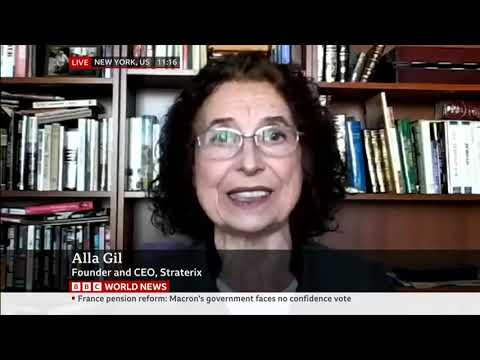
The banking turmoil of 2023 turned that argument into current affairs. In a BBC News conversation after Silicon Valley Bank collapsed and UBS was pushed into acquiring Credit Suisse, Gil focused on the range of outcomes that prevailing frameworks missed. Market shocks were only part of the picture. Client and depositor behavior could change, ripple effects could spread, and risks could compound across an institution faster than a familiar historical episode suggested.
That year she also joined a GARP symposium panel reassessing risk after SVB, alongside former Federal Reserve Bank of Minneapolis president Gary Stern and senior risk practitioners. In 2024, she presented Straterix’s methodology to decision-makers and analysts at the U.S. Department of the Treasury, discussing machine learning and AI in asset and liability management, capital and liquidity adequacy, and strategic risk.
The diagram is conceptual, not a performance claim. Its point is attention. Every additional scenario is not automatically useful, just as every extra word does not improve a sentence. The craft lies in generating a broad set, connecting it to the institution’s economics, and ranking what deserves a human decision.
A cyborg, sensibly dressed
Gil’s answer to AI in finance is neither romance nor panic. In a 2025 essay, she called for a “cyborg approach”: machines process large data sets, detect patterns and generate forecasts; humans interpret, challenge and keep the work aligned with strategy. She even recruits science fiction to the risk committee, citing 2001: A Space Odyssey and The Terminator as reminders that intelligent machinery and human control have been uneasy fictional companions for decades.
Her technical argument is precise. Machine-learning methods can identify changing drivers, reduce dimensionality and fit stressful outliers without beginning from a fixed hypothesis. Yet they can still find spurious relationships. Sensitivity analysis, backtesting and expert scrutiny remain necessary. The machine searches farther. The person decides whether the map makes sense.
That sentence also explains her interest in regulation. Gil has argued that stress tests should become a common analytical language for banks and supervisors, with comparable inputs and clearer methods. Opacity turns disagreements into arguments over machinery. Transparency lets people examine why one bank’s capital path diverges from its peers and ask whether the difference reflects a business model, an assumption or a warning.
The public notebook
Gil has developed these ideas in a steady stream of articles for GARP Risk Intelligence and elsewhere. The range is unusually broad: credit-loss modeling, liquidity, capital buffers, bank failures, annuities, CLOs, tokenization, private credit, hidden concentrations and the uses of AI. The recurring character is the downside nobody has properly introduced.
Her recent work has moved from diagnosing stress tests to redesigning the questions around them. In early 2026, she published a framework for evaluating bank mergers across distributions of forward-looking outcomes rather than resting on point estimates and base-case synergies. In April, she wrote about moving scenario design from imagination to exploration in a nonlinear world. In a New York workshop that February, she addressed integrated stress testing across capital, liquidity and interest-rate risk, including reverse tests and early warning signals.
The subjects change, but her method keeps returning to connectedness. Private-credit trouble can migrate into a lender’s portfolio. A shift in rates can alter funding costs, customer behavior and asset values at once. An acquisition that looks sensible under expected synergies can look very different when funding and capital are stressed together. Gil’s work asks people to follow those chains before they become headlines. Risk, after all, rarely respects the organizational chart. The credit desk, treasury team and strategy group may occupy separate boxes; the shock is free to visit all three.
The aspiration is larger than better compliance. Gil wants scenario analysis to become part of strategic management: a way to allocate capital, test a transaction, adjust a portfolio and recognize trouble while choices remain available. A stress test performed only to satisfy a calendar has the emotional texture of homework. A rehearsal linked to decisions can alter the plot.
The dignity of an honest range
The most personal quality in Gil’s work may be its refusal to turn uncertainty into theatre. Her early path met a bureaucracy that claimed the power to close a future. Her later career unfolded in an industry that often claims the power to calculate one. Straterix occupies the more interesting middle: futures are plural, models are tools, and preparation is a discipline rather than a prophecy.
This does not make decisions easier. It makes their conditions visible. A board may still choose the aggressive strategy. A regulator may still disagree. A machine may still surface an absurd correlation. But the conversation begins with a wider map and fewer illusions about its edges.
Finance will continue to ask for forecasts because budgets need numbers and people prefer a line to a cloud. Gil’s contribution is to let the cloud back into the room. Give it structure. Ask how the institution behaves inside it. Find the weak joints. Decide which signal should trigger action. Then rehearse again, because the future has a habit of revising the script.